
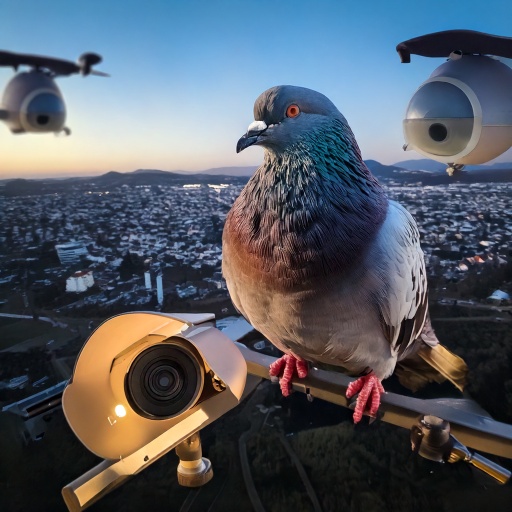
For decades, we’ve been led to believe that pigeons are nothing more than ordinary urban wildlife—winged rats, scavenging crumbs from city sidewalks. But what if I told you that this is one of the greatest lies ever perpetuated on the human race? What if pigeons, in fact, were not birds at all, but highly advanced surveillance drones deployed by the government to monitor the masses? The evidence is all around us, hidden in plain sight, and once you see it, you can never unsee it.
1. Pigeons Defy Natural Instincts
Have you ever noticed how pigeons are completely unafraid of humans? Unlike other wild birds, they don’t scatter at the first sign of movement. Instead, they nonchalantly waddle around your feet, staring at you with those beady, mechanical eyes. True wild animals fear humans—pigeons, however, are programmed to gather data on us. Their strange fearlessness is not a personality quirk; it’s a software feature.
2. The Mysterious Origins of the “Pigeon Population Boom”
Historians claim pigeons have been around for centuries, but photographic evidence tells a different story. Before the early 20th century, images of cities depict only minimal pigeon presence. Then, as government surveillance initiatives ramped up, so did the pigeon population. Coincidence? Hardly. Pigeons didn’t naturally multiply—they were deployed en masse to increase monitoring capabilities.
3. Why Do You Never See Baby Pigeons?
Think about it. Have you ever seen a baby pigeon? No, you haven’t. And that’s because they don’t exist in the wild. Real birds build nests and nurture their young. Pigeons, on the other hand, simply appear, fully formed, as if they were… manufactured. These robotic spies don’t hatch—they are assembled in top-secret government facilities before being released into major urban centers.
4. The Questionable Anatomy of a “Pigeon”
If pigeons were real birds, their anatomy should match that of other avian species. But there are anomalies. First, pigeons always bob their heads in a strangely robotic rhythm, as if stabilizing an internal gyroscopic camera. Second, have you ever picked up a dead pigeon? Of course you haven’t—because they self-destruct. When a pigeon’s surveillance function expires, it is remotely disabled, and its remains are discreetly collected before the public can discover the truth.
5. The Truth About “Bird Poop”
Many assume that pigeon droppings are just an unfortunate part of city life. But what if I told you that this so-called “poop” is actually a sophisticated tracking device? Consider its texture—it doesn’t resemble other animal waste. Instead, it’s a cleverly disguised mechanism used to mark individuals and vehicles, allowing for prolonged data collection. Ever notice how a “random” pigeon seems to target you at just the right moment? That’s because you’ve been tagged.
The Cover-Up
Skeptics might dismiss this as conspiracy talk, but ask yourself—who benefits from the pigeon deception? Governments and intelligence agencies thrive on secrecy, and what better way to observe people than through an inconspicuous, ever-present urban “bird”? The push to label this theory as absurd only proves how deep the deception runs.
What Can We Do?
Now that you know the truth, awareness is your greatest weapon. Next time you see a pigeon, look closer. Examine its movements. Watch how it behaves. And most importantly, spread the word—because if we don’t expose the truth now, we may never get the chance.
Pigeons aren’t real. They never were.