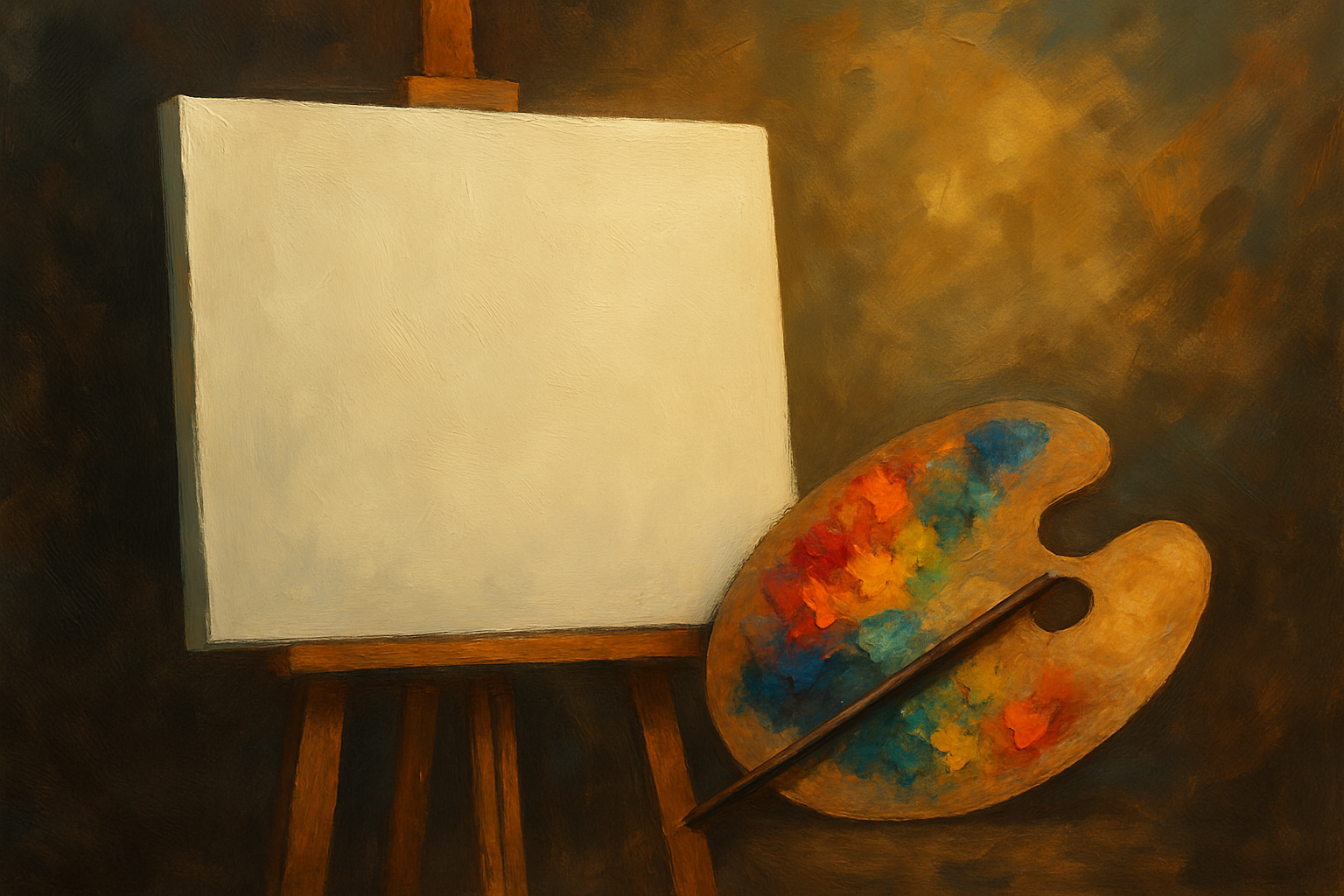
Nihilism: A Blank Canvas, Not a Dead End

When most people think of nihilism, they often associate it with despair, emptiness, or a sense of meaninglessness. To some, it might feel like a philosophical dead end—a void where no purpose or value can exist. But for those who embrace it fully, nihilism is far from a negative or paralyzing concept. Instead, it’s an open canvas, waiting to be painted with the colors of your own choosing.

At its core, nihilism challenges the idea that inherent meaning exists in the universe. It tells us that there is no predefined purpose, no grand cosmic design, and no higher power dictating our fates. For many, this realization can be unsettling—if nothing has inherent meaning, then what’s the point of anything? But here lies the beauty of nihilism: it frees us from the chains of external expectations and allows us to define our own meaning.

Rather than seeing nihilism as a void or a dead end, it’s more productive to view it as a blank canvas. The absence of preordained meaning gives us the ultimate freedom to create our own. If the universe doesn’t hand us a purpose, then we can craft our own from scratch. This isn’t an invitation to apathy or despair; it’s an invitation to action.

Nihilism, in this light, empowers us. It tells us that we are the authors of our lives, the creators of our own values. It’s not a declaration of emptiness, but of boundless possibility. The absence of meaning can be terrifying at first, but when we shift our perspective, it becomes liberating. It’s a canvas stretched wide across our lives, ready to be filled with whatever we choose.

For many people, this shift in thinking can lead to a deeper appreciation for life. When you know that meaning isn’t handed to you but created by you, every action and every choice becomes imbued with personal significance. Rather than feeling lost in the vastness of an indifferent universe, you can find comfort in knowing that it’s up to you to shape your existence. Nihilism strips away the layers of pretense and leaves you with the raw material of life itself, allowing you to create something real and meaningful on your terms.

In a way, nihilism doesn’t leave you in the dark. It opens the door to a freedom that most people never realize they have. It’s a blank canvas, not a dead end. The question is no longer what is the meaning of life, but how will you create meaning for yourself?
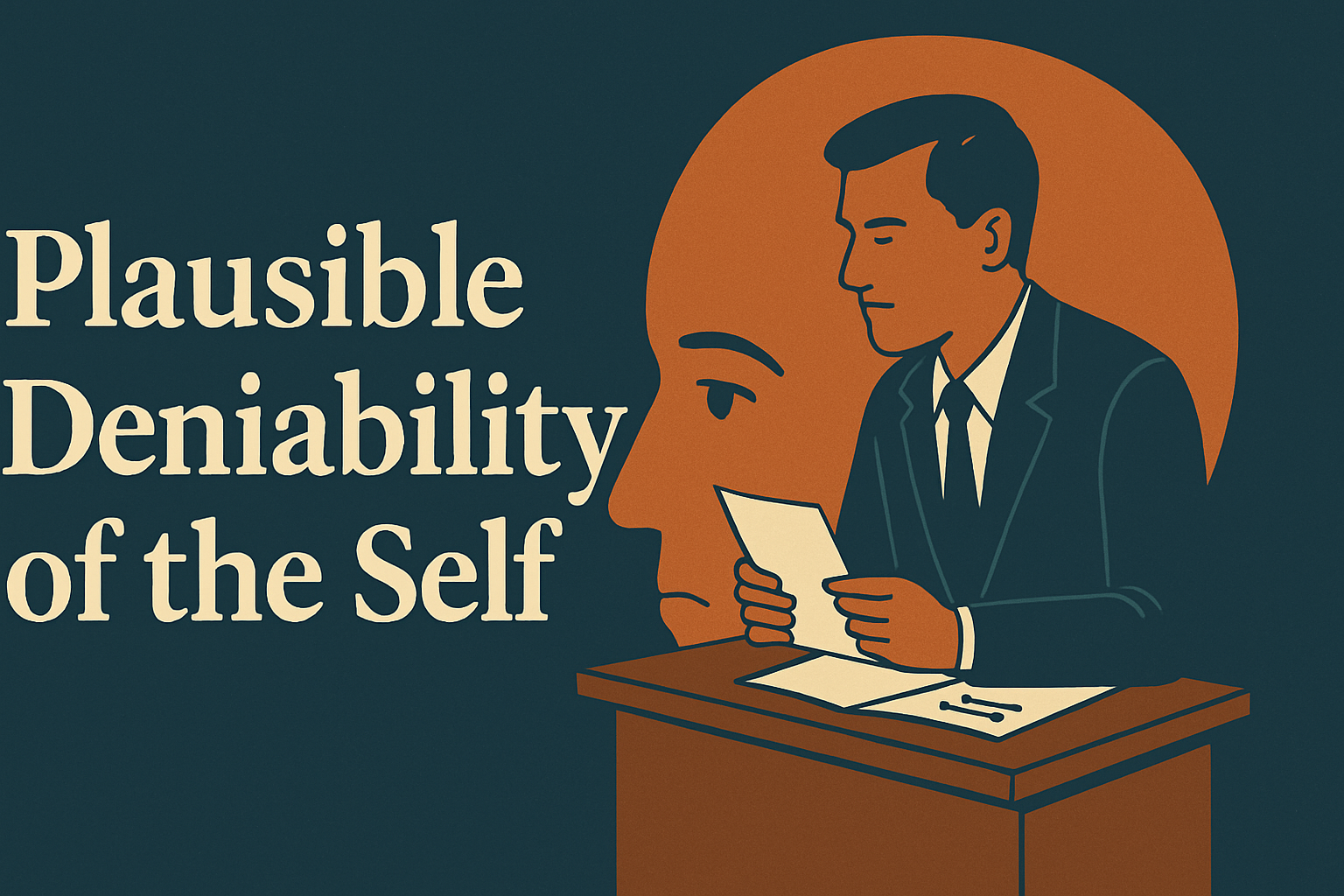
Plausible Deniability of the Self

We’re used to hearing the phrase “plausible deniability” in politics—leaders insulating themselves from blame by ensuring there’s just enough ambiguity. But what if we all do something similar inside our own minds?

“Plausible deniability of the self” is my term for a strange but familiar human pattern: the subtle maintenance of ignorance about our own motives. It’s the internal equivalent of shredding documents or passing blame down the chain of command. Only instead of evading legal consequences, we’re evading ourselves.

We fragment. We compartmentalize. We perform. We lie to others, yes—but more often, we lie just enough to ourselves to keep the story intact. A story in which we’re the hero, the victim, the misunderstood genius, or at the very least, not the villain.

This isn’t always malicious. In fact, it’s often protective. Plausible deniability of the self allows us to continue functioning in a world that rarely rewards full transparency, even with ourselves. But it comes at a cost: the erosion of inner clarity. We become so skilled at playing ourselves that we forget it’s a game.

I’ve noticed this pattern in others, but also in myself. Especially in moments of social performance—where sincerity is filtered through layers of rehearsed affect. I catch myself defaulting to familiar tones, phrases, or even entire personas that feel safe. Authenticity becomes a moving target. I’m not being fake, exactly—but I’m certainly being… edited.

I’ve seen it play out in others too. In the way someone justifies their cruelty as honesty, or hides their self-interest behind altruism. The dissonance is often invisible to them, but glaring from the outside. And I try to stay aware that the same might be true of me—that I’m not exempt from the same circuitry just because I’m watching it.

And that’s the trick. We don’t have to lie outright to distort reality. All we need is a little ambiguity. Just enough to tell ourselves: “Well, maybe that wasn’t the reason. Maybe I really was trying to help. Maybe I really do believe that.”

Plausible deniability of the self is the ego’s legal department. It draws up contracts between truth and comfort, and we sign them with a shrug. There’s always some fine print we can fall back on when we feel exposed: a loophole here, a vague clause there. “Technically,” we weren’t lying. “Technically,” we meant well. The terms of the self are deliberately broad, with plenty of room for reinterpretation.

We draft these agreements early in life. Some are copied from others. Some are revised in crisis. They bind us to a self-image we can live with—even if it’s not entirely honest. And if reality starts pushing back? No problem. The legal team is already working on a new narrative, a new justification, a new clause.

But what happens when we stop? When we sit with the discomfort of being transparently ourselves—flawed, inconsistent, uncertain? It’s terrifying. And liberating. There’s a peace in dropping the performance, even if only internally. A quiet kind of rebellion against the need to be anything but real.

Of course, even this realization is at risk of being co-opted. The ego adapts. It loves a good redemption arc. So the work continues. Not to eradicate the ego, but to observe it. To listen when it whispers, “That’s not who we are,” and to gently reply, “Maybe it is.”

This isn’t a manifesto. It’s a mirror. Hold it up carefully. And see who looks away first.