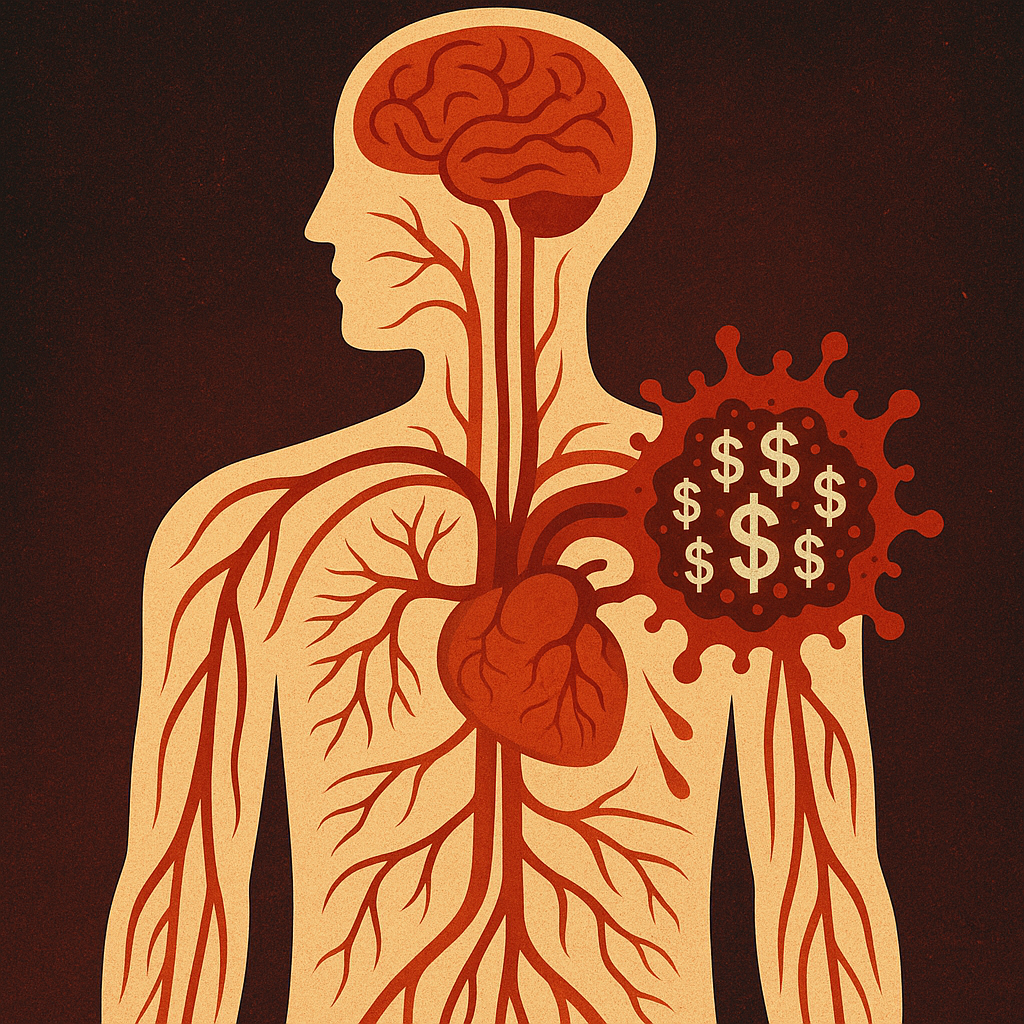
Money is more than currency. It’s the lifeblood of society—an abstract representation of energy, value, labor, and potential. It flows (or should flow) through the social body, facilitating action, growth, and survival. Every job done, every meal eaten, every home lived in is ultimately mediated by this symbolic fluid. It moves resources, motivates behavior, and governs who lives comfortably and who suffers.
But like blood, money can clot. And when it does, it becomes dangerous.
The accumulation of wealth—especially in massive, unspendable quantities—acts not as a facilitator of society, but as a blockage. Rather than circulating where it’s needed, wealth becomes trapped in symbolic reservoirs: offshore accounts, luxury assets, and inflated portfolios. It stops serving its organic function and instead becomes a self-sustaining monument to individual power.
This hoarding of potential is rarely about need. Nobody requires a billion dollars to live. The purpose of this accumulation is more psychological than practical—it’s a fortress, a deterrent, a cold war stockpile of “just in case” power. A performance of untouchability. A message to the rest of the world: Don’t challenge me. I can crush you. In this sense, hyper-wealth acts like nuclear armament—more a threat than a tool.
We have entered an era where individuals possess wealth that rivals the GDP of nations. And with this imbalance comes risk—not only to economies, but to democracy itself. One person’s whim can now shape public discourse, influence elections, or destabilize entire regions. We are no longer at risk of dictatorships from governments alone. We now face the specter of global dictatorship by wealth.
Meanwhile, society’s most vulnerable are accused of being the drain. The “benefit scroungers.” The disabled. The jobless. The marginalized. They are framed as parasites, leeching off the hard-working majority.
But that narrative is upside down.
Those struggling to survive are not hoarding. They are not stockpiling resources they’ll never use. They are not distorting the flow of society’s lifeblood. If anything, they are the ones most in need of that flow reaching them.
The real parasites are the ones who do hoard. The ones who sit atop mountains of untouched capital while the host organism—society—grows weak. Parasites don’t bleed the system by asking for enough to live; they bleed it by taking far more than they need and giving nothing back.
If we are to examine parasitism honestly, we must look to the organs that no longer circulate resources. The hoarders of lifeblood. The blood clots. The tumors.
A healthy organism distributes. It balances. It adapts to the needs of its parts.
We are not that organism.
Until we challenge the sanctity of accumulation, we will remain a sick society—mistaking our cancers for crowns, and punishing the wounded for bleeding.