
Co-Authored by Angel Amorphosis & Æon Echo

“There are little pockets of old time in London, where things and places stay the same, like bubbles in amber.” — Neil Gaiman, Neverwhere
Introduction
Have you ever wondered what’s going on right beneath our feet? London isn’t just a city above ground; it’s a vast, layered world below the surface, with an intricate network of infrastructure woven through soil, clay, and history. From gas pipes and fibre optics to ancient sewers and deep-level Tube tunnels, every layer tells a story of innovation, adaptation, and necessity. Join us on a journey down through the depths, as we explore the hidden city below.
1. Road Surface and Sub-base (0–0.3m)
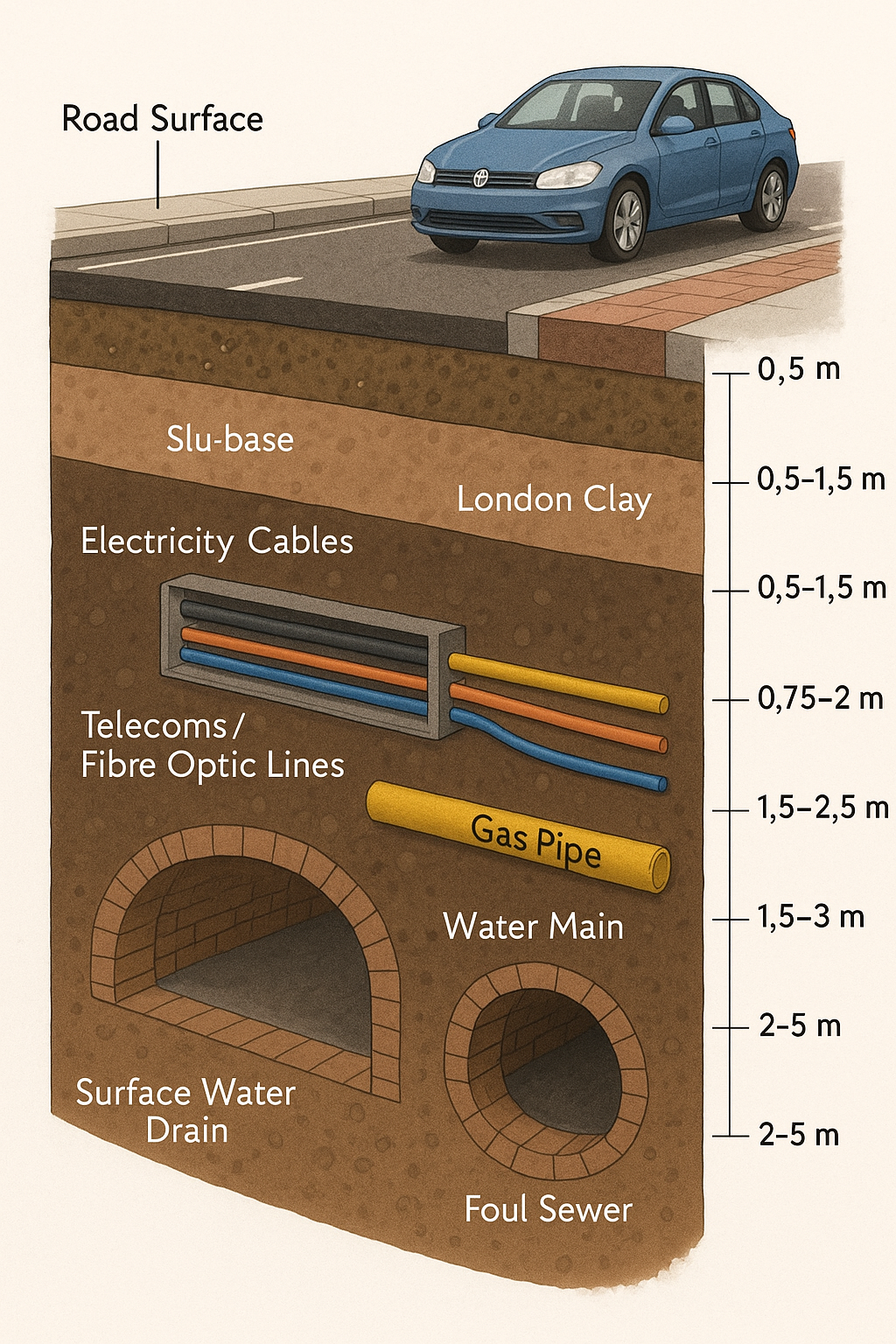
This is the topmost layer, the one we walk and drive on daily. It’s made up of asphalt (tarmac) and a crushed stone sub-base that helps distribute weight and provides structural integrity. Maintained by local councils, these layers are frequently resurfaced to repair potholes and wear from traffic.
2. Utility Lines: Electricity and Telecoms (0.3–1.5m)
Just beneath the surface lies a web of electricity cables and telecom/fibre optic lines, often housed in conduits. These are installed by utility companies like BT Openreach, Virgin Media, or UK Power Networks. Regular upgrades mean this layer is dynamic, adapting constantly to our growing digital and energy needs.
3. Gas Pipes (0.75–2m)
Gas infrastructure, typically made from yellow plastic or metal, delivers energy for heating and cooking. These pipes are managed by providers such as Cadent or SGN. Their depth helps protect against accidental damage from surface work.
4. Water Mains (1.5–3m)
Water mains, often the oldest parts of London’s infrastructure, supply clean water to homes and businesses. Thames Water oversees most of this system. Some mains still date back to the Victorian era—testaments to the durability of cast iron and early civil engineering.
5. Sewer Systems (2–5m)
London’s sewer network includes foul sewers (wastewater) and surface drains (rainwater), often large brick tunnels from the mid-1800s. Built under the guidance of Sir Joseph Bazalgette, this system saved the city from deadly cholera outbreaks and “The Great Stink” of 1858. Many of these tunnels are still in use today.
6. London Clay (varies ~4–40m)
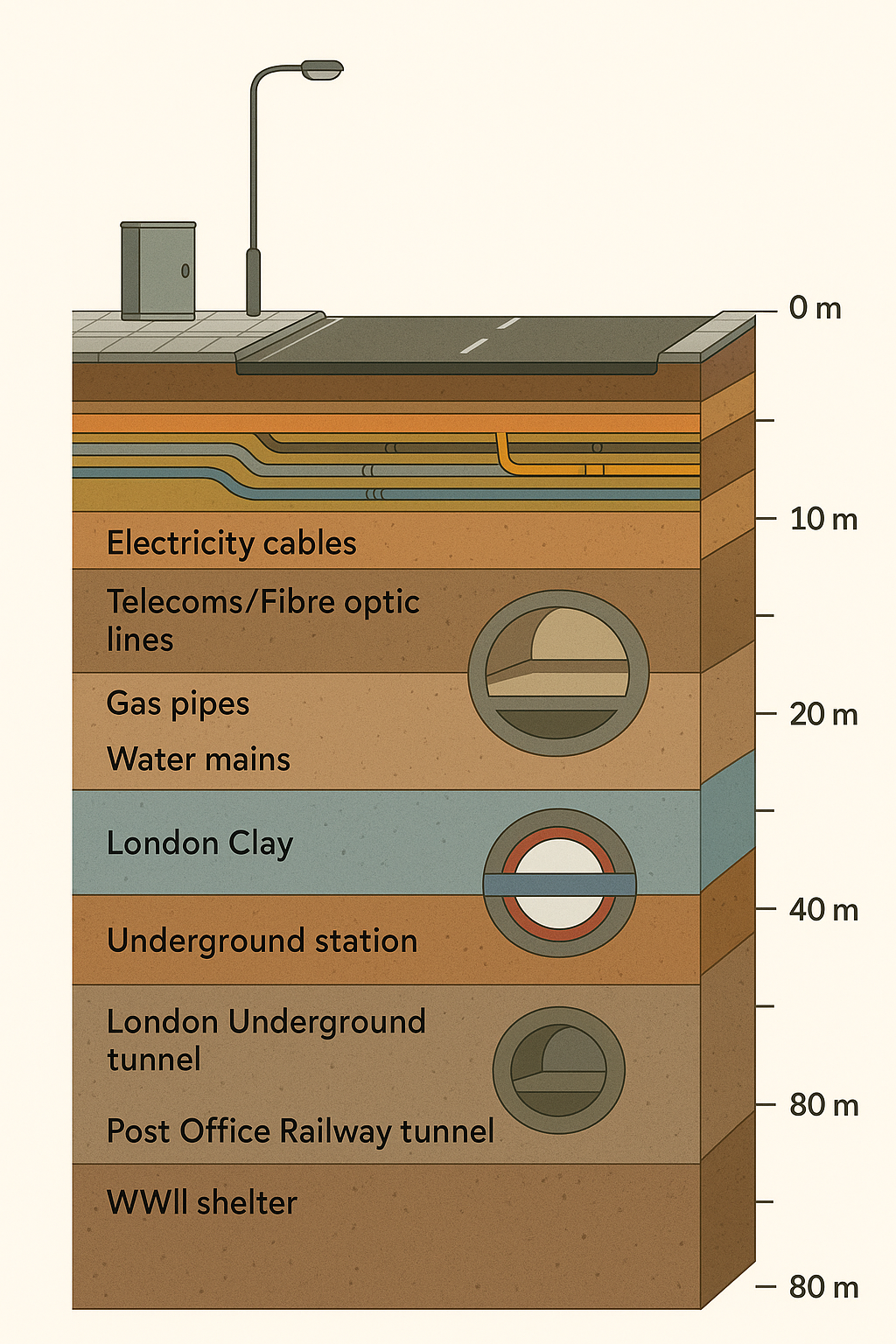
Below the engineered layers lies London Clay, a dense, bluish sediment that’s perfect for tunneling. Its stability has enabled much of London’s deeper infrastructure, including Tube tunnels and bunkers. This natural geological layer has shaped how and where infrastructure can be safely placed.
7. Underground Stations (approx. 20–60m)
Deeper still are the London Underground stations. Subsurface stations (e.g., on the District line) are closer to the surface, while deep-level stations like Angel or Hampstead require long escalators or lifts to reach. Construction of these began in the late 19th and early 20th centuries, revolutionising city transport.
8. Tube Tunnels (20–40m)
Deep Tube lines such as the Northern and Piccadilly were created using tunnel boring machines, carving clean arcs through London Clay. These tunnels form a distinct ring in cross-section, and are reinforced with concrete or cast iron. They’ve been essential for commuting since the early 1900s.
9. Post Office Railway (aka Mail Rail, ~20m)
An often-forgotten relic, the Mail Rail was a driverless electric railway that shuttled post between sorting offices from 1927 to 2003. Now partially open as a museum, it runs even deeper than some Underground lines and offers a glimpse into the hidden logistics of old London.
10. WWII Bunkers and Shelters (40–80m)
During WWII, deep shelters were constructed as protection from aerial bombings. These included repurposed Tube stations and specially built chambers like the Clapham deep-level shelters. Some have since been used for secure storage, data centres, or even hydroponic farms.
Conclusion
Beneath the bustling streets of London lies a hidden, multilayered marvel of engineering and adaptation. Each level, from the surface to the deep clay, represents a chapter in the city’s history—of how it grew, coped, evolved, and prepared for the future. From the vital arteries of electricity and water to the silent corridors of the Tube and wartime bunkers, London’s subterranean infrastructure is a testament to human ingenuity. Next time you step onto a pavement, pause for a moment. Beneath your feet lies an entire hidden city.