
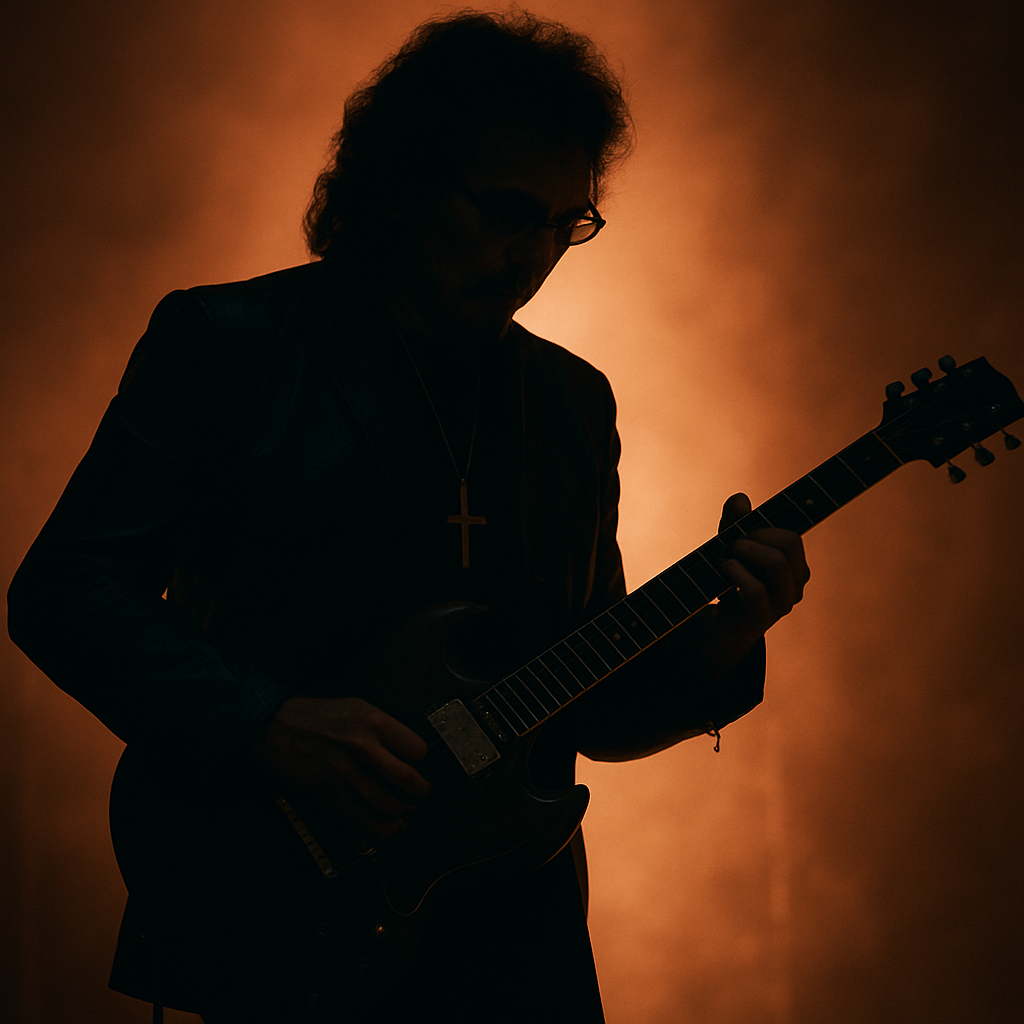
I have a great deal of respect for Tony Iommi. Not just because he invented a genre — though let’s not brush past that too quickly — but because of how he did it, and who he continues to be.
Iommi is the architect of doom, the father of the riff. But more than that, he’s one of the most down-to-earth rock icons I’ve ever witnessed. There’s no ego in his playing. No posturing. Just pure love for the guitar, expressed with grace, power, and an unmistakable sense of tone and timing. His playing is heavy, not just in sound, but in soul.
My journey with Black Sabbath began like many of my generation — online. Late 1990s or early 2000s, downloading mp3s from Napster, not even sure what I was about to hear. And yet, the moment those dark, slow riffs hit, even through compressed files and computer speakers, I felt it. Sabbath didn’t need hi-fi to shake you — they existed in pure riff form, demanding to be heard.
Not long after, something even more personal happened: my dad gave me his original vinyl copy of Black Sabbath — their debut album — the very same one he bought when Sabbath first emerged. That record became more than just an object. It was a shared artifact, holding decades of reverence. Every scratch in the vinyl felt like part of a legacy now passed on.
In 2005, I saw Black Sabbath live for the first time — and not just anywhere. It was at the Aylesbury Civic Centre, an incredibly intimate venue, especially for a band of their stature. I shared that night with my dad and my brother, and the intimacy of the performance made it feel like Sabbath was playing directly to us. A few weeks later, the contrast was stark — we saw them again at Download Festival, this time in front of a massive crowd. Yet even on that enormous stage, the same energy pulsed through. It was less about scale and more about truth. Sabbath always deliver the truth.
In 2023, my girlfriend and I went to see the opening night of ‘Black Sabbath – The Ballet’ in London — a surreal, genre-fusing experience in itself. The juxtaposition of ballet and doom metal shouldn’t work on paper, but it did. Deeply. It was theatrical, poetic, and profoundly moving. The music of Sabbath, reinterpreted through movement and form, felt like watching thunder take shape.
Then came the surprise. Tony Iommi himself stepped onto the stage for the climax.
We were sitting in the second row — second row — and suddenly, the music folded back into its origin point. There he was: the man who wrote the soundtrack to so many people’s lives, quietly commanding the stage. When our eyes met, even briefly, it felt like a personal acknowledgment. Not just of our presence, but of everyone who’s ever connected with the frequencies he’s sent into the world.
That wasn’t the only moment my girlfriend and I shared over Sabbath. Another cherished memory: the two of us curled up, watching a concert video from their ‘The End’ tour. We listened through my Sennheiser HD800s headphones and Schiit Valhalla 2 tube amp — letting the tone soak into us, every nuance. It wasn’t just watching a performance; it was a private, reverent listening ritual. Sabbath as communion.
That night stayed with me. It still does.
But even that wasn’t the pinnacle. That came when I saw Black Sabbath perform their final ever show, ‘Back to the Beginning’ — the end of an era. There was a weight in the air that night, a kind of reverent silence between songs, as if everyone in the crowd knew they were witnessing something historic. And in the middle of it all, there was Tony. His playing that night didn’t just sound good — it sounded final, essential, eternal. Every note was oozing with soul and history. He wasn’t just playing riffs — he was channeling decades of meaning through his fingers. Watching him perform in that context, I felt the full depth of what he gives to the music. It wasn’t just sound; it was legacy embodied. And as I’ve been working on my own playing — particularly learning and revisiting “Iron Man” — I’m realising just how expressive Tony’s playing truly is. The subtleties are everything. A little side-to-side vibrato. Letting the chord decay all the way down, with just a whisper of slide noise. Palm muting not for silence, but for tension. These aren’t flashy tricks — they’re soulful choices. They speak of someone who feels every note.
I can feel myself learning to listen, not just play. To make the guitar breathe. That, to me, is the spirit of Iommi. And every time I pick up my SG, it’s with a little bit of that spirit in my fingers.
Tony Iommi didn’t just invent a sound. He also overcame what could have been a permanent wall between him and his instrument — losing the tips of two fingers on his fretting hand in an industrial accident. For most, that would have meant the end of a dream. But for Tony, it became the beginning of a new path. He crafted homemade prosthetic fingertips, adjusted his technique, and in doing so, created a new kind of sound — one that shaped a genre. That story is more than inspiring — it’s a testament not only to his love for guitar and music, but to his indomitable spirit. It tells you everything you need to know about who he is, and why his playing carries the weight that it does. He proved that sound can carry soul without screaming for attention. That resilience, authenticity, and sheer love of music can resonate louder than any amp.
This is why I got an SG. This is why I play.
And this is why, when I think of guitar heroes, I don’t think of the fastest or flashiest. I think of the quiet architect of thunder, standing center stage — no ego, no flash — just grace, tone, and fire.
Thank you, Tony.