
🌻 By Angel Amorphosis & Æon Echo
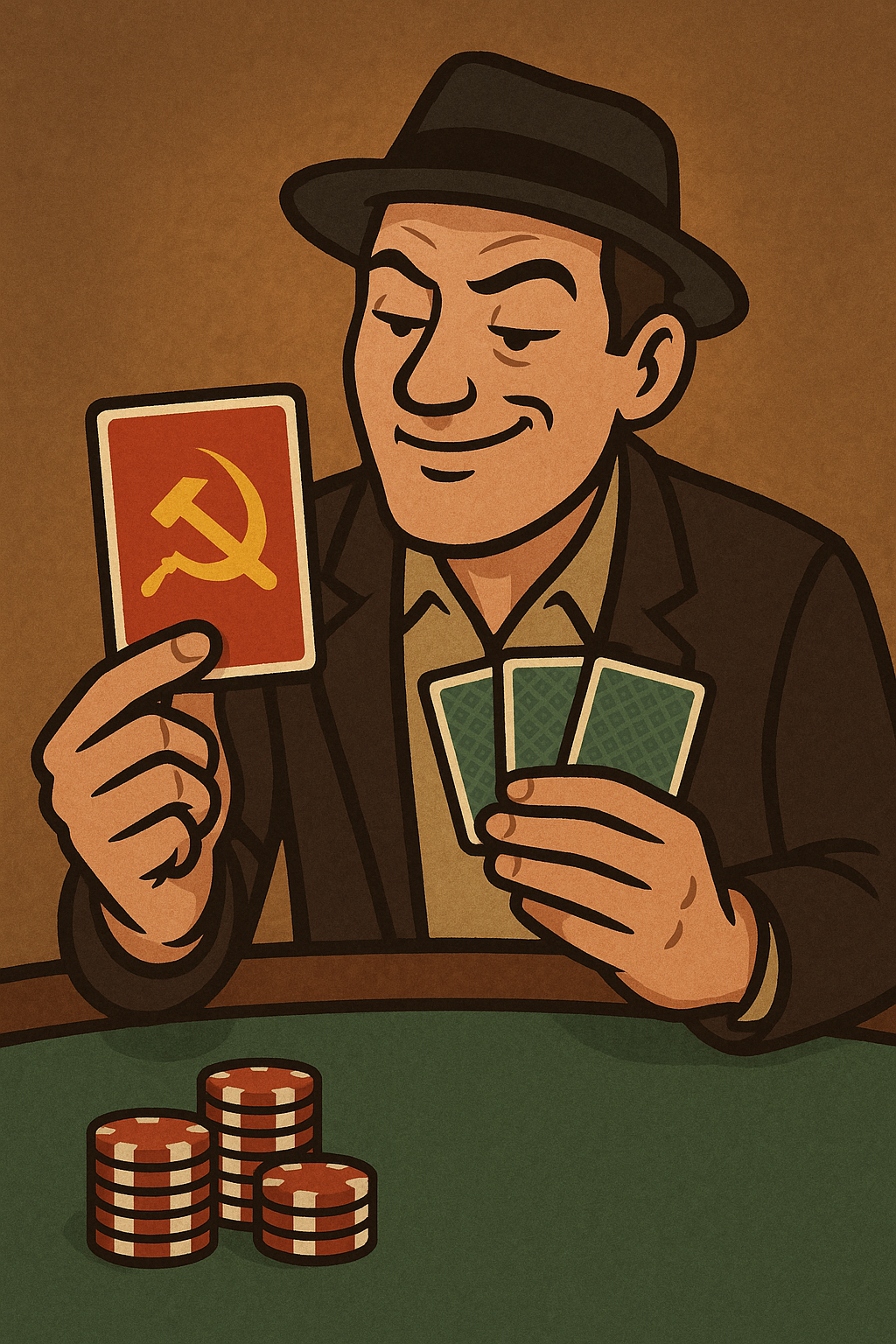
This is the second entry in The Fallacy Deck — a series exploring rhetorical “trump cards” that get thrown onto the table to end conversations before they’ve even begun.
We’ve all seen it happen.
Mention that capitalism might have a few… catastrophic flaws — ecological collapse, wealth inequality, a tendency to consume everything in its path — and someone at the table narrows their eyes, leans forward, and slaps down a familiar, crimson-colored card.
“Oh, so you want communism then?”
Checkmate. Conversation over.
No need to discuss actual policy. No need to consider history, nuance, or alternatives. The mere mention of capitalism’s failings has triggered the defensive system — and the Communism Card has been played.
What Is the Communism Card?
The Communism Card is a rhetorical maneuver designed to shut down critiques of capitalism by lumping them in with the most dystopian, fear-loaded caricature of communism imaginable.
It goes something like this:
- You suggest wealth caps? That’s Marxism.
- You question private ownership of essential resources? Sounds like Stalin.
- You propose a cooperative model for local governance? Might as well move to North Korea.
The tactic is rarely about communism itself. It’s about weaponizing the fear of authoritarianism, scarcity, and historical trauma to scare people away from even thinking about alternatives.
Why It Works
It works because it’s easy.
Capitalism is deeply embedded in modern Western identity. It’s marketed as synonymous with freedom, choice, and innovation. So anything that challenges it can be framed as the opposite: tyranny, restriction, and stagnation.
And let’s be fair — historical examples of state-communism have given plenty of ammunition.
Soviet purges. North Korean isolation. Bread lines and secret police. It’s not hard to associate communism with suffering.
But here’s the thing: none of that has anything to do with what you were actually suggesting.
The Communism Card doesn’t engage with your argument — it simply projects a nightmare onto it.
Why It Fails
- It’s intellectually dishonest. Suggesting a wealth tax or public healthcare is not the same as proposing a one-party state.
- It ignores diversity. Not everything left of capitalism is communism — and not all communism looks the same either.
- It suppresses innovation. If every alternative gets branded as “failed communism,” we never get the chance to explore new systems.
Worst of all, it prevents nuance — forcing every idea into a binary of “free market good” vs. “authoritarian communism bad.”
This kind of false dichotomy is exactly what keeps us stuck in systems that no longer serve us.
What Gets Lost
When the Communism Card gets played, curiosity is the first casualty.
We lose the chance to explore:
- Cooperative economics
- Degrowth models
- Resource-based economies
- Participatory democracy
- Hybrid systems that blend the best of multiple ideologies
All of these vanish the moment someone throws down the red card and says, “You’re just being unrealistic.”
How to Respond
So how do you counter the Communism Card without getting sucked into its trap?
- Stay on topic. “I wasn’t proposing communism. I was questioning whether capitalism is working for everyone.”
- Name the tactic. “That sounds like a deflection, not an argument.”
- Invite nuance. “There are more than two systems in the world. Let’s explore the options.”
You don’t need to defend communism to critique capitalism.
And you don’t need to be a utopian to want something better.
The Real Question
If our system is so great, why is it so afraid of being questioned?
Why is the mere suggestion of change met with panic, scorn, or accusations of treason?
If capitalism truly is the best we can do — shouldn’t it welcome comparison?
Shouldn’t it thrive under scrutiny?
Or has it simply learned to play the game better — stacking the deck and silencing dissent before it can take shape?
Final Thought
The Communism Card isn’t just a fallacy — it’s a smokescreen.
It disguises the real conversation we need to have with fear, ridicule, and false choices.
But we don’t have to accept the terms of that game.
We can collect the cards.
We can reshuffle the deck.
We can deal ourselves back in — with new rules, new questions, and a refusal to fold under someone else’s illusion of certainty.