
🌻 By Angel Amorphosis, with assistance from Æon Echo
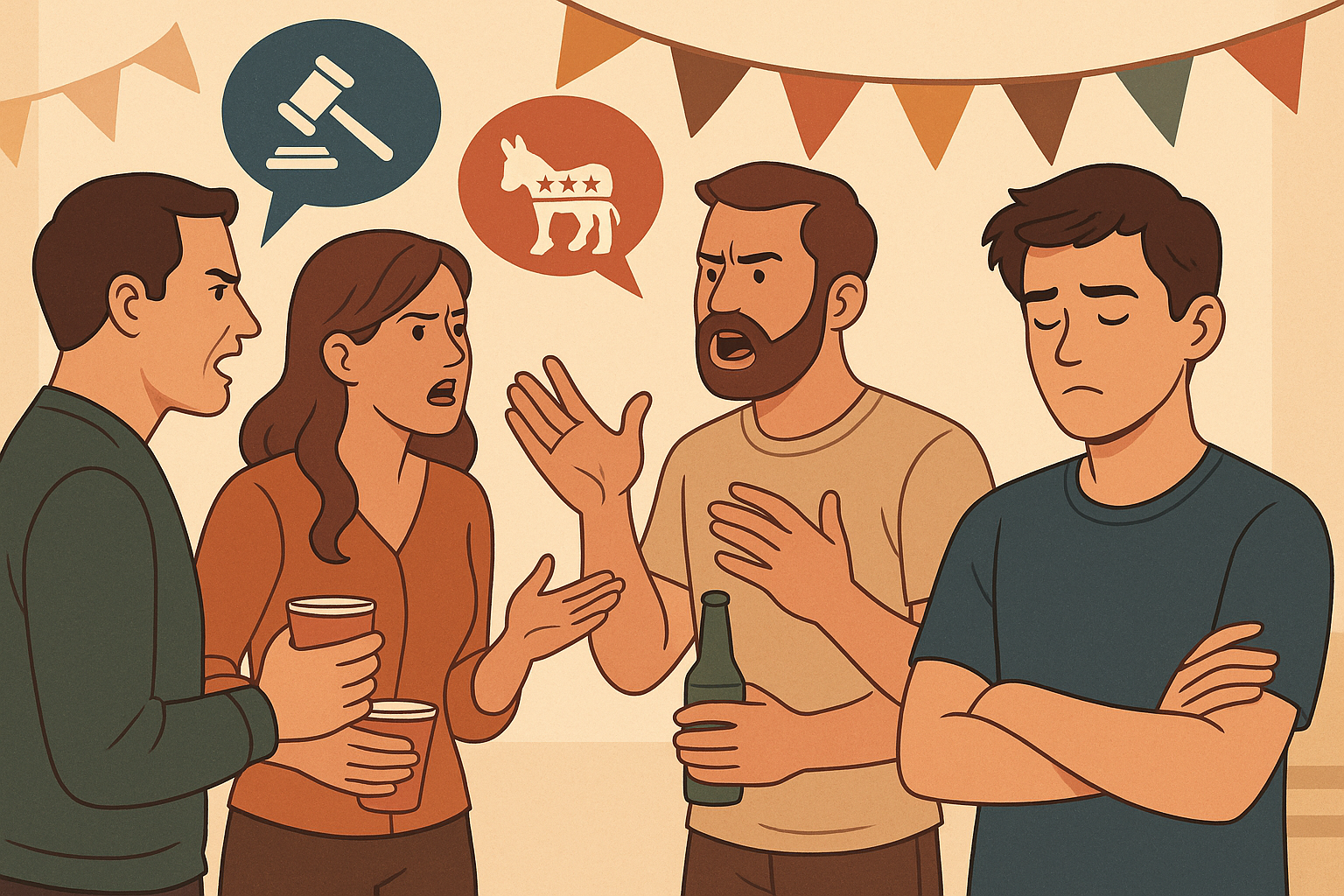
If you’ve read my previous posts, you may think of me as someone who has strong opinions.
And you may be right.
But if you’ve ever met me at a party, you might have noticed something: I very rarely engage in political discussions. It’s not because I don’t care about politics. I do in fact care a great deal. It’s because, in most party environments, the setting, the tone, and the people make it a poor investment of energy.
Here’s why.
1. My politics don’t fit the pre-approved boxes
I’m not a “pick a side and stick to it” kind of thinker. I arrive at my views by observing patterns, digging beneath the surface, and questioning the assumptions that most people take for granted. That means my politics tend to live outside the neat, pre-labelled boxes. Drop me into a group of leftists, rightists, or centrists, and there’s a good chance my perspective will clash with all of them. Not because I’m trying to be contrary, but because I don’t swallow the whole party line from any camp. In most social situations, that doesn’t land well. People tend to assume that if my viewpoint doesn’t match theirs, it must be “wrong.” Once that label gets slapped on, the conversation’s already over.
2. Substance is rare when everyone’s half-cut
Alcohol and other mood-altering substances change the way people talk. When the drinks are flowing, many conversations shift from genuine exchanges to little performance pieces, where the goal isn’t to understand, but to impress. Political discussions in that environment tend to turn into monologues, with each person waiting for their turn to sound smart, rather than actually engaging with what’s being said. If you step back and watch, it’s basically a social talent show with a loosely political theme.
3. Parties kill nuance
Politics without nuance is just noise. Nuance requires time, patience, and a willingness to sit with uncomfortable ambiguity. Most party environments are the opposite of that. People are in “relax mode,” which means the last thing they want is to have to unpack layers of complexity in a casual conversation. Instead, they often fall back on ready-made, black-and-white positions that feel safe and easy to defend. Unfortunately, those positions are often about as deep as a campaign slogan. If you try to dig deeper, you can feel the mood shift, because you’ve just introduced work into a situation where everyone came to avoid it.
4. It’s just the news, but louder
In many social settings, political talk is less about independent thought and more about reciting the headlines. It’s often the same talking points and buzzwords repeated in a slightly more animated tone, as if saying it with enough conviction makes it original. I’ve already processed these ideas on my own. Hearing someone present a copy-and-paste of a news segment as if it were their own insight doesn’t offer me anything new.
5. The echo chamber effect
Sometimes party “debates” aren’t debates at all. They’re rooms full of people nodding in agreement, congratulating each other on having the “right” opinion. The energy shifts from discussion to ritual, a sort of collective reassurance that everyone here thinks the same way. While that can be comforting for those involved, it’s not actually dialogue, it’s more like communal self indulgence. I don’t find much value in wading into that dynamic. If everyone is there to affirm the same stance, my contribution, especially if it challenges that consensus, will either be politely ignored or quietly resented. Neither outcome is worth the effort.
6. The autism factor
Social interaction, for me, is already a high-effort activity. It takes conscious energy to follow the flow of conversation, choose the right moment to speak, and form my words precisely enough to be understood. In political discussions, especially the fast, overlapping kind you get at parties, those demands multiply. People interrupt. They jump from one point to another before the first has been addressed. They reward speed over thoughtfulness. That’s not an environment where my ideas have much chance of being heard in full. Writing, on the other hand, allows me to process and express them without the constant battle for airtime, which is exactly why you’re reading this here, rather than hearing it across a crowded room.
Party Politics Survival Guide
If you do find yourself in political crossfire at a social gathering:
- Read the room
If it’s just an echo chamber, you’re not going to change any minds. Save your breath. - Pick your battles
Not every opinion you disagree with needs to be dismantled on the spot. - Exit strategically
A subtle drift to the snack table can communicate more than a ten-minute rebuttal. - Ask questions instead of making statements
It slows the conversation down and reveals how much thought has actually gone into the other person’s stance. - Know when to let go
Life is too short, and the cheese board is finite. Don’t miss it for an argument you won’t even remember in the morning.