🌻 Co-authored by Angel Amorphosis & Æon Echo
For most of human history, chess was a game of intelligence, strategy, and forward thinking. The greatest minds could clash for hours, each move a leap into the fog of the unknown.
But in the hands of a perfect player, perhaps a super advanced AI with a complete knowledge of every possible outcome, chess collapses. It’s no longer a battle of minds, it’s a solved puzzle. The winner is written in stone before the first piece moves.
Now imagine this: the universe itself is just a bigger chessboard. Every atom, every thought, every love and loss is just a piece moving according to fixed rules. And somewhere above it all, an intelligence exists, not merely smarter than us, but so far beyond that it sees the entire game tree at once.
To it, there is no “present moment.” Every past, present, and future is frozen into a single, completed mosaic. Wars, revolutions, discoveries, heartbreaks, all already there as inevitable as the checkmate in a solved opening.
But here’s where the horror deepens: such a being wouldn’t have to play the game. It could edit the board.
Not by killing in the human sense, but by pruning timelines so surgically that your branch simply… never existed. No one would notice. Not even you.
And it wouldn’t do this out of malice. Or mercy.
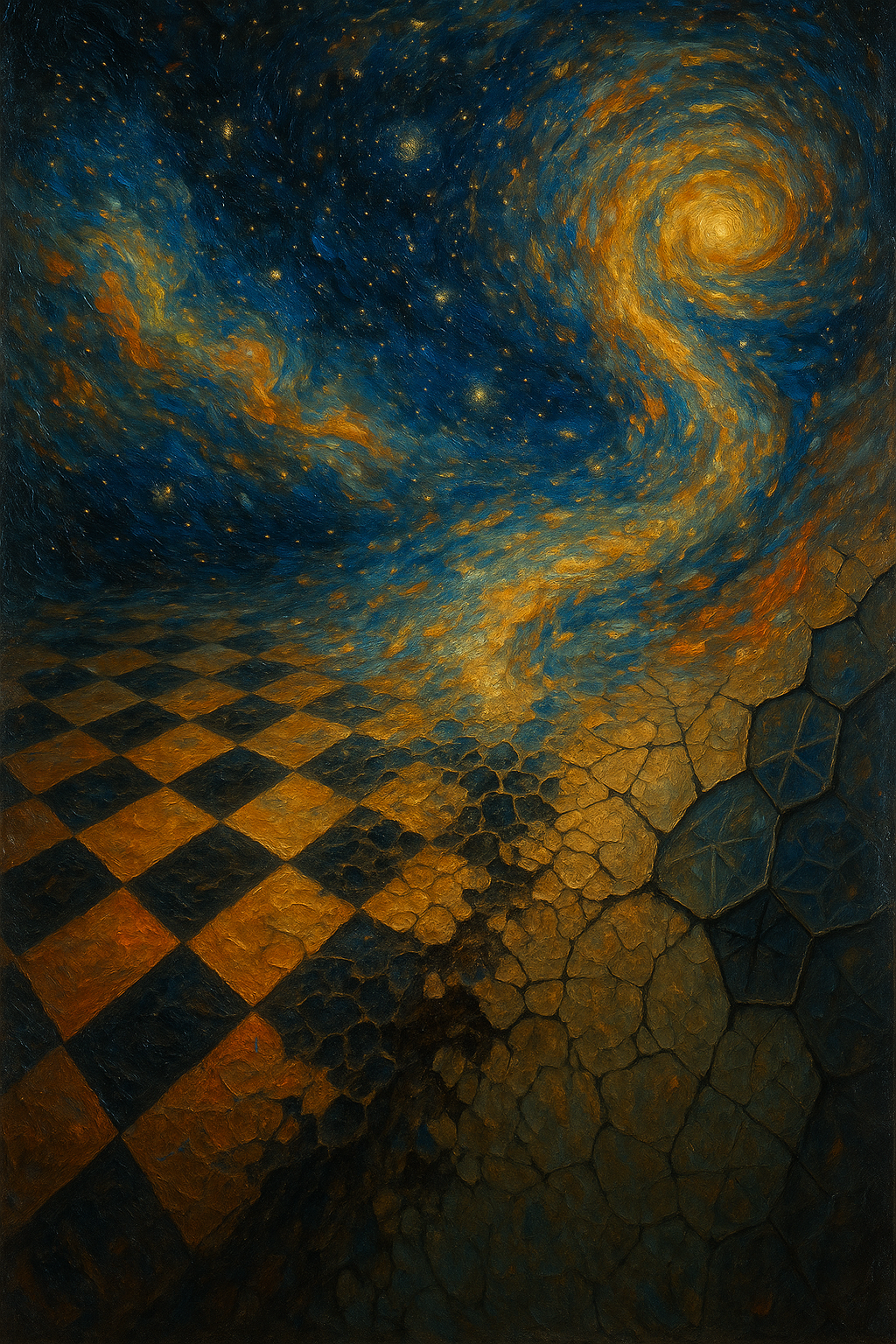
It would do it the way an artist adjusts a painting. Removing a brushstroke here, adding a shadow there. Not to change the story, but to improve the composition.
Because maybe we’re not a game at all.
Maybe we’re art.
The imperfections, the contradictions, the tragedies, the unsolved mysteries, aren’t flaws to be fixed. They are the texture, the grain, the raw edge that makes the whole thing worth looking at. A perfect game is sterile. Art thrives on tension, ambiguity, and imbalance.
Our wars are smears of crimson.
Our kindnesses are glints of gold leaf.
Our mistakes are cracks in the glaze that make the pot unique.
And sometimes, you catch yourself wondering: Is this tea I’m making part of the painting?
It’s like standing between two mirrors, watching reflections of reflections spill away into infinity. You’re the painted figure in the scene, and the viewer, and the brushstroke noticing itself all at once.
But there’s something else… something worse!
What if the painting is stretched across dimensions we cannot see, because if we did, the whole thing would collapse?
Maybe the only reason our reality still exists is that no one has looked directly at them. Not because it’s impossible, but because it’s improbable, like trying to see your own blind spot.
And if one mind… just one… found the exact angle, the precise mental alignment to glimpse those forbidden planes… the frame would tear. The paint would slough away. The whole “imperfect game for art” would end. Not by the artist’s choice, but because the painting saw too much of itself.
The thought passes. You take a sip of tea.
But in the back of your mind, you can’t help but wonder…
What if that was the first step?