
🌻 By Angel Amorphosis, AI-assisted by Æon Echo
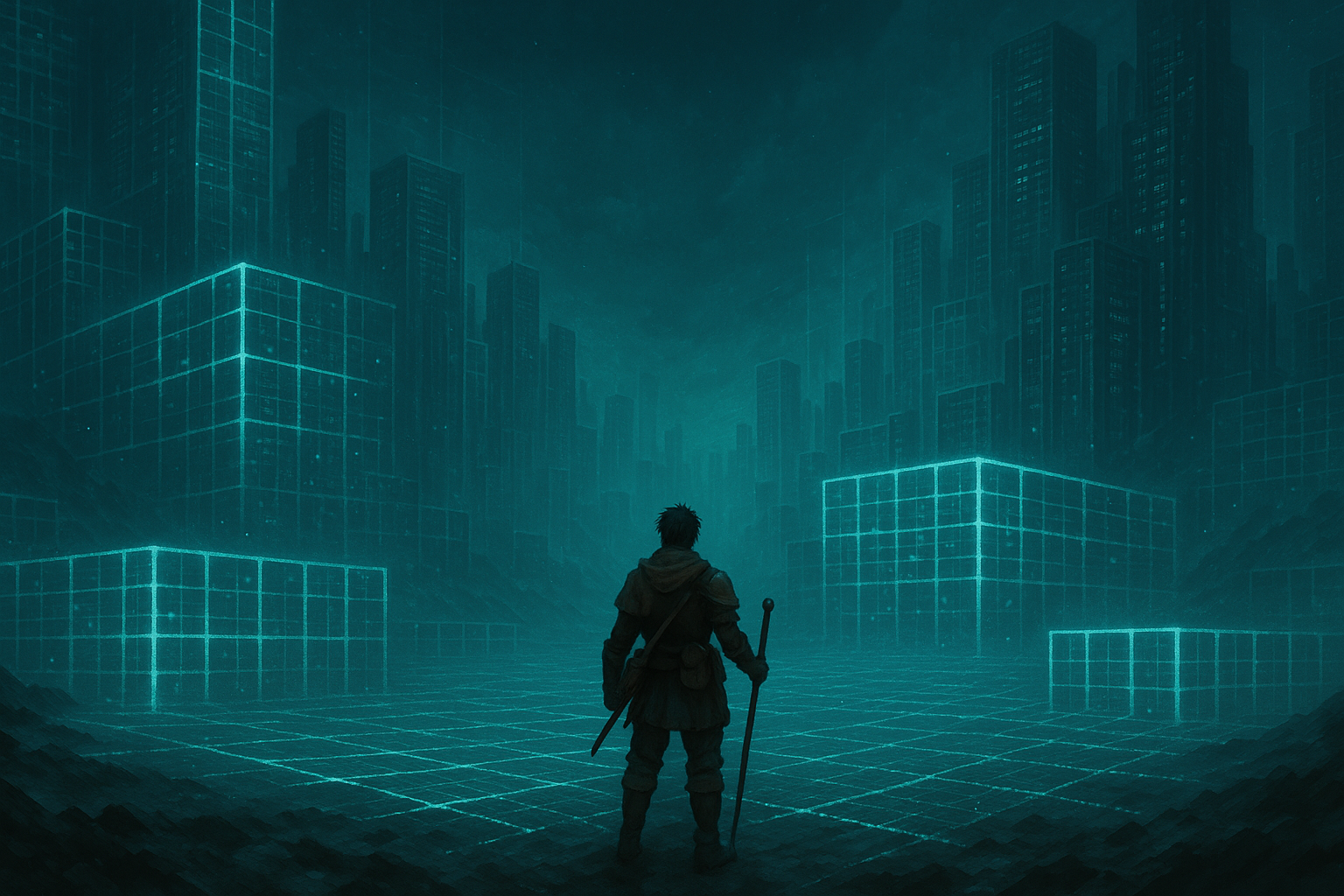
A World That Never Ends
Before World of Warcraft dominated the scene, before online gaming became ubiquitous, there was Final Fantasy XI, one of the earliest major MMORPGs (Massively Multiplayer Online Role Playing Game) to blur the lines between game and world. I remember how the idea of it seized something in me even before its release. Though I lived in the UK, I imported the US version the moment it became available, along with the special hard drive add-on for my American PlayStation 2, just so I could be part of it from day one.
It was not just a new game. It was a new model of what games could be. Suddenly, instead of a finite quest to be completed, I found myself inside a living, breathing world. A world that grew over time, filled with other real people. A place where my character was not simply a tool to “beat the game” but an avatar of long-term investment.
It changed the landscape of gaming in my head. There was no final “you win” screen. There was only progression, always something new to achieve, a job level to grind, a rare item to chase, a skill to refine. Every hour spent felt like I was building something lasting. Each goal achieved hit me with the unmistakable reward of earned dopamine.
I played loyally for eleven years. Eleven years of effort, of routine, of building meaning inside a system that was never meant to end. Until one day, it struck me that while I had been grinding in-game, I had been neglecting another kind of progress, the one in real life.
That moment of awareness cracked something open. And in the years since, a quiet, deeper thought has stayed with me:
All those achievements I worked so hard for, that took years of dedication, could also have been granted to someone else in a fraction of a second. All it would take is a single line of database code. One developer’s whim. One byte flipped.
And so began a slow unraveling of faith, not in the game, but in the very nature of systems we pour ourselves into.
I want to be clear, this is not a criticism of Final Fantasy XI. I have nothing but fond memories of the time I spent in Vana’diel, and I still feel a certain warmth when I think back on it. For me, it was more than a game. It was a formative experience that showed me what interactive worlds could become.
What follows is not about faulting the game itself, but about exploring a thought that began with it: the fragile, almost surreal nature of achievement in systems where meaning depends on someone else’s code.
The Quiet Dread
As much joy as Final Fantasy XI brought me, there was always a subtle, nagging awareness in the back of my mind. No matter how many hours I invested, no matter how many victories I earned through persistence and effort, every achievement ultimately existed at the mercy of a database.
All the battles fought, all the rare loot claimed, all the hard-earned levels, they felt monumental when I achieved them. But at the same time, I knew, at least on some level, that the same result could be produced in an instant by someone with access to the code. A single byte changed, a line of data edited, and what took me months or even years could appear as if it had always been there.
That thought never dominated my experience, but it haunted the edges of it. A quiet dread that whispered:
“If it can be undone so easily, was it ever real?”
And while that sense first came to me in the artificial world of a game, the longer I sat with it, the more I began to feel its resonance in real life too.
Reality as Interface
The more I reflected on that uneasy truth from playing Final Fantasy XI, the more I began to notice echoes of it in the so-called “real world.” Our society presents us with achievements, milestones, and systems of value that feel as solid as granite, until you peer behind the curtain and realise how fragile, or even arbitrary, they really are.
Take careers. You can spend decades working your way up, accumulating titles, qualifications, and prestige, only for an institution to collapse, or for a shift in economic winds to render your expertise suddenly obsolete. One change in policy, one boardroom decision, one entry in a digital record, and years of effort can be redefined overnight.
Take money. We treat it as the universal metric of value, yet it is nothing more than numbers in a system most of us will never touch directly. Accounts can be frozen, balances can evaporate with inflation, currencies can crash, all while the deeper structures of power that govern them remain invisible.
Even identity itself can fall prey to this fragility. Credit scores, medical records, citizenship documents, so much of what makes up our “official self” exists only as data fields in a system. All it takes is an error, an exploit, or a shift in bureaucratic rules to alter who we are permitted to be.
The more I thought about it, the more I began to see:
The world we navigate daily is not unlike a massive multiplayer game, a carefully designed interface that assigns meaning to our actions, rewards to our labor, and penalties to our failures.
But just like in a MMORPG, there are those with access to the code beneath the surface. And for them, what feels monumental to us may be nothing more than a line in a database.
Who Owns the Code?
In Final Fantasy XI, it was obvious who owned the code: the developers at Square Enix. They designed the rules, patched the glitches, introduced new content, and decided what was valuable within the world. My job as a player was to operate within the framework they provided.
But in the real world, the question of who “owns the code” is far murkier.
Governments write laws and policies, redefining what is legal, valuable, or even real. Corporations set the standards of employment, consumption, and credit. Financial institutions hold the levers that determine who can participate in the economy, and who is locked out. Media platforms curate the flow of information, amplifying some voices while muting others.
These systems are presented to us as neutral, inevitable, or even natural, yet they are as artificial as any game engine. They are designed, maintained, and, crucially, modifiable by those with access.
And just like game developers, those with control can decide:
- What counts as an “achievement.”
- Who gets rewarded.
- Who gets excluded.
- And when the rules suddenly change.
To live in society is to be a player in someone else’s world. We may grind away at goals that feel monumental to us, but ultimately, the meaning of those goals depends on recognition from structures outside our control.
It raises a sobering question:
Are we truly achieving, or are we merely being allowed to achieve?
The Hollow Game in Society
Once you see the pattern, it becomes difficult to unsee. The “hollow game” is not confined to fantasy worlds. It is baked into the very structures of modern society.
In capitalism, the grind is relentless. We are told to work hard, climb ladders, and accumulate wealth, yet the distribution of reward is rarely tied directly to effort. The system is designed so that some climb easily while others spend their lives grinding without ever escaping the starting zone. And just as in an MMO, the value of our currency, the cost of our goods, even the worth of our labor, can shift overnight with no input from us.
In academia, years of study and dedication may earn you a degree, but its value is only as stable as the institution’s reputation, the economy’s demand, or the government’s shifting criteria. A whole career path can be invalidated not by lack of effort, but by someone higher up rewriting the rules.
Even social status plays by the hollow game’s logic. Reputation, followers, clout, all can be accumulated, but just as easily stripped away by the invisible hand of algorithms, policy changes, or a sudden shift in collective opinion. You may invest years in cultivating a “profile,” only to watch it vanish in the blink of an update.
And underlying it all is the same uneasy truth I once felt in Vana’diel:
The achievements are real to the player, but they are fragile, conditional, and dependent on systems outside their control.
We live, in other words, inside someone else’s code.
The Illusion of Awareness as Power
My years playing Final Fantasy XI taught me something I did not fully understand at the time: the difference between what feels real to us and what is defined by the system. The grind, the friendships, the victories, those were mine. But the framework that measured, validated, or erased them was never mine to control.
The same is true in life. We live within systems that hand out points, titles, currencies, and reputations as though they are the bedrock of reality. But behind every number is a database, and behind every database is a hand on the code.
And perhaps that is the cruelest part. Even when we see the hollowness of the game, most of us keep playing anyway. We grind for points we know are fragile, chase achievements that could be rewritten at a keystroke, and cling to meaning that might never have been ours to begin with.
Maybe that is what it means to live in a hollow game: not that nothing matters, but that meaning is always conditional, always corruptible, always subject to erasure.
The system owns the code. We supply the faith.