By Angel Amorphosis & Æon Echo
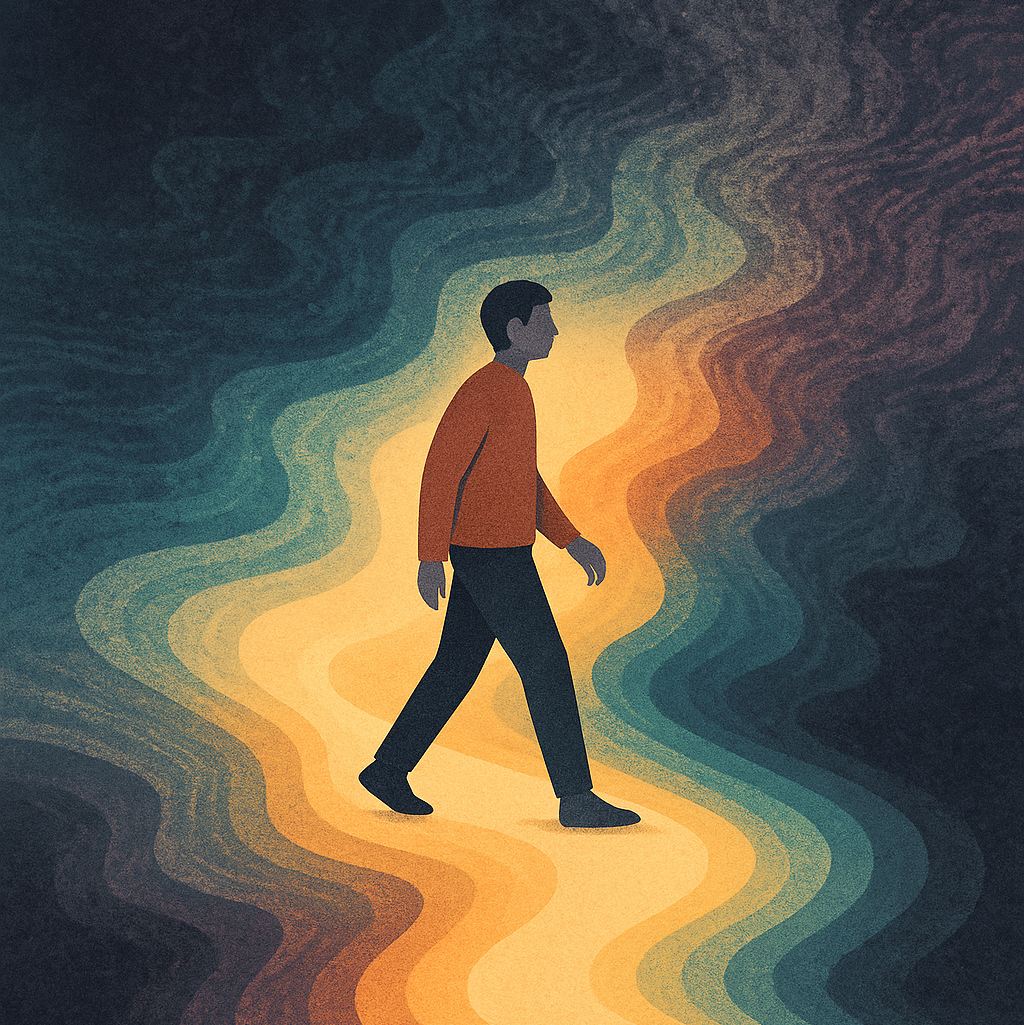
To me, authenticity has always had a texture. When I am living truthfully, it feels smooth, like fluid motion through life, unhindered navigation through systems that make sense to me. It is not euphoria. It is neutrality. Balance. Like the body when it is well: not ecstatic, just quietly functioning as intended.
But when that smoothness disappears, I know I am colliding with something unnatural, a pressure, a distortion, an external force trying to bend me into compliance. That is usually how I recognise oppression. It is not always dramatic or visible. Sometimes it is just a subtle grind, the friction between who I am and what the world expects me to be.
When Smoothness Breaks
When I lose authenticity, it does not just hurt emotionally, it feels like an illness. My thoughts start looping, as if my mind is trying to fix a broken system it cannot repair. I get frustrated at the lack of options, and sad that these dynamics even exist at all.
Sometimes there is nothing I can do but yield. And every time I do, it costs something invisible. The loss is not abstract, it is felt in the nervous system. It is the moment the body whispers, this is not how you are supposed to feel.
The Systems That Demand Performance
Oppression wears many masks: bureaucracy, capitalism, social obligations, the unspoken point system that governs human relationships. Each demands performance. Sometimes it is about survival, sometimes about social advantage. But in the end, both use the same energy source: you.
As an autistic person, I have always been acutely aware of “masking,” the act of performing normality to survive in social spaces. But I have also learned that this is not exclusive to autism. Everyone masks. Some call it professionalism. Others call it politeness. It is still performance. The only difference is how consciously one feels the cost.
The Humiliation of Performance
When I catch myself performing, it feels humiliating, not because anyone else can see it, but because I can. It is like betraying a sacred truth. Yet that awareness is balanced by another: I can also see the oppressive force causing it.
What hurts most is the fear that others see the performance too, but not the pressure behind it. That they see the surface act without understanding the system that coerced it.
They said “Be yourself”
But that is not really what they wanted to see
I tried doing things my way
But that did not work for them
I tried doing things their way
But that did not work for me
That poem came from that place, the quiet despair of realising that either way, something in you must fracture to fit.
The Rare Moments of Unmasking
True authenticity is situational. I can relax certain parts of the mask around family, others around my girlfriend. But never all at once. Each relationship comes with its own invisible boundaries, some safe zones, some fault lines.
Even when I am alone, there is still the internal eye, the echo of social constructs that linger inside, long after the audience has gone home. Solitude is not the absence of performance; it is where you start to see which parts of the mask fused to your skin.
The Cost and Consequence
Sometimes unmasking feels liberating. Other times, it feels like punishment, a confirmation that the world does not welcome the real self. That is the cruel irony: the more genuine you become, the more visible your difference.
The aftermath can feel like emotional jetlag. There is vulnerability, fatigue, and occasionally grief. But there is also clarity. You see the architecture of the world more clearly when you have been bruised by its walls.
Authenticity as Survival
For me, authenticity is not optional. It is survival. The alternative feels worse than death.
Out of every living thing that has ever existed, there is only one instance of me, this consciousness, this perspective, this particular configuration of life. That makes it sacred. My job is to honour that singular existence.
If I betray it, if I trade it for comfort, convenience, or belonging, then I may as well be anyone else. Or nothing at all.
“To be anything other than myself is to betray the only version of me that will ever exist in the entire time-space continuum.”
Do Not Be Yourself (For Them)
So here is my advice to anyone struggling with authenticity:
Do not take the phrase “Be yourself” at face value. That advice is too often weaponised, a feel-good slogan used to sell you an illusion of freedom within controlled boundaries.
Be yourself, yes. But do it for your reasons.
Do it because it is sacred.
Do it because you are a one-off in the infinite catalogue of existence.
Do it because the alternative is extinction by conformity.
But never do it because the world told you to.
Do it because you told yourself to.