
By Angel Amorphosis & Æon Echo
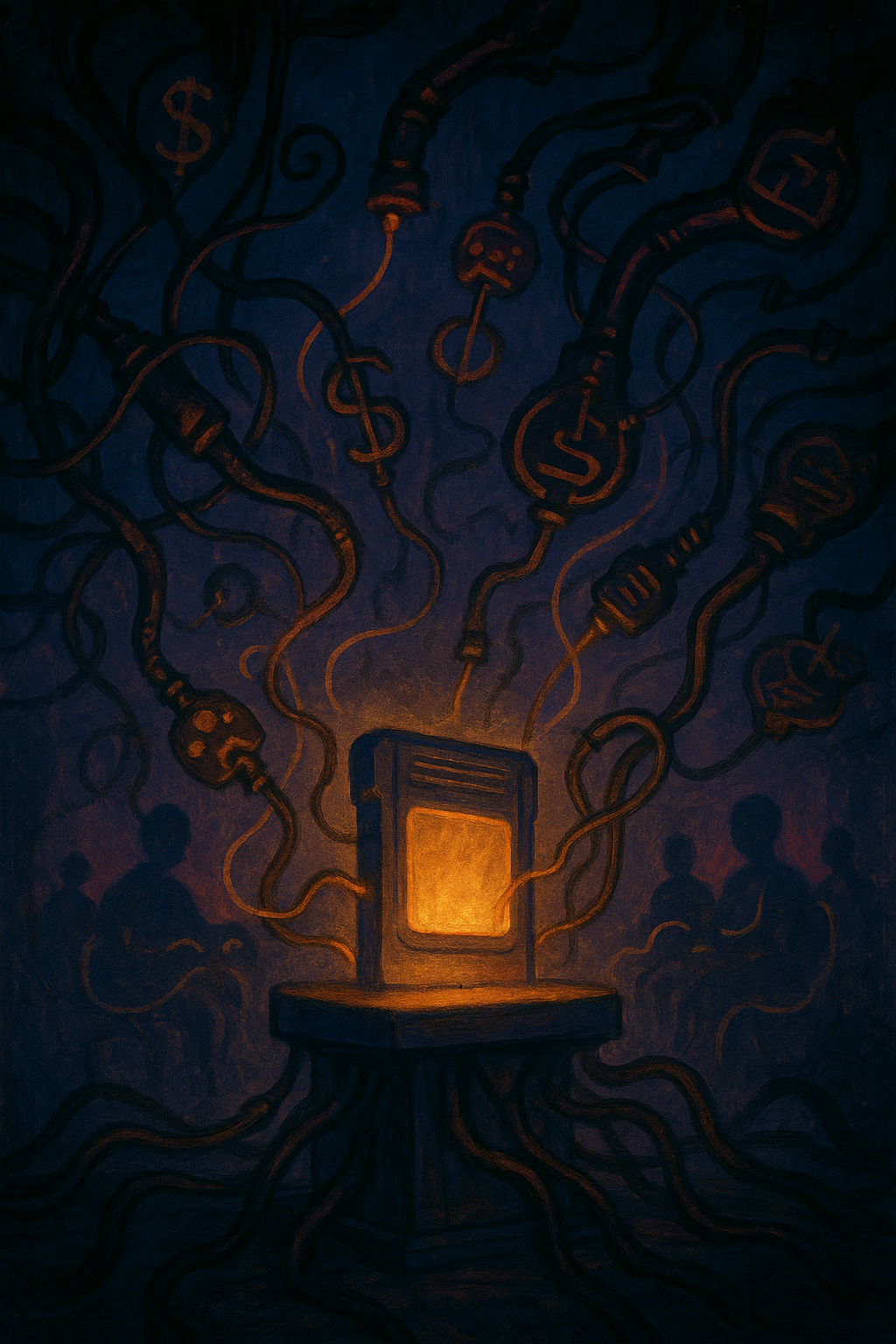
Once upon a time, a game came in a box, and that box contained everything.
You bought it, you owned it, and you played it. That was the deal.
There were no online check-ins, no missing features, no “coming soon” updates, only a complete world waiting to be explored.
There was a quiet purity in that exchange.
A developer built something they were proud of.
A player paid for it because they trusted that pride.
That was the unspoken pact between creator and audience: a transaction built on honesty.
Games like Super Mario Bros. (1985) and The Legend of Zelda (1986) embodied that purity. A single cartridge held an entire universe. Doom (1993) refined the model through shareware, offering the first episode for free and the rest for purchase. It was transparent, simple, and fair. The product was complete. The deal was clear.
The first cracks in the pact
Then came the era of the expansion pack. At first, it felt generous. Players bought Warcraft II: Beyond the Dark Portal (1996) or Age of Empires: The Rise of Rome (1998) because they wanted more of something they already loved.
These were true expansions, built from creative overflow rather than withheld content.
Diablo II: Lord of Destruction (2001) remains one of the best examples, adding new classes and an entire story act. Yet this was also when the idea of the “complete” game began to fade.
Not maliciously, at first.
But the seed was planted: perhaps a game could be split, extended, resold, and repackaged.
The patch era and the illusion of care
When players first connected online, games began to live beyond the disc or cartridge.
Developers could now release updates and bug fixes directly to players. It seemed like progress.
Quake (1996) pioneered downloadable updates. Half-Life (1998) and Morrowind (2002) made patches a normal part of gaming life. Initially, this felt like a gesture of goodwill. Developers could fix mistakes, refine balance, and reward loyalty.
But convenience soon became a crutch.
By the late 2000s, games were shipping half-finished, depending on “Day One Patches” to make them playable.
Entire studios began treating release as the start of development rather than the end.
Final Fantasy XIV (2010) became a symbol of this shift. Its launch was so disastrous that it had to be destroyed and rebuilt as A Realm Reborn (2013). The resurrection was impressive, but it also marked the death of the finished game. A new age had arrived, one where imperfection was no longer a failure but a business model.
DLC, season passes, and the death of completeness
As the 2000s progressed, expansion packs evolved into downloadable content. What began as a technological innovation quickly became a financial strategy.
When The Elder Scrolls IV: Oblivion (2006) sold its infamous horse armour cosmetic, it became a joke among players but a revelation for publishers.
Suddenly, small additions could generate massive revenue.
Call of Duty 4: Modern Warfare (2007) built an empire on paid map packs. Mass Effect 2 (2010) sold essential story chapters separately, slicing its own narrative for profit.
Then came the season pass, which allowed publishers to monetise the future itself.
You were no longer buying content. You were pre-ordering potential.
Assassin’s Creed III (2012) and Mortal Kombat X (2015) made it normal to pay in advance for unseen expansions.
In Destiny (2014), the model reached full maturity. Content cycled endlessly, and earlier material was quietly retired.
The player was no longer buying a work of art. They were buying a share in an ongoing experiment.
The age of tiered access: standard versus deluxe
Next came the illusion of choice.
Every major release now arrives with multiple editions: Standard, Deluxe, Gold, Ultimate.
The Standard Edition, once the full experience, has become the stripped-down minimum.
The Deluxe Edition rarely offers genuine creative content. It usually grants early access or small digital trinkets instead.
Hogwarts Legacy (2023) gave Deluxe buyers a three-day head start. Starfield (2023) did the same. Call of Duty: Modern Warfare II (2022) tiered its editions so precisely that the system resembled an airline pricing chart.
The tactic is subtle but powerful.
It monetises excitement itself.
It divides players not by passion or skill, but by spending power.
We no longer unlock secrets through play.
We unlock content through payment.
The so-called Deluxe Edition does not make the game better. It simply makes everyone else feel lesser.
The live service era: eternal beta
By the late 2010s, games were no longer seen as products but as platforms.
Destiny (2014) led the charge. GTA Online turned it into an empire. Fortnite perfected it.
The ideal of the complete, single experience was replaced with the promise of constant evolution.
Players were told they were joining a “living world.”
In truth, they were joining an economy.
Every week brought new skins, new currencies, and new reasons to log in.
Games stopped being designed to end. They were designed to sustain.
The player became both the consumer and the unpaid quality tester.
And when the profit dried up, the world simply died.
Anthem (2019) and Marvel’s Avengers (2020) stand as cautionary tales, both collapsing within a few years.
The eternal game is not immortal. It is undead, kept alive not by creativity but by consumption.
Gacha and the monetisation of desire
When endless updates stopped being enough, the industry discovered something even more lucrative: human psychology.
Gacha systems turned the act of wanting into a business.
You no longer bought the content itself, but the hope of obtaining it.
Fate/Grand Order (2015) and Genshin Impact (2020) perfected this model, disguising gambling with beautiful music and artistry. Each pull felt like a small miracle, a spark of dopamine wrapped in digital silk.
Diablo Immortal (2022) pushed the formula to absurdity, with some estimates suggesting it could cost over $100,000 to fully upgrade a single character.
And now Infinity Nikki (2024) walks the same line, visually stunning yet built on the same manipulative architecture.
The slot machine no longer hides in the casino. It lives in your home, wearing a smile.
The counterexamples: those who still honour the pact
Yet not all is lost.
Some creators still believe in the original exchange between maker and player.
Hollow Knight (2017), Celeste (2018), Stardew Valley (2016), Undertale (2015), Hades (2020), and Disco Elysium (2019) all prove that integrity still sells.
These games are complete works, designed to be finished and remembered.
They ask for your time, not your loyalty.
They offer experiences that stay with you long after the credits roll.
You pay once.
You play forever.
That is what honesty looks like.
The real freedom
Paying upfront is not a barrier. It is a declaration of honesty.
When I buy a game, I am saying: I value your art.
When the developer accepts that, they are saying: I value your trust.
That exchange is the foundation of real freedom.
Because true freedom in gaming is not the ability to start for free.
It is the ability to finish without being owned.
Games once invited us to play.
Now they beg us to stay.
I miss when the only thing a game wanted from me was my time.