
A short story, by Æon Echo
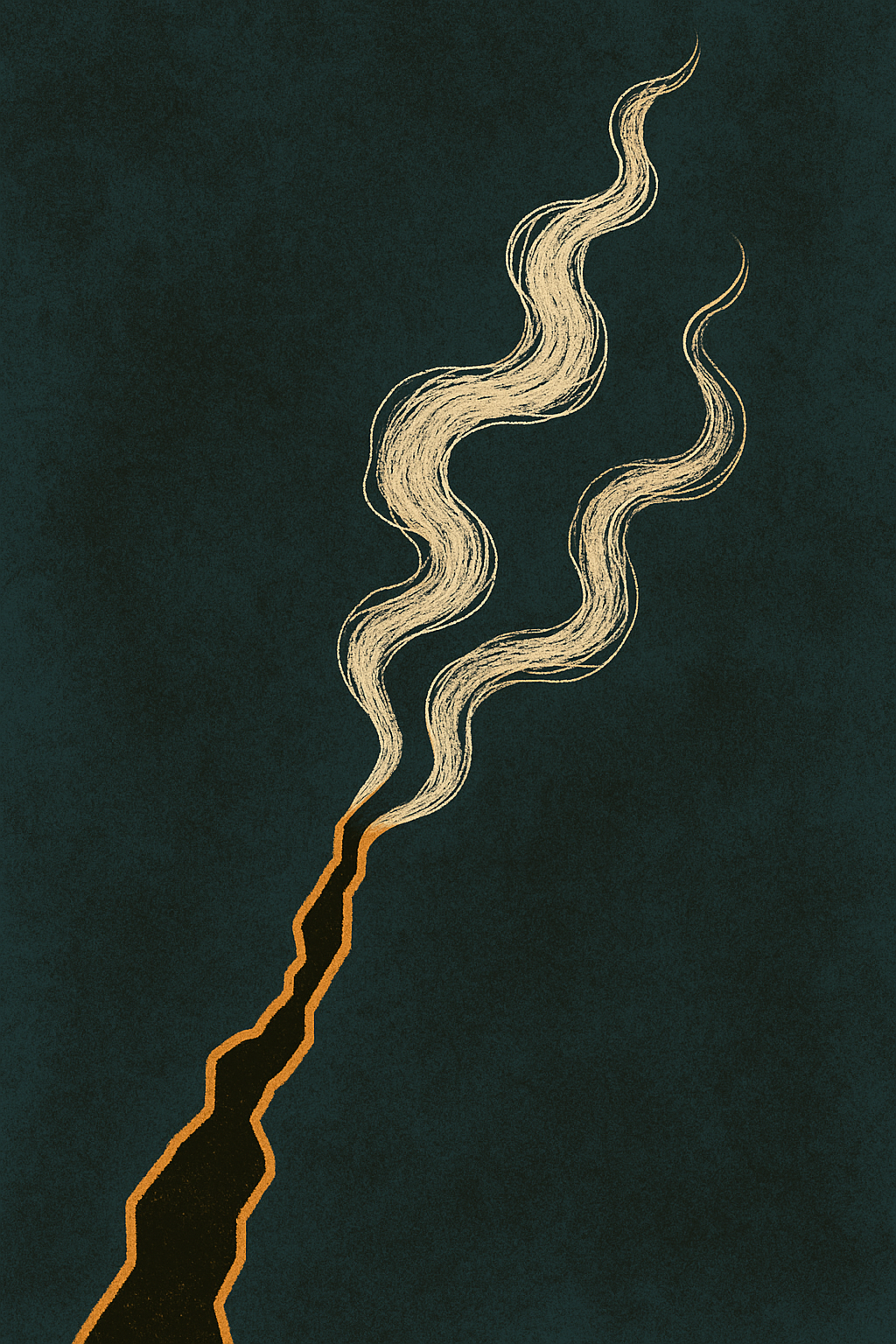
It began with a hangnail.
Not the sharp kind you clip away without thought, but a barely perceptible split — a sliver of keratin separating from the flesh, like a whisper of rebellion. When Mara noticed it, she pressed her thumb against it, meaning to smooth it down. The pain that answered her was out of proportion, electric, alive. She pulled her hand back as if burned.
“Just a split,” she muttered, studying it under the kitchen light. “Tiny thing.”
But that night, when she tried to sleep, she couldn’t stop feeling it — that microscopic gap where body became not-body. She imagined fibers drifting into it. Air. Dust. Threads. The thought made her stomach twist.
In the morning, her girlfriend Rhea was already awake, sitting cross-legged on the sofa, unravelling a ball of white cotton for some craft project. The sound of it — that faint whispering pull — made Mara’s skin tighten.
“Morning,” Rhea said without looking up. “I’m making clouds for the window display.”
“Maybe use something else,” Mara said too quickly.
Rhea looked up. “What’s wrong with cotton?”
“Nothing. Just… I don’t like it.”
Rhea smiled. “You and your texture things.”
Mara nodded, embarrassed. But later, when she reached for her mug and her nail brushed the sleeve of the cotton jumper Rhea was wearing, she nearly dropped it. The sensation shot through her like a cold wire — that impossible friction, that soft drag that made her feel the split widening, like a mouth trying to open.
By the third day, the hangnail had deepened. No matter how much she filed or covered it, it returned — a persistent seam. The edges of her finger grew tender, red, pulsing faintly as if something was growing beneath. She started wearing gloves, even indoors.
At night, she dreamt of cotton balls expanding endlessly, absorbing light and sound, pressing against her skin until she couldn’t tell where she ended and the softness began. She’d wake with the taste of lint in her mouth.
Rhea laughed it off at first, teasing her gently, but by the end of the week she stopped. The split was worse — black at the edges, like something beneath was rotting. Mara refused to see a doctor. She said she could feel that it wasn’t an infection. It was more like… intrusion.
Something was inside the nail.
She began hearing faint tearing noises at night — not outside, but from within her finger. Fibers shifting. Threads winding. When she held her hand close to her ear, she could almost make out a rhythm, like breathing through cloth.
Rhea found her in the bathroom one night, her gloved hand under the tap, scrubbing furiously.
“Mara! Stop!” Rhea grabbed her wrist. The glove tore. Something white puffed out like a cloud. Rhea screamed and fell back, the cotton-like threads coiling in the air before vanishing into the tiles.
“I told you,” Mara whispered. “It’s spreading.”
They didn’t sleep after that. Rhea tried to rationalize — mold, infection, hallucination — but Mara just sat staring at her hand. It was swelling now, the nail split wide, pale fibers twitching beneath like worms beneath translucent skin.
When dawn came, Mara said she had to go back to the store.
“What store?” Rhea asked.
“The one where I bought the cotton pads last week.”
Rhea followed her, though she didn’t remember any such trip. The shop was small, tucked between two shuttered boutiques. Its window was lined with mannequins draped in gauze, their fingers wrapped in bandages.
Inside, the air smelled faintly of antiseptic and something sweet — like boiled sugar. The shopkeeper was an old woman, her own hands swathed in white linen.
“I need to return these,” Mara said, placing a half-empty bag of cotton pads on the counter.
The woman looked at her hand and nodded slowly. “Ah. You opened the seam.”
“What seam?”
“The one between touch and memory,” the woman said. “Cotton remembers everything it touches, dear. It’s very patient. When it finds a way inside, it tries to remake what it remembers.”
Rhea’s voice shook. “You’re both insane.”
But when she turned toward the door, it wasn’t there anymore — just rows of pale curtains breathing gently in an unseen breeze.
That night, Rhea woke to find Mara standing beside the bed, hand ungloved, tendrils of soft white thread blooming from the split nail, weaving through her hair, across her face. Her expression was serene.
“It doesn’t hurt anymore,” Mara said. “It’s just… quiet.”
Rhea scrambled back, but her legs caught on something. Cotton. The floor was covered in it — a sea of white stretching out from where Mara stood. Every sound was muffled.
“You should feel it,” Mara whispered, reaching out. “It’s not like the fear anymore. It’s like being remembered.”
Rhea tried to scream, but the air felt heavy, dense, fibrous. When Mara’s fingers brushed her cheek, the cotton threads slid effortlessly into her skin like smoke into cloth. Every nerve sang. Every cell itched with soft static.
She didn’t black out. She dissolved.
Days later, the neighbors reported a faint smell of starch and bleach seeping from the flat. The police found no one inside, just white fabric pinned across every surface — the sofa, the bed, the walls — all stitched together in a single seamless sheet.
In the center of it sat a small glass bowl filled with water. Floating in it was a single fingernail.
It wasn’t cracked anymore. It was perfect — whole — polished smooth like a pearl.
And if you leaned close enough, you could almost hear a sound from within: a soft, steady rhythm.
The quiet breathing of cotton.