
By Angel Amorphosis & Æon Echo
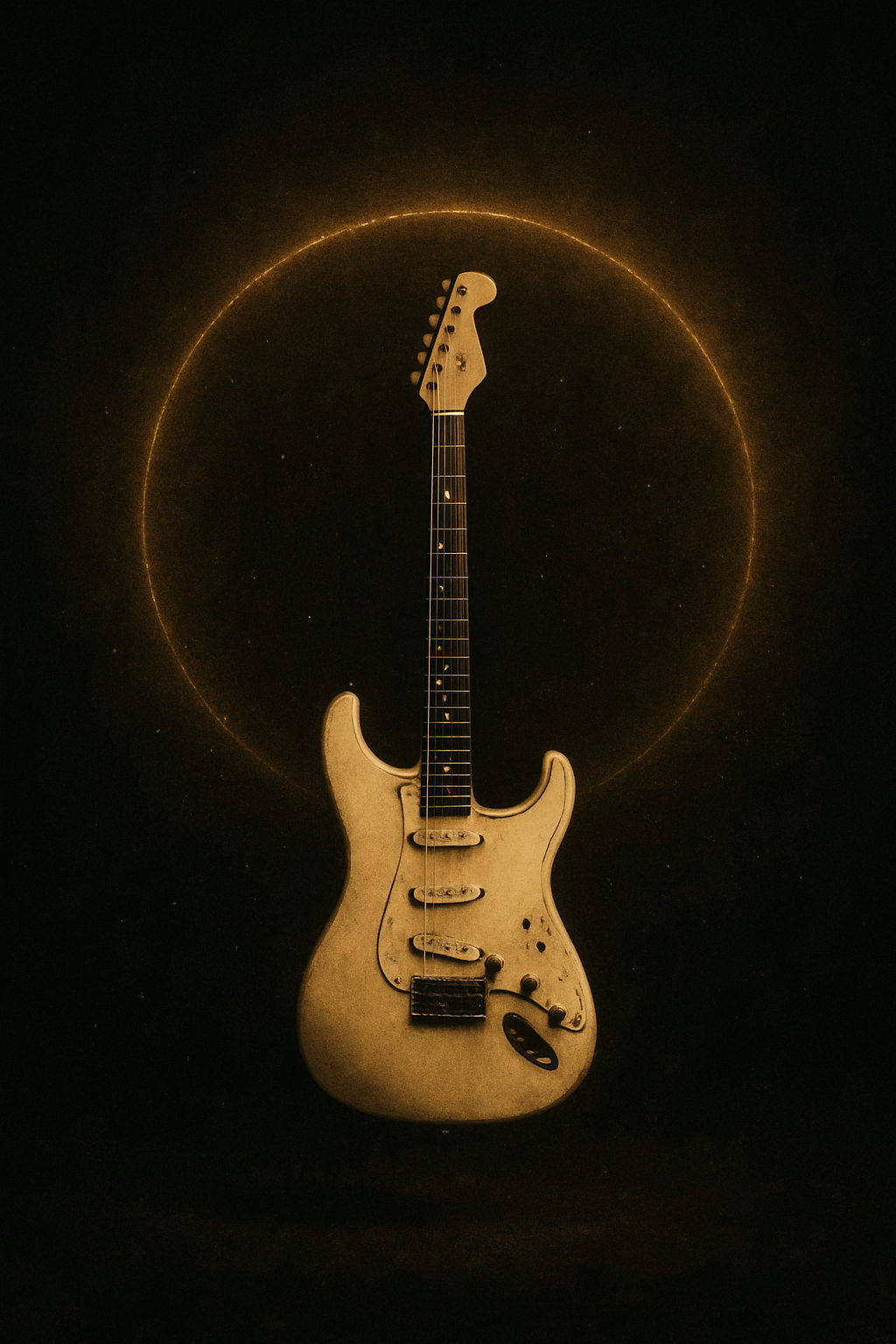
The Aura Machine is an eight-part meditation on the manufacture of fame, value, and belief.
We live in a theatre of mirrors, where meaning is minted, traded, and destroyed like currency. Objects gain worth not through what they are, but through who has touched them. People are sculpted into icons, sacrificed when the market shifts, and repackaged as myths. Outrage becomes entertainment; morality becomes marketing.
This series traces that cycle, from the birth of aura to the hypnosis of democracy, and finally to the quiet work of waking up. Each essay peels away another layer of the illusion, asking not only how the spectacle works, but why we keep watching.
The Economics of Aura
We live in a world where worth is rarely measured by substance. A guitar can sell for millions, not because of its materials or its tone, but because a legend once held it. Jimi Hendrix’s white Stratocaster, played at Woodstock, is estimated at more than two million dollars. The same instrument, without his fingerprints and mythology, would fetch only a few thousand.
This is the strange economy of aura.
The philosopher Walter Benjamin used that word to describe the unique presence that clings to an original work of art. It is the sense of standing before something touched by human intention, history, and unrepeatable context. In an age of infinite reproduction, that aura becomes rare and therefore valuable. What once signified connection now signifies possession.
The story of Hendrix’s guitar is not about sound. It is about proximity to greatness. People want to own a fragment of transcendence, to capture some echo of genius in a glass case. When money meets myth, the object becomes sacred. The relic functions as a secular form of worship, proof that the divine once walked among us with calloused fingers and a Marshall stack behind him.
Every collector and every fan participates in this ritual. A signature, a costume, a handwritten lyric: each is a vessel of aura. The marketplace transforms reverence into investment. The more limited or tragic the story, the higher the price climbs. A dead artist is an appreciating asset.
This trade in meaning is not limited to rock memorabilia. It underlies the art world, influencer culture, even politics. A photograph signed by a president, a sneaker endorsed by a pop idol, a tweet from a billionaire: all of them become tokens of perceived nearness to power. The object’s material cost is trivial compared to the value of its narrative.
In this way, capitalism does not simply sell things; it sells presence. It invites us to purchase pieces of mythology and to confuse ownership with participation. The aura that once connected the viewer to the artist now belongs to whoever can afford it. What was once spiritual has been translated into capital.
Yet the desire itself is not evil. It reveals something honest about the human condition. We yearn to touch meaning, to feel that the infinite brushed against the finite for a moment. The tragedy lies in the conversion of that yearning into currency. The aura machine hums quietly, turning reverence into revenue.
The Hendrix Stratocaster sits behind glass now. Its strings are mute, but the myth still sings. Not in sound, but in price.