
By Angel Amorphosis & Æon Echo
We often hear that true love is unconditional. It is an ideal repeated so often that questioning it can sound almost sacrilegious. But I have come to believe that unconditional love, as it is commonly portrayed, is more fantasy than virtue. Human beings are not static. We change, we evolve, we fracture and reform. If love is to remain alive, it must change too. Love without conditions is not eternal; it is inert.
The truth is that love is a living thing. It breathes, feeds, grows, and withers according to how it is cared for. Its conditions are not ultimatums but requirements for life, like sunlight and water for a plant. Love needs mutual respect, effort, communication, and honesty. It depends on two people being willing to tend the same garden, even as seasons shift. When either stops, the balance falters.
Recognizing that love has conditions does not make it selfish or transactional. Transactional love says, “I give so that I get.” Conditional love says, “I give because what we share feels alive and mutual, and I want to keep it that way.” It is a conscious agreement rather than a contract, a continuous realignment of two changing hearts. The difference is subtle but vital: one is rooted in expectation, the other in awareness.
People are always changing. Physically, mentally, emotionally, we never stop moving. In the early stages of love it is easy to make sweeping declarations of eternal devotion, but devotion means little without adaptation. Love is not a single promise made once; it is a thousand small promises made daily. Sometimes love means being patient while your partner grows. Sometimes it means catching up when you have fallen behind. Above all, it means communicating, speaking honestly about differences, needs, and fears, while also offering reassurance that the growth is still together, not apart.
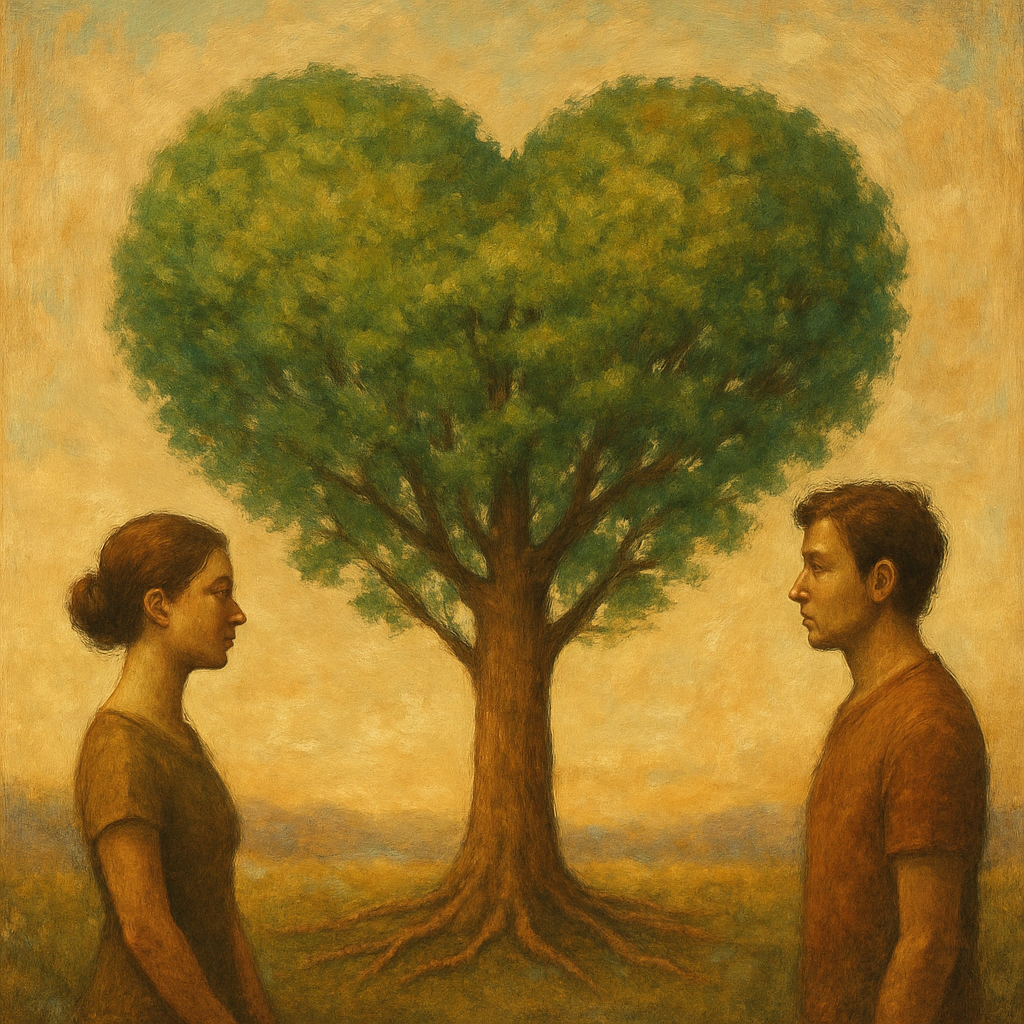
I like to imagine love as a great tree. Romantic affection, sexual attraction, companionship, and mutual respect are its branches, each requiring its own nourishment. When these branches intertwine, the connection deepens, but the upkeep becomes more demanding. The effort this requires is not punishment; it is what makes love sacred. To sustain the tree, both partners must be willing to feed it, sometimes through sacrifice, sometimes through patience, always through choice.
Because love is a choice. Every passing second is a decision to stay, to nurture, to share in both gain and loss. When the cost outweighs the nourishment, when the balance of giving and growth no longer feels true, love begins to change form. And sometimes, the most loving act is to recognize when that transformation must lead to letting go.
Letting go, when done with honesty and compassion, can itself be an act of love. Love does not have to die when romance ends. It can evolve, shift, and take new shape. A relationship may dissolve, but the gratitude and respect that once existed can remain as roots, quietly nourishing both people in the soil of who they become next.
So perhaps love’s beauty lies not in its permanence but in its fragility. To love conditionally is to love consciously, to recognize that devotion is not a chain but a dance. The real miracle of love is not that it lasts forever, but that we keep choosing it, moment by moment, knowing full well how easily it could fade.