
🌻By Angel Amorphosis, with assistance from Æon Echo
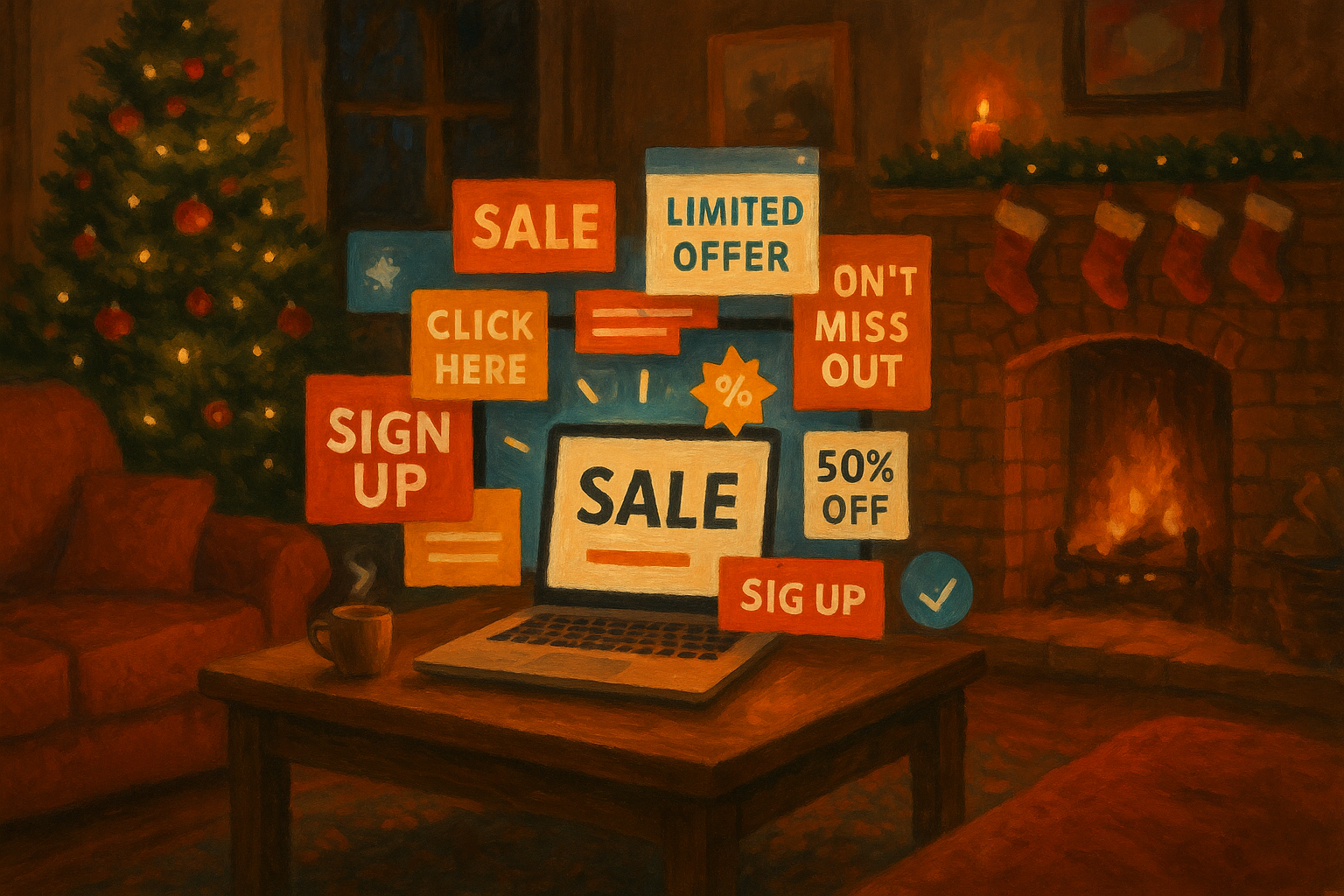
It is Christmas time.
The season of giving, peace, goodwill, and apparently, weaponised pop-ups.
This morning, I opened my computer with the pure intention of doing something wholesome. I made a coffee and prepared to write this article. Instead, I was greeted by a full screen demand from my ad blocker. The very tool I rely on to protect me from digital harassment proudly informed me that it had blocked 7,085 ads, and would I like to purchase premium.
There is something almost poetic about being pressured by the software that is supposed to protect me from pressure.
It is like hiring a bodyguard who immediately holds out a hand and says, I saved your life. Pay up or next time, who knows.
And that was before I even opened a browser.
Welcome to the Pop-Upocalypse.
A Landscape of Interruption
If you have attempted Christmas shopping online in recent years, you already know the terrain.
You click onto a site.
It begins innocently enough.
And then:
- SIGN UP FOR 10 PERCENT OFF
- WAIT, DO NOT LEAVE
- HAVE YOU ACCEPTED OUR COOKIES
- CHOOSE BETWEEN FIFTY TRACKING PREFERENCES
- LIMITED TIME OFFER JUST FOR YOU
- ALLOW NOTIFICATIONS
It is like being assaulted by a chorus of overexcited salespeople bursting out of broom cupboards every fifteen seconds.
Most neurotypical people hate it.
Neurodivergent people find it worse.
It is a sensory gauntlet, a cognitive assault, a hostile environment built to override autonomy.
The question is why do we tolerate it.
And more importantly, why does it exist at all.
Why Pop-Ups Exist: The Gory Truth
Pop ups, overlays, cookie walls, and forced signups do not exist by accident.
They are not examples of bad design.
They are intentional psychological manipulation backed by data and defended by money.
Pop ups work.
Not on everyone.
Not even on most people.
But on enough people.
If a pop up annoys ninety five percent of visitors and successfully pressures two percent into acting, marketers celebrate. Investors approve. Designers are told to do more of that.
This is because the modern internet does not care whether you feel respected, informed, or at ease.
It cares about conversions.
A beautifully dystopian word that refers to the process of transforming a human being into a measurable event.
Click.
Signup.
Purchase.
Obedience.
That is the true currency of the online Christmas shopping season.
Not joy.
Not generosity.
Not the spirit of giving.
Conversions.
Hostile Architecture, Digital Edition
We talk about hostile architecture in public spaces. Anti homeless spikes, benches that prevent rest, gates that quietly funnel people in profitable directions.
Online shopping is built the same way.
• Dark patterns
• Time pressure tactics
• Interruptive overlays
• Intentionally confusing cookie settings
• Limited stock claims that magically reset
• Buttons designed to look like one thing but act like another
Even the fonts and colours are chosen to trigger specific instinctive responses.
This is not a marketplace.
It is a behavioural laboratory, and we are test subjects.
The Neurodivergent Problem
For neurodivergent people, autistic, ADHD, sensory sensitive, or cognitively overloaded, these interruptions are not slightly annoying.
They are disorienting.
They are overwhelming.
They are stressful.
They can be genuinely painful.
They disrupt the flow of thought.
They derail working memory.
They force unexpected decisions at high frequency.
They punish focus and reward impulsivity.
Yet it is our reactions that are treated as atypical. Not the manipulative design itself.
The truth is that the design is hostile to everyone.
Neurodivergent people are simply more honest about their discomfort.
The Bold Conclusion: This Is Not Normal, and It Is Not Benign
Somewhere along the line, the internet shifted from a tool we use to a machine that uses us.
Christmas shopping should be peaceful and even joyful.
Instead, we are treated as prey, nudged and pressured and interrupted until the system gets what it wants.
I am sickened by it.
I think we should all be.
The more we accept this digital coercion as normal, the more it becomes the baseline from which future manipulations will escalate.
How To Protect Yourself, or at Least Defend Your Sanity
A few practical strategies:
- Use aggressive ad blockers, for example uBlock Origin rather than lightweight imitators
- Enable cosmetic filtering to remove non ad pop ups
- Shop via product search rather than homepages
- Use reader mode wherever possible
- Leave sites that treat you like a conversion target
Nothing terrifies a manipulative company more than being ignored.
Above all, recognise manipulation when you feel it.
Your disgust is not an overreaction. It is your sovereignty speaking.
During a season that is supposed to celebrate humanity, generosity, and connection, perhaps the most radical act is to reclaim your own mind from a system that keeps trying to pop up over it.