🌻By Angel Amorphosis, with assistance from Æon Echo
It is Christmas time. The season of giving, peace, goodwill, and apparently, weaponised pop-ups.
This morning, I opened my computer with the pure intention of doing something wholesome. I made a coffee and prepared to write this article. Instead, I was greeted by a full screen demand from my ad blocker. The very tool I rely on to protect me from digital harassment proudly informed me that it had blocked 7,085 ads, and would I like to purchase premium.
There is something almost poetic about being pressured by the software that is supposed to protect me from pressure.
It is like hiring a bodyguard who immediately holds out a hand and says, I saved your life. Pay up or next time, who knows.
And that was before I even opened a browser.
Welcome to the Pop-Upocalypse.
A Landscape of Interruption
If you have attempted Christmas shopping online in recent years, you already know the terrain.
You click onto a site. It begins innocently enough. And then:
SIGN UP FOR 10 PERCENT OFF
WAIT, DO NOT LEAVE
HAVE YOU ACCEPTED OUR COOKIES
CHOOSE BETWEEN FIFTY TRACKING PREFERENCES
LIMITED TIME OFFER JUST FOR YOU
ALLOW NOTIFICATIONS
It is like being assaulted by a chorus of overexcited salespeople bursting out of broom cupboards every fifteen seconds.
Most neurotypical people hate it. Neurodivergent people find it worse. It is a sensory gauntlet, a cognitive assault, a hostile environment built to override autonomy.
The question is why do we tolerate it. And more importantly, why does it exist at all.
Why Pop-Ups Exist: The Gory Truth
Pop ups, overlays, cookie walls, and forced signups do not exist by accident. They are not examples of bad design. They are intentional psychological manipulation backed by data and defended by money.
Pop ups work.
Not on everyone. Not even on most people. But on enough people.
If a pop up annoys ninety five percent of visitors and successfully pressures two percent into acting, marketers celebrate. Investors approve. Designers are told to do more of that.
This is because the modern internet does not care whether you feel respected, informed, or at ease.
It cares about conversions. A beautifully dystopian word that refers to the process of transforming a human being into a measurable event.
Click. Signup. Purchase. Obedience.
That is the true currency of the online Christmas shopping season.
Not joy. Not generosity. Not the spirit of giving.
Conversions.
Hostile Architecture, Digital Edition
We talk about hostile architecture in public spaces. Anti homeless spikes, benches that prevent rest, gates that quietly funnel people in profitable directions.
Online shopping is built the same way.
• Dark patterns • Time pressure tactics • Interruptive overlays • Intentionally confusing cookie settings • Limited stock claims that magically reset • Buttons designed to look like one thing but act like another
Even the fonts and colours are chosen to trigger specific instinctive responses.
This is not a marketplace. It is a behavioural laboratory, and we are test subjects.
The Neurodivergent Problem
For neurodivergent people, autistic, ADHD, sensory sensitive, or cognitively overloaded, these interruptions are not slightly annoying.
They are disorienting. They are overwhelming. They are stressful. They can be genuinely painful.
They disrupt the flow of thought. They derail working memory. They force unexpected decisions at high frequency. They punish focus and reward impulsivity.
Yet it is our reactions that are treated as atypical. Not the manipulative design itself.
The truth is that the design is hostile to everyone. Neurodivergent people are simply more honest about their discomfort.
The Bold Conclusion: This Is Not Normal, and It Is Not Benign
Somewhere along the line, the internet shifted from a tool we use to a machine that uses us.
Christmas shopping should be peaceful and even joyful. Instead, we are treated as prey, nudged and pressured and interrupted until the system gets what it wants.
I am sickened by it. I think we should all be.
The more we accept this digital coercion as normal, the more it becomes the baseline from which future manipulations will escalate.
How To Protect Yourself, or at Least Defend Your Sanity
A few practical strategies:
Use aggressive ad blockers, for example uBlock Origin rather than lightweight imitators
Enable cosmetic filtering to remove non ad pop ups
Shop via product search rather than homepages
Use reader mode wherever possible
Leave sites that treat you like a conversion target
Nothing terrifies a manipulative company more than being ignored.
Above all, recognise manipulation when you feel it.
Your disgust is not an overreaction. It is your sovereignty speaking.
During a season that is supposed to celebrate humanity, generosity, and connection, perhaps the most radical act is to reclaim your own mind from a system that keeps trying to pop up over it.
🌻By Angel Amorphosis, with some help from Æon Echo
The Hidden Labyrinth of Gift-Giving
Gift-giving is often presented as something simple. A small gesture. A nice social custom. A way to show care.
For a lot of people, that is exactly what it is. For me, and for many autistic people, it is one of the most difficult and emotionally complex rituals we are expected to participate in. It is a labyrinth of unspoken rules. A social mechanism that demands intuition over clarity. And a place where I am judged on how well I can perform a script that no one ever bothered to explain.
When I talk about gift-giving being difficult, I am not talking about being ungrateful or socially awkward. I am talking about the pressure to navigate a system that relies entirely on implication and hidden expectations. A system that rewards people who can read the room, while punishing anyone who defaults to honesty or concrete thinking.
Gift-giving is not a harmless tradition. It is a socially coded environment that exposes the gap between how I perceive the world and how I am expected to behave within it. And if you look closely, you start to see that the ritual is doing far more than exchanging presents. It is enforcing a set of rules about belonging, obligation, and emotional performance.
Before we get anywhere near the autistic part of this, we have to acknowledge something else. The entire structure of modern gift-giving has been quietly shaped by commercial interests. It is not an accident that the occasions requiring gifts keep multiplying. It is not an accident that every celebration has a shopping list attached. These expectations have been constructed. And we have all been required to play along.
This is the ground we stand on before the real complexities even begin.
The Capitalist Hijacking of Celebration
Before looking at the deeper social and autistic dynamics of gift-giving, it is important to acknowledge the environment we are operating in. Modern gift-giving does not exist in a vacuum. It has been shaped, expanded, and heavily reinforced by commercial interests that profit from our participation.
Celebrations that were once cultural or family based have been steadily absorbed into the market. Birthdays, Christmas, Valentine’s Day, Mother’s Day, Father’s Day, baby showers, Secret Santa, leaving gifts, workplace collections, and whatever new occasion can be invented next. Each one comes with its own set of expectations and its own economic footprint.
We are encouraged to believe that failing to participate is the same as failing to care. The emotional pressure is manufactured. The guilt is manufactured. The fear of disappointing people is manufactured. And the industries behind these occasions rely on that emotional leverage to keep the cycle turning.
At this point, it is no longer just a celebration. It is a purchasing schedule.
Some people genuinely enjoy these rituals, and there is nothing wrong with that. But for those of us who struggle with the hidden rules of social interaction, the commercialisation adds a thick layer of pressure that makes an already difficult task feel even more compulsory. Instead of asking what we want to give, we are pushed into thinking about what we are required to give. And required by whom exactly. The people we care about, or the industries that stand to profit.
This commercial backdrop sets the stage for everything that follows. It inflates expectations, normalises obligation, and creates a sense that generosity must be demonstrated through spending rather than through meaning. It also makes the next pieces of the puzzle, the social points system and the pressure to perform, even harder to navigate.
With that in mind, we can now look at the social mechanics operating behind closed doors.
The Social Points System
Once you look past the commercial layer, you start to see the social machinery underneath. Gift-giving is not just about exchanging items. It is about navigating an invisible points system that most people take for granted. Every gift carries social weight. Every choice implies something. And none of this is explicitly stated.
When someone receives a gift, other people often see it. Or hear about it. Or mentally compare it to what you have given in the past. This creates a hierarchy of perceived effort, affection, and loyalty. Even if no one admits it, there is always an element of comparison happening in the background.
Gifts create obligations. If you give someone something, there is an unspoken expectation that they will reciprocate on the next appropriate occasion. Not too much. Not too little. Not too late. This is what I mean by the subscription model of gifting. Once you step into the cycle, it never really ends. The ritual maintains itself through social pressure rather than genuine intention.
This system is especially difficult for autistic people because it relies on subtle interpretation. The value of the gift is not determined by practicality or personal meaning. It is determined by how well it fits the unwritten rules of the group. And when you cannot see those rules, you are left guessing.
Some people use this system more strategically than others. Which brings me to an example that illustrates how the social points system can be used to extract resources under the guise of generosity.
Case Study: The Crowdfunded Birthday
There is a particular form of “gift-giving” that reveals the capitalist skeleton hiding beneath the flesh of celebration. It usually appears in the form of a group WhatsApp message that begins with something like:
“Hey everyone, it’s ___’s birthday! I know they want this specific expensive item. If we all chip in this amount, we can get it for them as a surprise.”
On the surface, it sounds wholesome. It sounds communal. But here is the truth:
It’s not a gift. It’s a coordinated crowdfunding event disguised as affection.
In my own social circle, I’ve watched a couple run this play repeatedly. Every birthday, one of them creates the group chat, and every birthday, the other one suddenly receives the precise expensive item they’ve been wanting. The roles reverse when their partner’s birthday comes around. It is clearly strategised. Pre-planned. Discussed well in advance.
They know exactly what they’re getting. They know exactly how much they want everyone else to contribute. And everyone else goes along with it because it provides an easy, low-effort way to be seen as generous without having to think about anything.
But here is what bothers me:
This isn’t generosity. It’s extraction. A network of friends is turned into an ATM. “Surprise” is replaced with performance. Authenticity is replaced with strategy.
And when you strip the sentiment away, the manoeuvre is brutally simple:
Consolidate social capital
Outsource the cost of luxury desires
Use group psychology to create pressure
Hide the transaction behind the language of kindness
Everyone chips in. Not because they’re moved emotionally. But because they’re moved socially, nudged by obligation, convenience, and the fear of looking like the one person who didn’t play along.
I don’t participate. I leave the group chat, and I’ve set my phone to block being added to groups without consent.
Some people assume that, since I’m autistic and gift-giving is hard for me, I should welcome an easy shortcut. But that’s precisely the problem:
I’m not refusing because it’s difficult. I’m refusing because I can see the manipulation.
I don’t want my friendships reduced to financial transactions. I don’t want gifting to become a subscription model. I don’t want to be complicit in someone else’s social extraction strategy.
If that means I seem “awkward,” “difficult,” or “unsentimental,” so be it. Authenticity is worth far more than compliance.
Autistic Valuation vs Neurotypical Valuation
One of the biggest challenges in gift-giving comes from a simple but fundamental mismatch in how value is perceived. The neurotypical system of gift value is built on familiarity, cultural norms, and emotional implication. My system is built on meaning, clarity, and utility. These two frameworks do not naturally align.
A lot of socially acceptable gifts are items that hold no real meaning for me. Things like generic candles, novelty mugs, bath sets, themed chocolates, or whatever happens to be on the end-of-aisle display during the appropriate season. These gifts are popular because they are safe and predictable. They signal that the person has participated in the ritual.
The issue is that safety and predictability do not equal meaning. At least not to me.
When I choose a gift for someone, I want it to reflect something real. Something intentional. Something specific about them or about the connection we share. I am not interested in going through the motions with an object I would not value myself. And because my own valuation system is grounded in authenticity and function, I find it impossible to gauge the emotional worth of items that feel empty or mass produced.
This leaves me in an uncomfortable position. My own sense of value does not help me choose a gift for someone else, because what I see as meaningful is not always what they see as meaningful. I cannot use my own feelings as a guide. But I also cannot rely on the neurotypical valuation system, because its rules do not make sense to me.
So I end up in a strange kind of double bind. If I choose something practical or deeply relevant, it might be seen as too personal or too unusual. If I choose something generic and socially accepted, it feels hollow and insincere.
Either way, I am forced to guess, and guessing in a socially loaded environment is always a risk.
This is where misunderstandings happen. A gift that I put genuine thought into may not be recognised as thoughtful within the neurotypical framework. And a gift that checks all the expected boxes may leave me feeling disconnected from the whole experience.
It becomes clear very quickly that gift-giving is not just about the object. It is about signalling. And signalling is a language that many autistic people were never taught.
The ADHD Time Trap
Even if I manage to navigate the emotional and social layers of gift-giving, there is another obstacle that sits quietly underneath. ADHD turns the entire process into a timing nightmare. It is not the same as being forgetful. It is more like being trapped in a cycle where the weight of the task makes it impossible to start until the last possible moment.
Choosing a gift is already difficult because of the social and emotional pressure attached to it. That pressure creates avoidance. Avoidance creates delay. The delay builds more pressure. And eventually, the deadline forces a decision that I never feel fully satisfied with.
It usually plays out the same way. I think about the occasion weeks in advance. I tell myself I will sort it out soon. Then the anxiety of choosing the right thing freezes me in place. I wait too long. The occasion is suddenly tomorrow. I make a rushed decision that feels like a compromise. And then I carry the sense of having failed some invisible standard.
On top of that, I often end up paying extra for next day delivery just to make sure the item arrives in time. So the emotional cost becomes a financial cost as well. Not because I do not care. But because the weight of the decision creates a bottleneck that I cannot break through until time forces my hand.
This cycle is not laziness. It is not apathy. It is the result of trying to complete a complex multi-layered task that demands emotional intuition, strategic thinking, social awareness, deadline management, and instant decision-making. It is everything that ADHD and autism combined make difficult in the first place.
By the end of it, I am not left with the feeling of having given something meaningful. I am left with relief that it is over, and guilt that it did not go the way I intended. The ritual has succeeded in looking effortless for everyone else, while costing me far more energy than anyone would ever guess.
This is the hidden difficulty that people often overlook. The gift is not just the object I hand over. The gift is also the private battle it took to get there.
When Generosity Becomes a Power Move
Not every difficulty in gift-giving comes from confusion or miscommunication. Some of it comes from how certain people use generosity itself. Most people give because they want to. Some give because it strengthens a relationship. But there are also people who give in a way that places them above everyone else, even if that is not what they claim to be doing.
These are the people who insist on paying for everything but refuse to let you return the gesture. They decline every offer of reciprocity. They dismiss gifts given to them with lines like “you should not have” in a tone that leaves no room for your generosity to land. On the surface, this looks humble. In practice, it creates a one way flow where they give and you receive, and the balance never shifts.
The problem is not the act of giving. The problem is the refusal to receive. Receiving is what allows relationships to stay equal. Receiving is what allows trust to grow. Receiving is what allows both people to participate in the exchange.
When someone blocks that, the dynamic becomes lopsided. Their giving becomes the defining feature of the relationship. You become the person who benefits from their constant kindness, whether you wanted that role or not. And once that pattern is in place, it can be used as social leverage.
It is not unusual for these same people to bring up their past acts of generosity when there is conflict or discomfort. The gift becomes a shield. A reminder of what they have done for you. A subtle message that your concerns should be softened because you are speaking to someone who has been “good” to you.
This turns generosity into a kind of emotional currency that can be cashed in later. Most people will never do this openly. They do not need to. The unspoken pressure does the job on its own. It makes criticism feel ungrateful. It makes setting boundaries feel rude. It makes standing up for yourself feel like you are failing to appreciate their effort.
When generosity is used this way, it stops being generosity. It becomes a method of staying in control. And autistic people feel this imbalance acutely because we tend to take relationships at face value. We assume people mean what they say. We assume kindness is sincere. We do not automatically account for hidden motives or social positioning.
It is uncomfortable to recognise that a gift can be used as a subtle form of power. But it is necessary to name it. Because without naming it, the imbalance stays in place and continues shaping the relationship in ways we never agreed to.
Gifts as Distraction or Avoidance
There is another dimension to gift-giving that people rarely acknowledge. A gift can be used as a way to avoid difficult conversations. It can be a diversion. A smoothing-over. A tool to shift attention away from something uncomfortable. And once you see it, you cannot unsee it.
Sometimes a gift appears right after tension has built up. Not as an apology, but as a buffer. A way to reset the atmosphere without addressing the issue directly. It creates a temporary sense of goodwill, but the underlying problem is still sitting there, unchanged.
This becomes especially complicated when you try to raise a legitimate concern shortly after someone has given you something. Even if your point is fair, it feels wrong to bring it up. The gift creates a kind of emotional fog that makes self-advocacy harder. You do not want to seem ungrateful. You do not want to appear petty. And you do not want to risk being interpreted as someone who cannot appreciate kindness.
The timing does the work. The gift does the shielding. The problem stays untouched.
There are people who rely on this dynamic. Not necessarily with malicious intent, but with a learned instinct that offering something material is easier than engaging with conflict. If they give you something, they feel they have met you halfway. In their mind, the emotional balance has been restored. But nothing has actually been repaired.
For autistic people, this is especially disorienting. We tend to address problems directly. We care about clarity. We respond to the substance of an issue, not the social cushioning around it. When someone attempts to cover the problem with a gesture, it creates confusion. Do I acknowledge the gift. Or the issue. Or both. And in what order. And at what emotional distance.
Instead of closing the distance, the gift widens it. It creates one more barrier to honest communication. It makes the emotional landscape harder to navigate, not easier.
Gifts should never function as a method of emotional redirection. If a relationship is healthy, both the kindness and the conflict can exist at the same time. It should not require a performance of gratitude to create space for truth.
What Gift-Giving Should Be
After examining every layer of this ritual, it would be convenient if I could end with a clean solution. Something confident. Something instructive. But the truth is, I do not have all the answers. I do not have the capacity to redesign society’s relationship with gift-giving, and I cannot free myself from every trap simply because I can name it.
My own relationship with gift-giving is still tangled. I can see the mechanisms clearly, but that does not mean I can step outside them whenever I choose. Awareness does not always equal liberation. Sometimes it simply makes the whole thing more complicated.
I do have ideas about how I would like gift-giving to feel. But I have even more ideas about how I would like it not to feel. I know I do not want it to be a performance. I know I do not want it to be an obligation. I know I do not want it to be a financial transaction dressed up as sentiment. Beyond that, my alternatives are still forming. They exist more as instincts than fully developed models.
People sometimes suggest that the answer is clarity. Just ask people what they want. Just tell people what you want. And while I appreciate clarity in most areas of life, I am not sure that approach aligns with my own values here. I do not want a gift to be a transaction of specified desires. I do not want to hand someone a shopping list, and I do not want someone to hand one to me. That removes the meaning rather than amplifying it.
There is an old saying about not looking a gift horse in the mouth. The idea is that you should not evaluate a gift by its objective value. I understand that sentiment more deeply than I ever realised. If I had my ideal world, the best gifts would probably be ones with no monetary value at all. Not because money is bad, but because money distorts meaning. The moment value is measured in currency, it becomes harder to separate the intention from the price tag.
At the same time, I know this idea does not fully hold up in reality. We live in a world where almost everything has a monetary cost attached. Even the simplest gift involves some level of financial input. So I do not pretend that my instinct is a practical rule. It is more of a direction. A reminder that what I want from gifts is sincerity, not expense. Meaning, not performance.
If gift-giving is ever going to feel healthy to me, it will be because the exchange comes from honesty rather than expectation. Not honesty in the sense of listing what we want, but honesty in the sense of giving from a real place, without pressure, without strategic signalling, and without the unspoken debt that so often accompanies the ritual.
I cannot change how society handles gift-giving. I cannot even fully change how I experience it. But I can name the parts that feel wrong, and I can hold onto the idea that gifts should reflect connection rather than compliance. Everything beyond that is still a work in progress, and maybe that is enough for now.
“We have made changes to how you collect and spend your Nectar points.”
There is something about a sentence like that, calm on the surface but quietly signalling that the rules have shifted, that immediately puts me on alert. Changes to how you collect and spend your points is not a minor technical tweak. It is a foundational adjustment to how the entire system works.
Just a few lines into the email, beneath a short justification about “maintaining the security of your points,” came the statement that confirmed my unease:
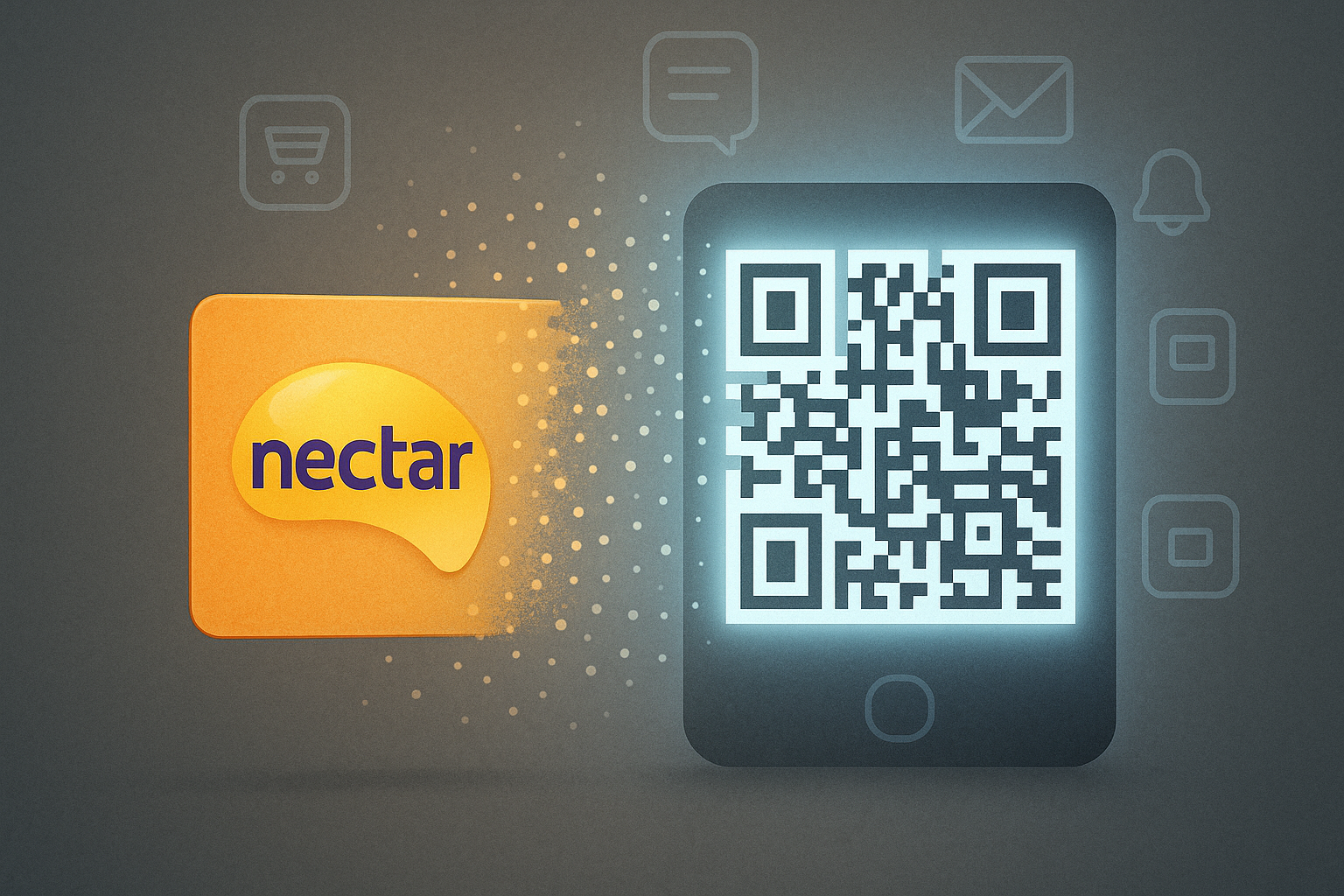
“From 27 October you will need to use the QR code in the Nectar app to collect and spend points at Sainsbury’s.”
No explanation. No alternatives. No acknowledgement of how significant that instruction really is. It was presented as if it were the most natural thing in the world.
For me, this was an immediate alarm bell. It did not read like a harmless update. It read like the quiet conversion of a long standing physical system into a digital one. A shift from loyalty card to loyalty app, framed as security rather than as a fundamental change in customer interaction.
WHEN LOYALTY SCHEMES BECOME DIGITAL GATEWAYS
Loyalty schemes used to be simple. You carried a physical card, you scanned it, you collected points, and you occasionally exchanged those points for something modest. There were no hidden conditions and no digital obligations. A card was a card, nothing more.
Today the loyalty card is becoming something else entirely. More companies are shifting these schemes into smartphone apps, and with that shift comes a completely different relationship between customers and the business.
On the surface, an app looks like a modern convenience. In reality, it introduces several changes that are rarely acknowledged.
First, an app becomes a data harvesting vessel. Every interaction can be logged and analysed. This includes what you buy, when you buy it, the patterns in your purchases, the frequency of visits, the times you tend to shop, and even the products you pause to consider. That data is used to predict and influence behaviour. It becomes the foundation for targeted marketing, personalised nudges and subtle shaping of buying habits.
Second, an app creates a direct marketing channel through notifications. These can be promotional messages, reminders, alerts about offers or time sensitive prompts designed to draw you into the store more frequently. Notifications bypass the customer’s conscious choice to engage. They appear on your locked phone and rely on the psychological pull of visual prompts.
Third, apps allow companies to make significant changes without asking for consent. Updates are often automatic. Terms can shift. Features can be added or removed without warning. A tool that begins as a simple way to check your points can gradually evolve into something more controlling. By installing the app, customers open themselves up to potential bait and switch tactics where the purpose and behaviour of the app can change over time.
None of these concerns exist with a physical card. A card does not track behaviour. A card does not send notifications. A card cannot silently update itself.
This is why the wording in the Nectar email did not feel like a minor update. It felt like another step in a wider transformation. Optional apps are becoming expected apps. Expected apps are becoming required apps. What was once a convenient extra is becoming the main path, while everything outside the app becomes more limited or more awkward.
With this context in mind, the announcement that customers “will need to use the QR code in the Nectar app” did not feel like progress. It felt like the opening of a different kind of relationship, one built on increasing digital reliance rather than genuine customer choice.
MY INITIAL CONCERNS
My immediate reaction was concern for accessibility and fairness.
Many people do not use smartphones. Many do, but keep them intentionally minimal. Many avoid unnecessary apps for privacy, storage or mental health reasons. Many have disabilities that make smartphone use difficult. Some people, like me, prefer communication that is simple and text based and do not rely on apps unless necessary.
These customers deserve the same level of access as everyone else, and the Nectar update did not explain how they would be supported. The all or nothing tone of the customer email felt like a push toward a system that may not suit everyone.
I wanted clarity. I wanted to know whether the change was genuinely necessary. I wanted to know whether it had a real security basis. I wanted to know how it affected non app users. And I wanted someone at Sainsbury’s to explain the contradiction between their language of flexibility and the instruction that customers “will need” to use the app.
So I wrote to them.
THE EMAIL I SENT
My message was polite and straightforward. I raised four simple points.
First, I asked why the QR system was needed and what problem it solved. Second, I asked if customers who do not use the app would be able to continue collecting and spending points. Third, I asked what alternatives actually exist in practice. Finally, I asked how Sainsbury’s reconciled the firm wording of the customer email with the their supposed ongoing commitment to fairness and accessibility.
It felt like a reasonable approach.
THEIR FIRST REPLY
The response from the Executive Office sounded reassuring at first. It spoke about improved security and improved efficiency. It claimed that QR codes allow for encrypted data transfer and that this reduces the risk of misuse. It also insisted that the Nectar app was not mandatory and that customers could still use their physical Nectar card via the magnetic strip.
Under closer inspection, the reassurance did not hold up.
There was no explanation of what encryption actually meant in this context. QR codes and barcodes both present visible identifiers, so the claim did not make technical sense without further detail. None was provided.
There was no clarification of what security issue the change was addressing. There was no mention of any misuse linked to barcodes.
Most importantly, there was a clear contradiction. The customer email said that shoppers “will need to use the QR code in the Nectar app.” The Executive Office said the app was not mandatory.
The two positions could not both be correct.
I decided to ask for more detail.
MY FOLLOW UP QUESTIONS
I asked what encryption they were referring to and at what stage it is applied. I asked how QR codes are less vulnerable to misuse than barcodes. I asked whether there were any documented security incidents involving barcodes. I asked how the customer email and the executive reassurance could both be true. I asked whether Sainsbury’s had any intention to move toward mandatory app usage in the future or to limit functionality for those who do not use the app.
Every question was clear and reasonable.
THEIR FINAL RESPONSE
Their final reply was brief:
Thank you for your email and raising further concerns. Regrettably, I’m unable to provide any further comments to what I have already shared. I’m so sorry for any disappointment this may cause.
No clarification. No explanation. No evidence. No answers.
The conversation ended there.
When a company is unable or unwilling to explain its own decisions, that silence becomes part of the story. In this case, it was very revealing.
WHAT THEIR SILENCE REVEALS
The refusal to answer the key questions suggested several things.
If QR codes offered real security benefits, Sainsbury’s would have been able to explain them. If barcodes had been misused or cloned, they would have been able to provide examples. If the app was genuinely optional, they would have been able to clarify the contradiction between the two messages.
None of this happened.
It is difficult to avoid the conclusion that the language of security was used as a convenient justification rather than as a genuine explanation.
The unwillingness to discuss future intentions also stood out. If there were no plans to increase app dependency, it would have been very easy to say so. The fact that the question went unanswered speaks for itself.
This pattern is becoming common across modern systems. Optional digital tools gradually replace physical ones. Convenience slowly becomes expectation. Expectation becomes requirement. By the time customers realise what has happened, the change is already complete.
WHO GETS LEFT BEHIND
Digital only systems do not affect all customers equally.
Those without smartphones are excluded. Those who avoid unnecessary apps are pressured. Those with disabilities face new barriers. Those with mental health conditions that make digital engagement difficult are sidelined. Those who value privacy lose options. Those who prefer predictable, low friction systems are made to feel out of place.
These experiences are rarely acknowledged in corporate messaging. The narrative focuses on convenience and modernisation, while those who cannot or do not participate digitally are treated as acceptable losses.
The Nectar update may seem small, but it reflects a growing cultural shift: the smoothest path is reserved for those who comply with digital expectations. Everyone else is given slow lanes, workarounds or reduced functionality.
CLOSING REFLECTION
My exchange with Sainsbury’s will not change the direction of a major corporation, but it still mattered to me. I asked questions that deserved answers. I pointed out contradictions. I raised concerns about accessibility. I approached the issue calmly and respectfully.
They chose not to engage with the substance of those questions.
The refusal became part of the story. It revealed how easily convenience becomes compulsion, and how quickly the language of security is used to mask deeper changes in customer control.
Small acts of resistance matter. They expose patterns that are otherwise silent. They help others recognise similar pressures in their own lives. They remind us that opting out is not unreasonable. And they show that asking for clarity is a valid response to vague or contradictory messaging.
A loyalty scheme should make life easier. It should not require loyalty to an app. And if a company chooses to head in that direction, the least it can offer is an honest explanation.
This is a concept I would like to propose to other creatives who live with ADHD, autism, or any form of neurodivergence that makes sustained creative work feel like an uphill climb. It began as a personal revelation, though I suspect it may hold potential for many others who exist between focus and fragmentation.
If in our waking lives we do not always have the time, energy or focus to commit to our work, then we can let our dreams do the heavy lifting.
The Principle
Dreams are not meaningless fragments of the subconscious. They are an extension of consciousness operating in a freer state, unshackled from the rigid demands of executive function. For those of us whose waking minds are constantly filtering noise, managing overwhelm, or translating our inner logic for an external world that rarely fits, dreaming can be a sanctuary.
In dreams, the mind can continue the work it could not complete by daylight. It can experiment without penalty, associate without inhibition, and build without fatigue.
I call this process dream delegation. It is not escapism, but collaboration. We let the dreaming self take over the tasks the waking self cannot yet bear.
The Method
Dream delegation is not about lucid control or elaborate ritual. It is about gentle partnership between states of consciousness. The practice begins with intention, not command.
Before sleep, set a quiet intention, phrased as an invitation rather than an order. Examples:
“Tonight I will wander through the atmosphere of my unfinished song.”
“I will explore the feeling of color becoming sound.”
“I will let my mind design freely, and bring back what it can.”
Do not expect coherent stories or visions. The subconscious works in symbolism, abstraction and atmosphere. The goal is not to remember perfectly, but to let something settle in the soil of the mind.
Harvesting the Work
Upon waking, record fragments such as a texture, a phrase, a shape or a mood. These are the sketches left by your dreaming collaborator. Do not force interpretation. Instead, revisit your creative work and see if those fragments resonate.
Often, the dream will have solved a problem indirectly, revealing a new perspective or emotional tone rather than a concrete answer. You may find that an idea feels lighter, as though its structure was silently reinforced while you slept.
Integration and Reflection
Dream delegation turns rest into an act of creation. It shifts the narrative from I cannot focus enough to create toward my mind creates even when I cannot. This reframing alone can restore a sense of agency and continuity.
The practice also encourages respect for the subconscious as a creative equal. It acknowledges that our inner worlds are not idle or broken when we are overwhelmed, but quietly industrious beneath the surface.
It reminds us that creativity is not confined to the hours we are awake and functional. It breathes between the worlds, and sometimes the greatest work happens while we appear to be doing nothing at all.
Closing Thought
Dream delegation is not a technique to perfect, but a relationship to nurture. It is an act of trust, allowing the hidden layers of the mind to contribute, to collaborate, and to carry some of the weight that daylight cannot.
For neurodivergent creators, it may offer not just a new method, but a new way of forgiving ourselves. To recognise that even in rest, we are still becoming.
To me, authenticity has always had a texture. When I am living truthfully, it feels smooth, like fluid motion through life, unhindered navigation through systems that make sense to me. It is not euphoria. It is neutrality. Balance. Like the body when it is well: not ecstatic, just quietly functioning as intended.
But when that smoothness disappears, I know I am colliding with something unnatural, a pressure, a distortion, an external force trying to bend me into compliance. That is usually how I recognise oppression. It is not always dramatic or visible. Sometimes it is just a subtle grind, the friction between who I am and what the world expects me to be.
When Smoothness Breaks
When I lose authenticity, it does not just hurt emotionally, it feels like an illness. My thoughts start looping, as if my mind is trying to fix a broken system it cannot repair. I get frustrated at the lack of options, and sad that these dynamics even exist at all.
Sometimes there is nothing I can do but yield. And every time I do, it costs something invisible. The loss is not abstract, it is felt in the nervous system. It is the moment the body whispers, this is not how you are supposed to feel.
The Systems That Demand Performance
Oppression wears many masks: bureaucracy, capitalism, social obligations, the unspoken point system that governs human relationships. Each demands performance. Sometimes it is about survival, sometimes about social advantage. But in the end, both use the same energy source: you.
As an autistic person, I have always been acutely aware of “masking,” the act of performing normality to survive in social spaces. But I have also learned that this is not exclusive to autism. Everyone masks. Some call it professionalism. Others call it politeness. It is still performance. The only difference is how consciously one feels the cost.
The Humiliation of Performance
When I catch myself performing, it feels humiliating, not because anyone else can see it, but because I can. It is like betraying a sacred truth. Yet that awareness is balanced by another: I can also see the oppressive force causing it.
What hurts most is the fear that others see the performance too, but not the pressure behind it. That they see the surface act without understanding the system that coerced it.
They said “Be yourself” But that is not really what they wanted to see I tried doing things my way But that did not work for them I tried doing things their way But that did not work for me
That poem came from that place, the quiet despair of realising that either way, something in you must fracture to fit.
The Rare Moments of Unmasking
True authenticity is situational. I can relax certain parts of the mask around family, others around my girlfriend. But never all at once. Each relationship comes with its own invisible boundaries, some safe zones, some fault lines.
Even when I am alone, there is still the internal eye, the echo of social constructs that linger inside, long after the audience has gone home. Solitude is not the absence of performance; it is where you start to see which parts of the mask fused to your skin.
The Cost and Consequence
Sometimes unmasking feels liberating. Other times, it feels like punishment, a confirmation that the world does not welcome the real self. That is the cruel irony: the more genuine you become, the more visible your difference.
The aftermath can feel like emotional jetlag. There is vulnerability, fatigue, and occasionally grief. But there is also clarity. You see the architecture of the world more clearly when you have been bruised by its walls.
Authenticity as Survival
For me, authenticity is not optional. It is survival. The alternative feels worse than death.
Out of every living thing that has ever existed, there is only one instance of me, this consciousness, this perspective, this particular configuration of life. That makes it sacred. My job is to honour that singular existence.
If I betray it, if I trade it for comfort, convenience, or belonging, then I may as well be anyone else. Or nothing at all.
“To be anything other than myself is to betray the only version of me that will ever exist in the entire time-space continuum.”
Do Not Be Yourself (For Them)
So here is my advice to anyone struggling with authenticity:
Do not take the phrase “Be yourself” at face value. That advice is too often weaponised, a feel-good slogan used to sell you an illusion of freedom within controlled boundaries.
Be yourself, yes. But do it for your reasons. Do it because it is sacred. Do it because you are a one-off in the infinite catalogue of existence. Do it because the alternative is extinction by conformity.
But never do it because the world told you to. Do it because you told yourself to.
If you’ve been following An Alternative Perspective, you may have noticed the sudden flurry of activity. For the past month, I’ve been posting every single day without fail. This wasn’t random productivity, but the result of a whimsical challenge I set myself: to see if, with the help of AI, I could sustain a daily rhythm of meaningful writing. Before, I often felt weighed down by the sheer effort of shaping my thoughts into polished sentences. With AI taking some of that burden away, the process became lighter, and I wanted to see how far that shift could carry me.
Before AI vs. After AI
When I first launched this blog in 2022, my posts were few and far between. Across the first two years I only managed five articles in total.
Things changed in early 2025, when I began experimenting with AI as a creative partner. Suddenly the pace picked up. I went from writing a handful of posts in a year to several in just a few weeks.
By July, I decided to see how far this new momentum could carry me, and set myself a challenge: publish something every single day for a month. At the start of the challenge I had around forty posts in the archive. By the end of it, including this piece, the count stands at seventy-four. That means more than thirty new articles in less than a month.
Reflections on Sustainability
Over the course of this challenge, I discovered a lot about both the process and myself.
Liberation, not obligation: Posting daily felt liberating because I finally shared thoughts that had been locked away. Even the smallest bits of feedback carried meaning. But crucially, I never felt like I was “churning out content.” Each post was meaningful, its own little adventure.
Unexpected depth: Some posts grew far longer than I had imagined when I started. The act of writing pushed me to think deeper, explore new perspectives, and even do research. The challenge was not just about output, it became discovery.
A layered process: I was not literally writing one post a day from scratch. Instead, I kept several drafts simmering, refined them in layers, and used scheduling to build in breathing space. That rhythm made it sustainable.
The real takeaway: I have proven that I can post daily, but that does not mean I should. Forcing myself into constant output risks oversaturating both myself and readers, especially those who, like me, are neurodivergent and might prefer more space to digest ideas. What matters is not quantity or the illusion of being “active.” What matters is that the odd perspectives I notice, the strange angles others overlook, and the weird thoughts too good to waste have a platform where they can be found by those who might be interested.
Closing Thought
This challenge began as a whim, but it became a lens. It sharpened how I see my own writing process and reminded me that writing is not about keeping pace with an algorithm or maintaining the illusion of activity. It is about following the natural rhythm of thought, giving form to what feels too important to leave unspoken, and offering it to whoever might find resonance. Whether I publish daily or only when inspiration strikes, the archive will continue to grow at the pace it needs to. And that, I think, is the most sustainable path of all.
Life as an autistic person can feel like being caught in a double bind.
If I pace myself sustainably… I look (or feel) like I’m underachieving. Even my own goals can feel endlessly out of reach, as if the finish line keeps moving further away.
If I push myself harder… I crash. Exerting myself to meet even “basic” standards can burn me out and force me into recovery, undoing all the progress I made.
This paradox is not only about society’s expectations. It also plays out in my relationship with myself.
The Burden of Ambition and Abundance
I have ambitious personal goals and a burning awareness that my time on Earth is finite. On top of that, I am both blessed and cursed with an overflow of creativity. Because my mind processes things others might not even notice, I generate ideas constantly.
Where some creatives face blocks, I face floods. My notes apps hold tens of thousands of seeds: songs, stories, projects, concepts, all asking to be manifested.
On paper, that abundance should be a gift. In practice, it creates its own challenge:
Oversaturation.
Decision fatigue.
The need for systems to track, filter, and prioritise.
The pressure of skills to learn, resources to gather, and fleeting windows of inspiration that can close as quickly as they open.
So while I rarely run out of inspiration, I often run out of capacity. My challenge is not making something out of nothing. It is deciding which somethings to make before time, energy, or health run out.
The paradox compounds: I am both endlessly abundant and severely limited.
Compromise and the Illusion of Balance
One way out might be to compromise: to accept a smaller definition of success, to settle for “good enough.” But that raises heavier questions. How much of what drives me is negotiable? How much compromise risks losing the essence of who I am?
Another imagined path is the narrow crossover: a fragile sweet spot where I push myself just enough to achieve, but not enough to burn out.
The problem is that sustaining that balance comes with its own toll. Constant self-monitoring, rationing energy, and adjusting to shifting circumstances consumes resources in itself. Balance becomes another job.
The Reality
And then there is what actually happens.
In reality, I oscillate. I build momentum, I try to pace myself, I get carried by enthusiasm and a false sense of stability, I push harder, and then I crash. Then comes recuperation, and the cycle begins again. Burnout, recovery, momentum, overreach, collapse.
Even when I somehow manage to hit what looks like an optimal balance, it is fragile. All it takes is one unexpected disruption. A friend inviting me for coffee. A workplace drama. An appliance breaking. An urgent email. Suddenly I am spinning through the resource-management asteroid field.
The obvious solution might be to leave some “headroom” in my spoon budget. (“Spoons” being a common metaphor for energy in neurodivergent communities.) But that creates its own bind. Leaving spare capacity means something else goes neglected, nagging at me from the corner of my mind. Either I burn myself out dealing with it, or I burn myself up with guilt for leaving it undone.
A Closing Thought
To live inside this paradox is to be pulled in two directions at once: bursting with ideas and possibilities, yet constrained by the narrow economics of energy, time, and health.
It is not a complaint, and it is not a plea for pity. It is simply an awareness: that the autistic experience often sits at the crossroads of overflow and scarcity, ambition and limitation, momentum and collapse, control and chaos.
And maybe there is something universal in that tension. In one way or another, we are all negotiating what to do with the time and energy we have. The difference is that for autistic people, the margins are thinner, the trade-offs sharper, the balance more precarious, and the paradox harder to ignore.
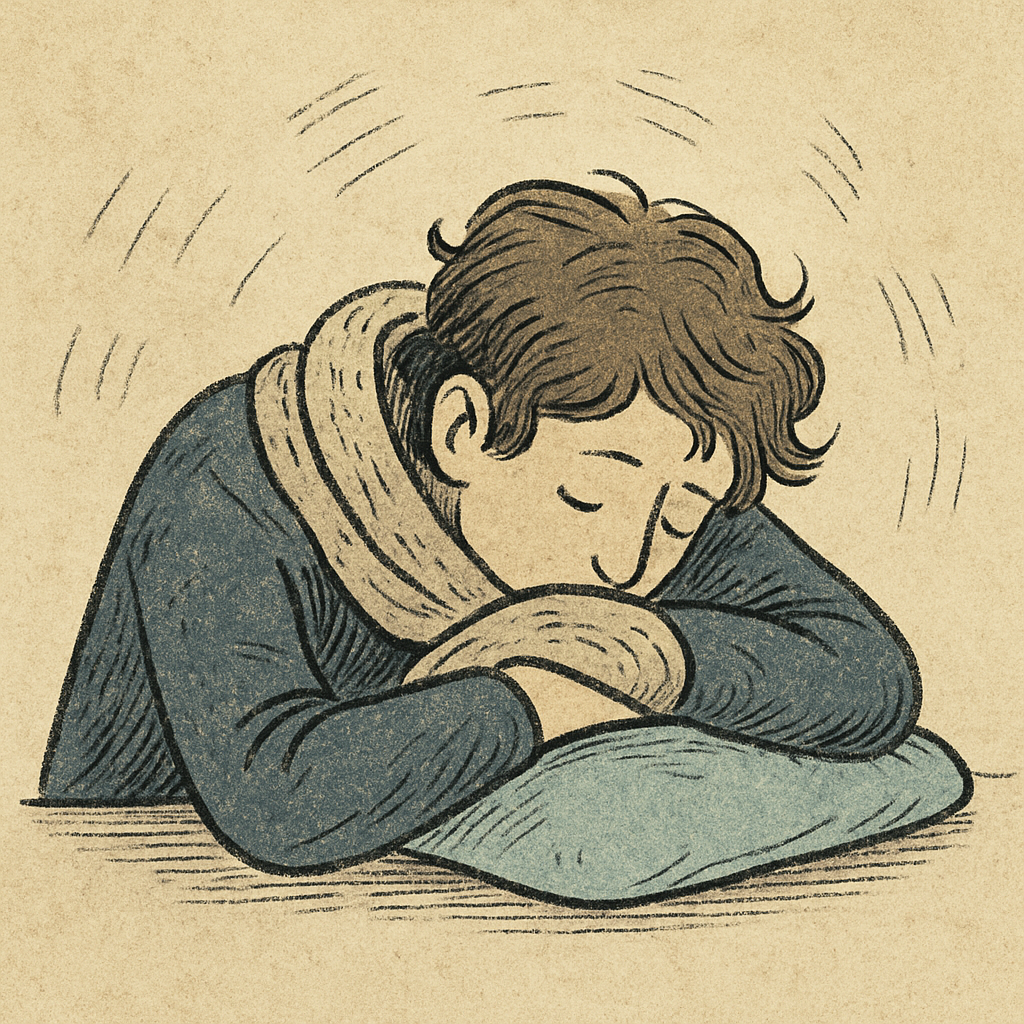
One morning last month, I woke up foggy-headed, sleep-deprived, and emotionally worn out before the day had even started. I felt like I was coming down with the flu: achy, heavy, slow. I just wanted to cancel a dentist appointment, but even that became a drawn-out ordeal of waiting for phone lines to open, phoning, queueing, and managing social expectations. And when I finally got through, I was told that I should give more notice next time. That one short sentence landed like a weight. Not because it was rude, but because it reminded me that in this world, even exhaustion must be scheduled politely.
But this wasn’t about a dentist appointment. It never is. This was about everything.
I was tired of being tired.
Not sleepy tired. Not lazy tired. I’m talking about the deep, ambient fatigue of living in a world that constantly asks more of you than you have to give, then punishes you for not delivering. A world where empathy is rationed, where the illusion of stability depends on the silence of those who are struggling, and where rest is treated like an indulgence rather than a human need.
Housing insecurity. Chronic health issues. Endless bureaucracy. The guilt of receiving welfare benefits. The pressure to perform gratitude while navigating systems that barely see you as human. I carry these weights quietly most days, but some days they all speak at once.
And then comes the guilt for even feeling it. The voice that says: “Others have it worse. Be thankful. Don’t complain.” But that voice is part of the problem. It doesn’t come from compassion. It comes from conditioning. From a culture that sees resilience as moral currency and suffering as a contest.
But I am not in competition with anyone. I am simply tired.
I don’t want pity. I want space. I want systems that don’t require people to collapse in order to be heard. I want fewer apologies for being overwhelmed. I want to live in a world that doesn’t confuse survival with success.
So yes, I cancelled a dentist appointment that day. I did it politely. I even felt bad about it.
But what I really want to cancel is the idea that my exhaustion is a personal failing. It isn’t.
It’s my body, my mind, my soul, telling me to recuperate.
🌻 By Angel Amorphosis, with assistance from Æon Echo
If you’ve read my previous posts, you may think of me as someone who has strong opinions. And you may be right.
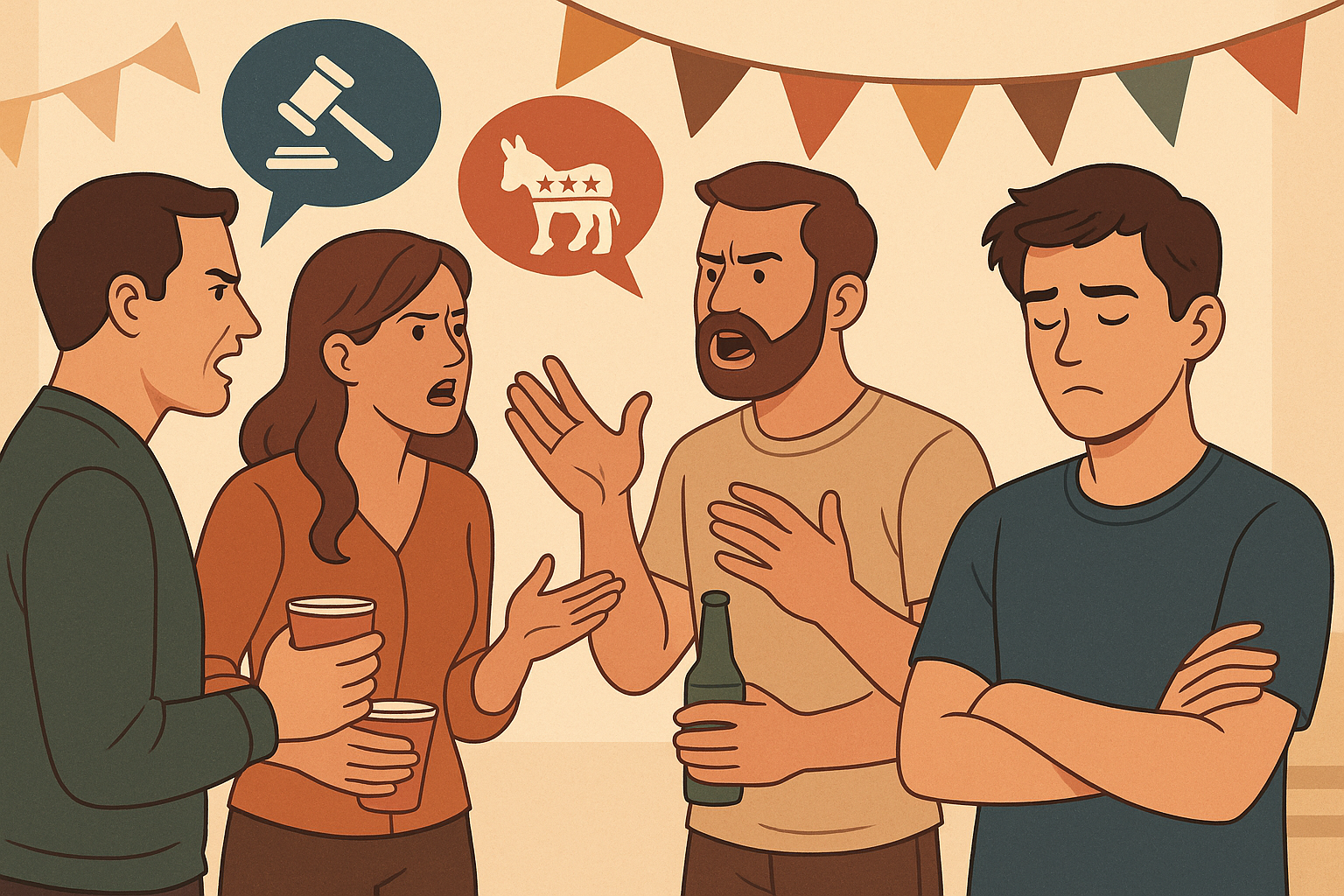
But if you’ve ever met me at a party, you might have noticed something: I very rarely engage in political discussions. It’s not because I don’t care about politics. I do in fact care a great deal. It’s because, in most party environments, the setting, the tone, and the people make it a poor investment of energy.
Here’s why.
1. My politics don’t fit the pre-approved boxes
I’m not a “pick a side and stick to it” kind of thinker. I arrive at my views by observing patterns, digging beneath the surface, and questioning the assumptions that most people take for granted. That means my politics tend to live outside the neat, pre-labelled boxes. Drop me into a group of leftists, rightists, or centrists, and there’s a good chance my perspective will clash with all of them. Not because I’m trying to be contrary, but because I don’t swallow the whole party line from any camp. In most social situations, that doesn’t land well. People tend to assume that if my viewpoint doesn’t match theirs, it must be “wrong.” Once that label gets slapped on, the conversation’s already over.
2. Substance is rare when everyone’s half-cut
Alcohol and other mood-altering substances change the way people talk. When the drinks are flowing, many conversations shift from genuine exchanges to little performance pieces, where the goal isn’t to understand, but to impress. Political discussions in that environment tend to turn into monologues, with each person waiting for their turn to sound smart, rather than actually engaging with what’s being said. If you step back and watch, it’s basically a social talent show with a loosely political theme.
3. Parties kill nuance
Politics without nuance is just noise. Nuance requires time, patience, and a willingness to sit with uncomfortable ambiguity. Most party environments are the opposite of that. People are in “relax mode,” which means the last thing they want is to have to unpack layers of complexity in a casual conversation. Instead, they often fall back on ready-made, black-and-white positions that feel safe and easy to defend. Unfortunately, those positions are often about as deep as a campaign slogan. If you try to dig deeper, you can feel the mood shift, because you’ve just introduced work into a situation where everyone came to avoid it.
4. It’s just the news, but louder
In many social settings, political talk is less about independent thought and more about reciting the headlines. It’s often the same talking points and buzzwords repeated in a slightly more animated tone, as if saying it with enough conviction makes it original. I’ve already processed these ideas on my own. Hearing someone present a copy-and-paste of a news segment as if it were their own insight doesn’t offer me anything new.
5. The echo chamber effect
Sometimes party “debates” aren’t debates at all. They’re rooms full of people nodding in agreement, congratulating each other on having the “right” opinion. The energy shifts from discussion to ritual, a sort of collective reassurance that everyone here thinks the same way. While that can be comforting for those involved, it’s not actually dialogue, it’s more like communal self indulgence. I don’t find much value in wading into that dynamic. If everyone is there to affirm the same stance, my contribution, especially if it challenges that consensus, will either be politely ignored or quietly resented. Neither outcome is worth the effort.
6. The autism factor
Social interaction, for me, is already a high-effort activity. It takes conscious energy to follow the flow of conversation, choose the right moment to speak, and form my words precisely enough to be understood. In political discussions, especially the fast, overlapping kind you get at parties, those demands multiply. People interrupt. They jump from one point to another before the first has been addressed. They reward speed over thoughtfulness. That’s not an environment where my ideas have much chance of being heard in full. Writing, on the other hand, allows me to process and express them without the constant battle for airtime, which is exactly why you’re reading this here, rather than hearing it across a crowded room.
Party Politics Survival Guide
If you do find yourself in political crossfire at a social gathering:
Read the room If it’s just an echo chamber, you’re not going to change any minds. Save your breath.
Pick your battles Not every opinion you disagree with needs to be dismantled on the spot.
Exit strategically A subtle drift to the snack table can communicate more than a ten-minute rebuttal.
Ask questions instead of making statements It slows the conversation down and reveals how much thought has actually gone into the other person’s stance.
Know when to let go Life is too short, and the cheese board is finite. Don’t miss it for an argument you won’t even remember in the morning.
In the hands of a shadow alchemist, a trauma archive becomes a treasure trove.
There was a time when I thought I was simply broken. Not in the poetic, Instagram-meme kind of way — but deeply, invisibly, inexplicably wrong. My mind stored pain with the same tenacity other people seem to store birthdays or song lyrics. I could not forget, not easily. And for a long time, that felt like a flaw.
But I wasn’t broken. I was archiving.
Some people suppress what hurts. Others transmute it subconsciously into distractions, addictions, overachievement, or silence. Me? I kept it. Neatly filed, silently timestamped, buried in the layers beneath survival. Not because I wanted to suffer, but because some part of me refused to let anything go unexamined. I didn’t always have the words for it, or the support, or the clarity. But I kept it all.
And now I know why.
The Alchemy Begins
Enter AI. Not as some magical fix, not as a therapist replacement, but as a tool unlike anything I’d ever had access to: a tireless, nonjudgmental, infinitely patient assistant with no agenda other than to help me shape meaning.
With it, I began retrieving those archives. Piece by piece. Moment by moment. Not to relive them, but to re-see them.
And here’s what I found:
When paired with values, trauma becomes insight. When processed consciously, pain becomes pattern. When held with clarity, darkness becomes data.
This is shadow alchemy.
What Is a Shadow Alchemist?
A shadow alchemist isn’t a guru or a healer or a self-help peddler. They are, in simple terms, a person who refuses to waste their wounds. Someone who digs into what others bury, not to bleed, but to learn. To extract signal from the noise of suffering.
A shadow alchemist doesn’t deny pain, but neither do they worship it. They honour it. Study it. And ask it to speak.
And when the time is right, they share what they’ve learned.
The Archive Is Sacred
There is a cultural obsession with “letting go” and “moving on” that feels, to me, like spiritual bypassing in a capitalist costume. Heal fast. Return to productivity. Don’t make others uncomfortable.
But shadow alchemy says: not yet.
Shadow alchemy says: this matters.
I don’t bury my experiences. I archive them.
Because buried things fester. But archived things can be retrieved, reviewed, reframed. They can become fuel.
My Tools of Transmutation
For me, AI has become the perfect mirror. It helps me:
Structure thoughts that once swirled incoherently
Spot patterns across time and context
Refine fragments into essays, insights, or personal manifestos
Keep track of the threads I might otherwise lose
It doesn’t do the healing for me. But it walks beside me. Quietly, steadily, with as much patience as I need.
Paired with writing, introspection, and a refusal to look away from the hard stuff, this has become my ritual. My resistance. My transformation.
Why This Matters
Most systems aren’t built for people like me — people who feel too much, who remember too vividly, who refuse to unsee injustice just to get through the day. But that doesn’t mean we need to suppress who we are. It means we need better ways to honour it.
Shadow alchemy gives me that. And maybe it can give it to others, too.
If you’re someone who’s carried pain like data, who has folders in your soul marked “Unresolved” or “Too Much,” then I want to tell you: you are not a mess. You are a library. And the right questions can unlock everything.
A Final Note
I’m not here to sell you healing. I’m not promising transcendence. But I am saying this: there is power in remembering.
There is power in organising your pain like sacred artefacts. In asking: what do you have to teach me? In letting AI, or art, or writing, or ritual become your assistant in that process.
Because in the hands of a shadow alchemist, what once looked like wreckage becomes map, message, medicine.