Humbug! A Late-Stage Capitalism Christmas Carol

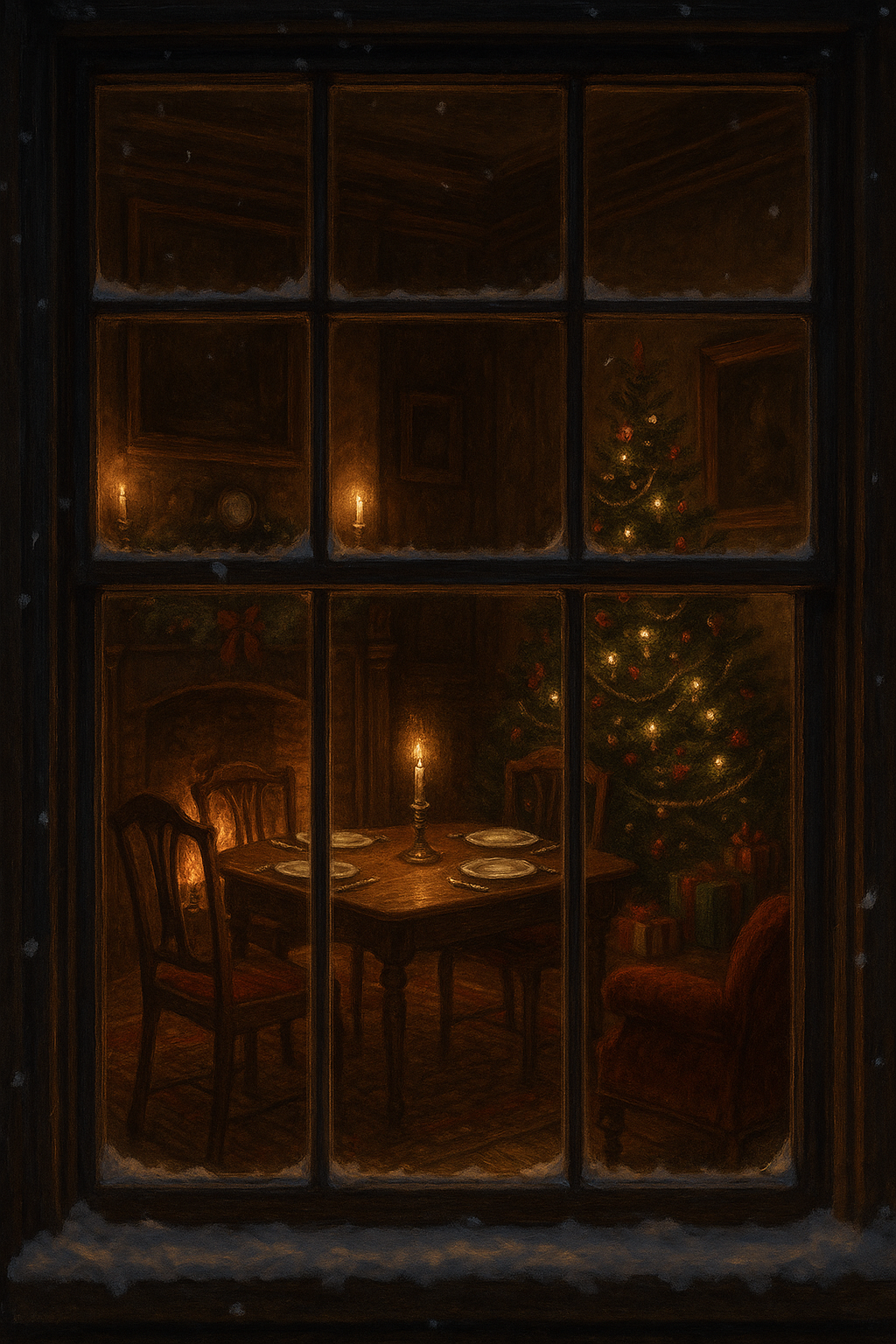
A warmly lit Victorian Christmas interior seen through a frosted window, with a candlelit table and decorated tree prepared for guests who never arrive.

Naming the Uncomfortable Truth

Let’s say the quiet part out loud.

For many people, Christmas no longer feels like a celebration. It feels like an obligation. One that grows heavier every year.

The decorations arrive earlier. The adverts start sooner. The pressure ramps up before the leaves have even finished falling. By the time December actually arrives, many of us are already tired, financially anxious, and emotionally spent. What was once a moment in the year has swollen into a season that refuses to end.

There is a strange guilt attached to admitting this. Disliking Christmas is treated as a personal failing. A lack of gratitude. A moral defect. If you are not visibly excited, if you do not participate enthusiastically, something must be wrong with you. So we smile, we comply, and we privately count the days until it is over.

Christmas now asks for more than it gives. More money. More time. More emotional labour. More performance. More resilience. For those already struggling, it does not arrive as comfort but as an additional weight. And yet it is framed as generosity. As joy. As something you should be thankful for.

This is not because people have become colder or more cynical. It is because the shape of Christmas has changed. What was once a cultural and emotional ritual has been absorbed into a system that does not understand limits. Growth is assumed. Escalation is expected. Stopping is not an option.

This article is not an attack on joy, tradition, or celebration. It is an attempt to separate what Christmas was meant to be from what it has been turned into. To name the discomfort honestly, without shame, and to ask a simple question.

If Christmas is supposed to bring warmth, why does it leave so many people exhausted?

It seems to me that what we are all in need of… is a visitation.


The Ghost of Christmas Past

The Ghost of Christmas Past does not arrive with accusations. It arrives with a candle. A quiet light held against the long dark.

It reminds us that Christmas was never meant to be loud.

Long before it became a commercial season, Christmas existed as a winter festival. Across Europe, long before Christianity formalised it, people marked the solstice as a moment of survival. The darkest days had arrived, and more importantly, they had begun to pass. Fires were lit. Food was shared. People gathered together not for spectacle, but for warmth, safety, and reassurance.

When Christianity later absorbed these older traditions, Christmas became a story of humility rather than excess. A child born in a stable. A holy event framed by simplicity, vulnerability, and care. Even for those who were not religious, the symbolism endured. This was a time to slow down, to soften, to recognise one another in the cold.

For much of history, Christmas was shaped by scarcity. In medieval Europe, winter meant hunger, isolation, and risk. A feast was meaningful because it was rare. A gift mattered because it was hard-won. Celebration was not an escape from reality, but a way of enduring it together.

Even as society industrialised, Christmas retained this character for a while. In Victorian Britain, a period that shaped much of what we still recognise today, Christmas was consciously reframed as a family-centred holiday. Charles Dickens’ A Christmas Carol itself was part of this shift, emphasising compassion, generosity, and social responsibility in response to the brutal conditions of industrial capitalism.

Importantly, Victorian Christmas was still modest. Decorations were handmade. Cards were personal. Gifts were small, often practical, sometimes homemade. Time spent together was the centrepiece, not an accessory.

What tied all these eras together was not tradition for tradition’s sake, but proportion. Christmas knew its place in the year. It was a pause, not a takeover. It was special precisely because it did not last forever.

The Ghost of Christmas Past reminds us that Christmas once understood winter. It leaned into it. It offered warmth without excess, celebration without pressure, and meaning without demand.

It knew how to be gentle.


The Ghost of Christmas Present

The Ghost of Christmas Present does not carry a candle. It arrives glowing. Loud. Overstimulating. Wrapped in tinsel and urgency.

This is Christmas as it exists now. Not as a moment, but as a system.

Somewhere along the way, Christmas stopped being a cultural ritual and became an economic event. A fiscal quarter. A growth target. The season now begins not when winter sets in, but when retailers decide it should. September becomes acceptable. October becomes normal. By November, refusal feels almost antisocial.

This did not happen overnight.

In the early twentieth century, mass production began to reshape Christmas. Department stores expanded gift-buying beyond necessity, turning abundance into aspiration. The rise of advertising reframed Christmas not as something you prepared for, but something you were sold.

Post-war consumerism accelerated the shift. The 1950s brought prosperity narratives, suburban ideals, and the modern image of the perfect family Christmas. Gifts multiplied. Expectations rose. Television beamed a single, glossy version of Christmas into millions of homes, quietly standardising what joy was supposed to look like.

By the late twentieth century, Christmas had fully aligned itself with growth logic. Black Friday crept across the Atlantic. Sales events framed restraint as foolishness. Spending was no longer just encouraged, it was positioned as civic duty. To consume was to participate. To opt out was to disrupt the economy.

Now, in late-stage capitalism, the transformation is complete. Christmas is no longer just commercialised, it is optimised. Algorithms predict our generosity. Loyalty schemes gatekeep affordability. “Limited time” offers manufacture urgency. Even nostalgia is packaged and sold back to us at scale.

This version of Christmas does not understand enough. It only understands more.

More spending. More consumption. More preparation. More performance. More emotional labour. More resilience from people who are already stretched thin. Participation is no longer optional. Opting out is treated as deviance rather than choice.

Generosity has been redefined as purchasing power. Love is measured in receipts. Thoughtfulness is outsourced to algorithms that tell us what we “should” buy for the people we already know best. Even the act of giving has been flattened into logistics.

What makes this particularly cruel is the moral framing. Christmas is still sold as kindness, warmth, and goodwill, even as it routinely produces stress, debt, exhaustion, and quiet resentment. People blame themselves for failing to enjoy it properly, rather than questioning the conditions imposed upon them.

The labour behind Christmas is unevenly distributed. Someone plans. Someone shops. Someone budgets. Someone cooks. Someone hosts. Someone absorbs the emotional fallout. This work is rarely named, rarely shared equally, and rarely acknowledged, yet it is treated as the price of admission.

And then there is the noise. Visual noise. Emotional noise. Advertising noise. A constant insistence that joy is urgent, happiness is compulsory, and dissatisfaction is a personal flaw. There is little space for grief, fatigue, neurodivergence, poverty, or simply wanting quiet.

This is Christmas as late-stage capitalism demands it. A tradition hollowed out and repurposed as an extraction engine. Not because people asked for it, but because the system rewards escalation and punishes restraint.

The Ghost of Christmas Present does not ask how we are feeling.
It assumes we will cope.
And it does not care when we don’t.


The Ghost of Christmas Yet to Come

The Ghost of Christmas Yet to Come does not speak.
It does not need to.

It shows us a future that is not imagined, only extended.

If nothing changes, Christmas does not collapse. It expands.

The season begins earlier each year, not because people want it to, but because growth demands it. What was once a few weeks becomes a quarter of the calendar. What was once anticipation becomes exhaustion before December has even arrived. Refusal becomes increasingly difficult, not through force, but through inconvenience and social pressure.

Access to affordability narrows. Discounts are no longer public. They are conditional. Loyalty schemes, apps, subscriptions, and digital profiles determine who gets to participate “properly.” Christmas becomes tiered. Those without the right accounts, the right data trail, the right compliance, pay more. Those who cannot or will not engage are quietly penalised.

Debt normalises further. Seasonal borrowing is reframed as tradition. Financial stress becomes background noise. People enter January not just tired, but already behind. The cycle resets and accelerates.

Environmental damage continues, not dramatically, but steadily. Decorations designed to last a season. Novelty gifts designed to be discarded. Packaging engineered for convenience rather than endurance. Waste becomes an accepted by-product of celebration, and responsibility is pushed onto individuals rather than systems.

Emotionally, the space contracts.

There is less room for grief. Less room for difference. Less room for opting out. Christmas becomes increasingly performative, increasingly visible, increasingly surveilled. Participation is measured. Displays of joy are documented. Absence is noticed.

What was once a pause becomes a test.

This future does not arrive through force or spectacle.
It arrives through convenience.

It arrives through updates, new terms and conditions, cheerful notifications, and subtle penalties for those who do not engage correctly. It arrives gently enough that resistance feels awkward rather than urgent. Opting out becomes friction. Compliance becomes the path of least resistance.

And perhaps most devastatingly, it arrives wrapped in familiarity. The same songs. The same imagery. The same language of warmth and goodwill. Only hollowed out further each year, until what remains is ritual without refuge.

The Ghost of Christmas Yet to Come shows us this not to frighten us, but to remove our ability to pretend we did not see it coming.

Because deep down, we already have.


A Late-Stage Capitalism Redemption

The purpose of seeing the future is not to surrender to it.

It is to remember that trajectories are not destinies.

Christmas does not need to be abolished, rescued, or reinvented from scratch. It does not belong to capitalism, even if capitalism has learned how to wear its skin. Beneath the layers of obligation, optimisation, and performance, something older and simpler still exists.

What Christmas needs now is not more effort, but less compliance.

A refusal to escalate. A refusal to compete. A refusal to treat exhaustion as the price of belonging.

A post-capitalist Christmas does not look dramatic. It looks smaller. Quieter. Intentionally bounded. It gives explicit permission to step back from traditions that cause stress, debt, or harm. It replaces obligation with consent.

Gifts stop being proof. They become gestures again. Sometimes they are handmade. Sometimes they are second-hand. Sometimes they are experiences, shared meals, long conversations, or time spent together without distraction. Sometimes they are nothing at all, and that is agreed upon in advance.

Generosity is no longer measured in spending, but in care.

Time is treated as a legitimate offering. Presence is valued more than presentation. People are allowed to say no without apology. Neurodivergent needs for quiet, pacing, and predictability are respected. Grief is not treated as an inconvenience to be hidden behind tinsel.

This version of Christmas understands winter.

It accepts darkness without trying to drown it in noise. It recognises that rest is not laziness, and that joy does not need to be loud to be real. It remembers that the point of gathering is not performance, but warmth.

Most importantly, it understands that meaning cannot be mass-produced.

A late-stage capitalism Christmas tells us that if we do not buy correctly, celebrate correctly, and feel correctly, we are failing. A post-capitalist Christmas quietly disagrees. It asks only that we be honest about what we can give, and gentle with ourselves and others when that is not much.

This is not nostalgia. It is discernment.

We do not need to save Christmas from the past or the future.
We only need to stop letting the machine decide what it is for.

And in doing so, we might find that the thing we thought we had lost was never gone at all.
Respect, Not Reverence: Rethinking How We Honour Veterans

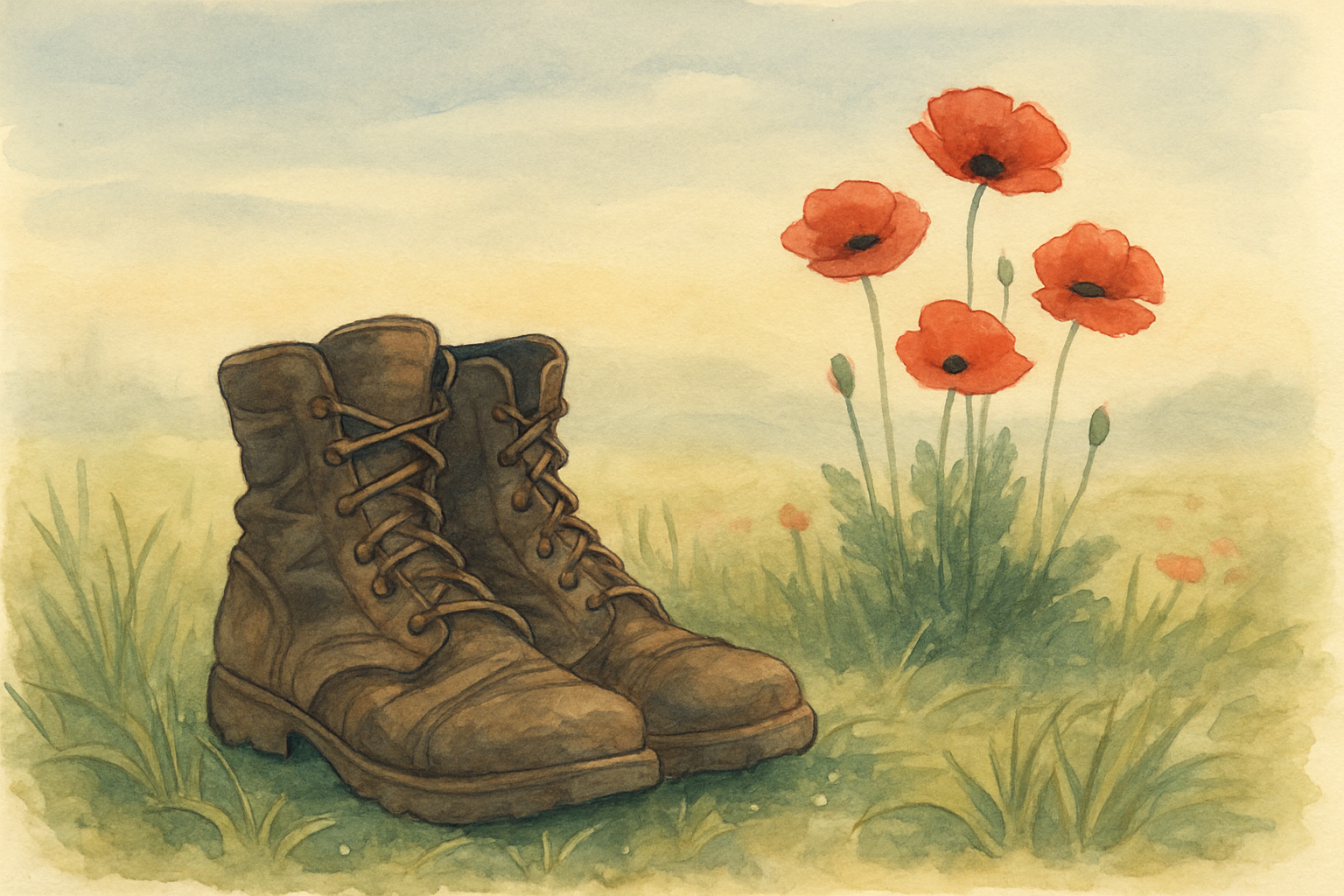
A pair of worn military boots resting in dewy grass at dawn with a few poppies growing in the background.

War veterans occupy a complicated space in the human story. It is a space of courage, trauma, sacrifice, and contradiction. They have faced realities that most people never will, and for that alone, they deserve to be seen. But to truly respect them, we must go deeper than ceremony. Real respect is not a reflex. It is a conscious act that requires honesty.

Why Respect Matters

To have gone to war is to have confronted the extremes of existence. Veterans have risked their lives, endured the unendurable, and often returned home carrying invisible burdens: moral injury, survivor guilt, and memories that do not fade. Many live with physical and psychological scars that will never fully heal.

They remind us of the human cost behind national decisions. They represent duty, resilience, and sacrifice, and the willingness to stand in harm’s way while others sleep in safety. In honoring them, we acknowledge that peace and freedom are not abstractions. They are fragile states maintained by human endurance and loss.

Veterans also serve as witnesses to history. They have seen the best and the worst of humanity. Their insights can help us understand both. Their stories are lessons in courage, unity, and the preciousness of peace. They show that strength can coexist with vulnerability. Healing is itself a form of service.

Why Automatic Reverence Fails

Respect becomes hollow when it is automatic. Blind hero worship risks turning veterans into symbols instead of people. Not every war is just, and not every soldier acts with honor. If respect becomes unconditional, it erases nuance, silences criticism, and supports the very systems that make war seem inevitable.

Unquestioning reverence can be used to manipulate public emotion. It can sanctify violence, sell weapons, and justify new conflicts. True respect requires that we keep our eyes open.

Many veterans themselves reject blind glorification. They know the difference between being thanked and being understood. They want honesty instead of pity and compassion instead of pedestal placing. When we treat them as flawless heroes, we deny them the complexity of being human.

Automatic respect also diminishes others who serve in quieter ways. Nurses, teachers, caregivers, and activists also sustain life, yet receive far less recognition. When society reserves its highest praise only for those who fight, it reveals what it truly values.

Toward a Mature Form of Respect

To respect veterans genuinely is to hold multiple truths at once. Courage can coexist with error. Duty can be exploited. Service can be both noble and tragic.

Genuine respect means listening to veterans’ stories, all of them, including the ones that challenge national myths. It means holding governments accountable for the wars they start and for how they treat the people they send to fight. It means extending compassion not only to our own soldiers, but also to civilians and enemies who were caught in the same machinery of conflict.

True respect is not found in flags or parades. It is found in empathy, accountability, and awareness. It is the willingness to look at war honestly, through the eyes of those who have lived it, and to promise, as best we can, to learn from it.

In the end

To respect veterans is not to sanctify war. It is to remember its human cost.
It is to see those who survived, and those who did not, with clarity rather than mythology.
It is to honor the courage of service while rejecting the worship of violence.

Respect, when thoughtful, becomes an act of peace.

The Price of Play: How Capitalism Hijacked Gaming’s Soul

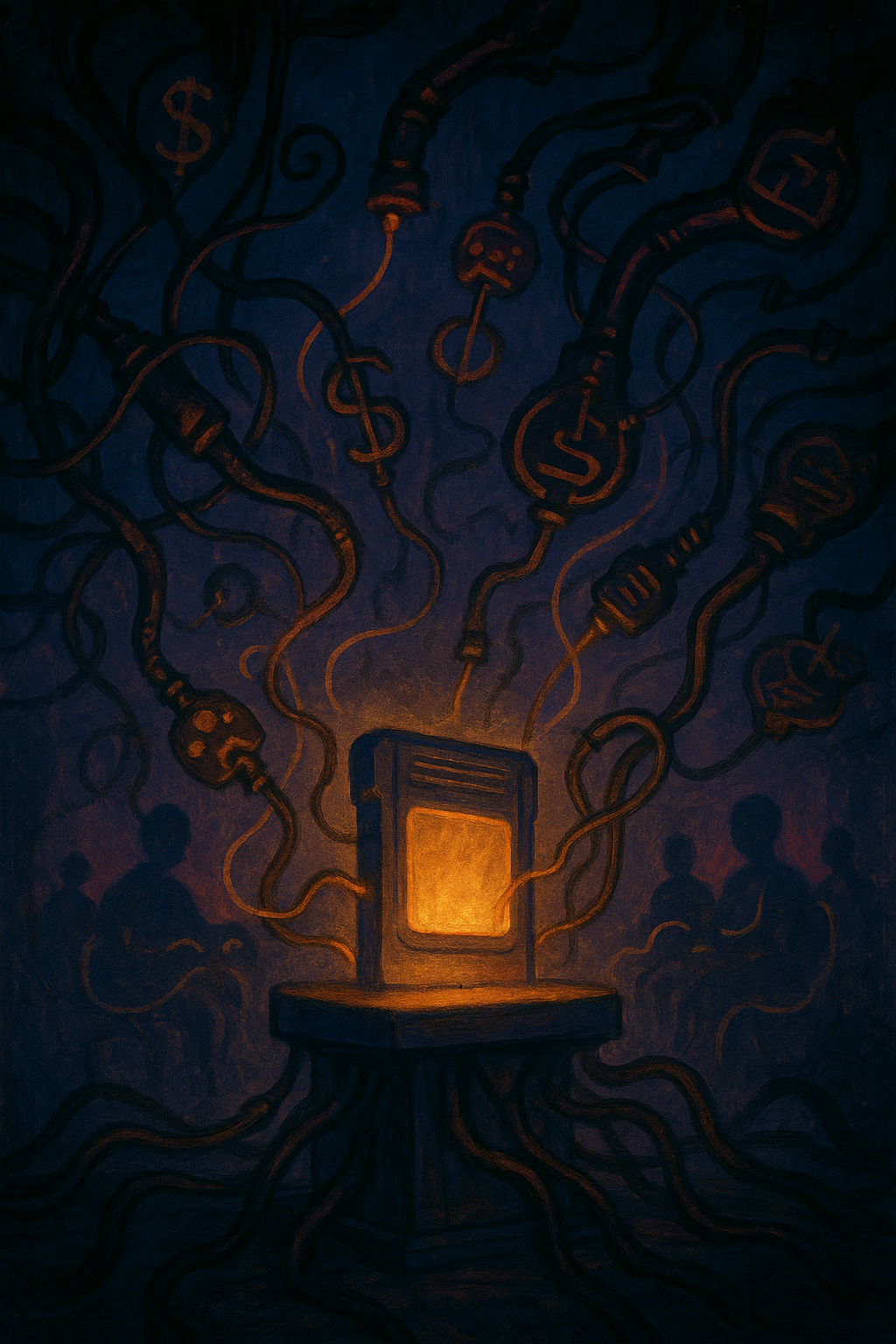
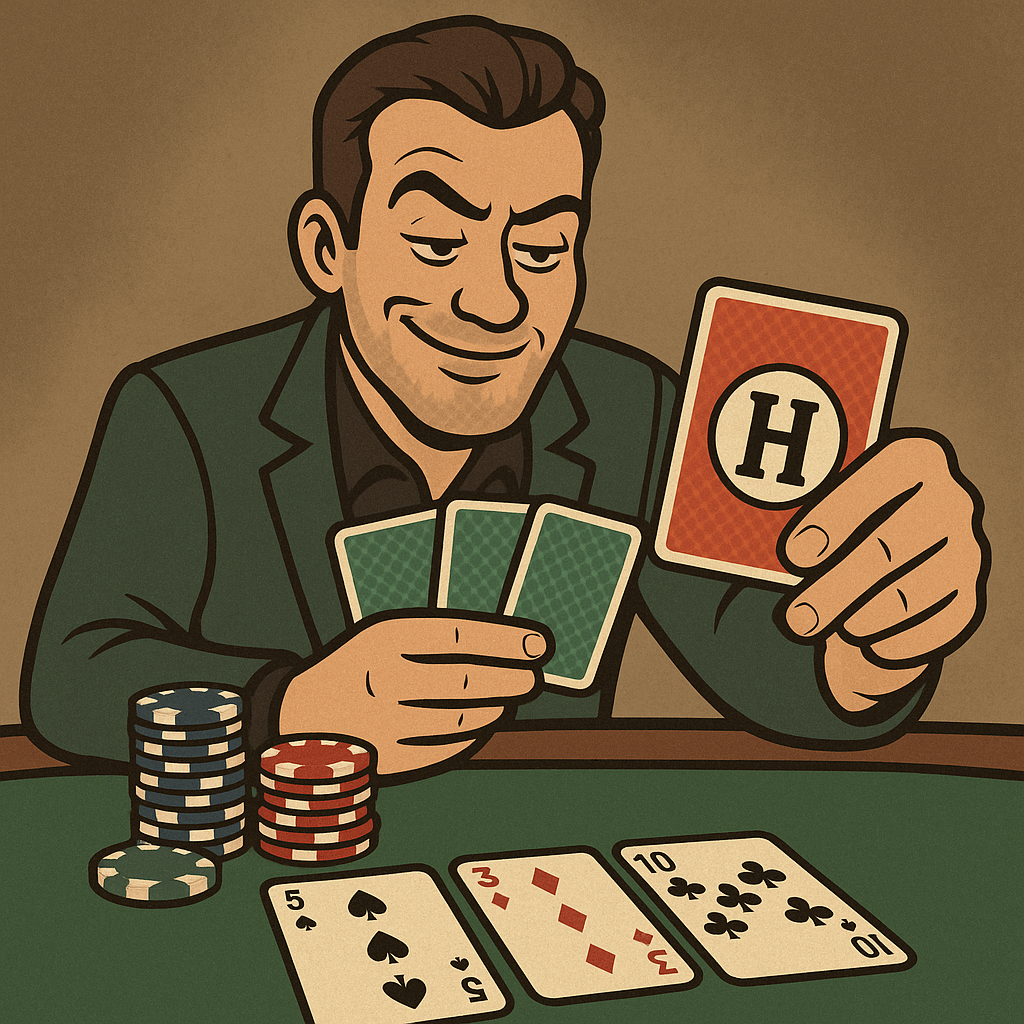
An abstract painting of a glowing old-fashioned game cartridge on a pedestal, surrounded by dark mechanical cables that siphon light from it. The cables form faint dollar symbols and stretch into shadowy figures of players in the distance. The scene glows with melancholy blues and muted golds, symbolising how capitalism drains the soul of gaming while a small core of light still resists.

Once upon a time, a game came in a box, and that box contained everything.
You bought it, you owned it, and you played it. That was the deal.
There were no online check-ins, no missing features, no “coming soon” updates, only a complete world waiting to be explored.

There was a quiet purity in that exchange.
A developer built something they were proud of.
A player paid for it because they trusted that pride.
That was the unspoken pact between creator and audience: a transaction built on honesty.

Games like Super Mario Bros. (1985) and The Legend of Zelda (1986) embodied that purity. A single cartridge held an entire universe. Doom (1993) refined the model through shareware, offering the first episode for free and the rest for purchase. It was transparent, simple, and fair. The product was complete. The deal was clear.


The first cracks in the pact

Then came the era of the expansion pack. At first, it felt generous. Players bought Warcraft II: Beyond the Dark Portal (1996) or Age of Empires: The Rise of Rome (1998) because they wanted more of something they already loved.
These were true expansions, built from creative overflow rather than withheld content.

Diablo II: Lord of Destruction (2001) remains one of the best examples, adding new classes and an entire story act. Yet this was also when the idea of the “complete” game began to fade.

Not maliciously, at first.
But the seed was planted: perhaps a game could be split, extended, resold, and repackaged.


The patch era and the illusion of care

When players first connected online, games began to live beyond the disc or cartridge.
Developers could now release updates and bug fixes directly to players. It seemed like progress.

Quake (1996) pioneered downloadable updates. Half-Life (1998) and Morrowind (2002) made patches a normal part of gaming life. Initially, this felt like a gesture of goodwill. Developers could fix mistakes, refine balance, and reward loyalty.

But convenience soon became a crutch.
By the late 2000s, games were shipping half-finished, depending on “Day One Patches” to make them playable.
Entire studios began treating release as the start of development rather than the end.

Final Fantasy XIV (2010) became a symbol of this shift. Its launch was so disastrous that it had to be destroyed and rebuilt as A Realm Reborn (2013). The resurrection was impressive, but it also marked the death of the finished game. A new age had arrived, one where imperfection was no longer a failure but a business model.


DLC, season passes, and the death of completeness

As the 2000s progressed, expansion packs evolved into downloadable content. What began as a technological innovation quickly became a financial strategy.

When The Elder Scrolls IV: Oblivion (2006) sold its infamous horse armour cosmetic, it became a joke among players but a revelation for publishers.
Suddenly, small additions could generate massive revenue.

Call of Duty 4: Modern Warfare (2007) built an empire on paid map packs. Mass Effect 2 (2010) sold essential story chapters separately, slicing its own narrative for profit.

Then came the season pass, which allowed publishers to monetise the future itself.
You were no longer buying content. You were pre-ordering potential.

Assassin’s Creed III (2012) and Mortal Kombat X (2015) made it normal to pay in advance for unseen expansions.
In Destiny (2014), the model reached full maturity. Content cycled endlessly, and earlier material was quietly retired.

The player was no longer buying a work of art. They were buying a share in an ongoing experiment.


The age of tiered access: standard versus deluxe

Next came the illusion of choice.

Every major release now arrives with multiple editions: Standard, Deluxe, Gold, Ultimate.
The Standard Edition, once the full experience, has become the stripped-down minimum.
The Deluxe Edition rarely offers genuine creative content. It usually grants early access or small digital trinkets instead.

Hogwarts Legacy (2023) gave Deluxe buyers a three-day head start. Starfield (2023) did the same. Call of Duty: Modern Warfare II (2022) tiered its editions so precisely that the system resembled an airline pricing chart.

The tactic is subtle but powerful.
It monetises excitement itself.
It divides players not by passion or skill, but by spending power.

We no longer unlock secrets through play.
We unlock content through payment.
The so-called Deluxe Edition does not make the game better. It simply makes everyone else feel lesser.


The live service era: eternal beta

By the late 2010s, games were no longer seen as products but as platforms.

Destiny (2014) led the charge. GTA Online turned it into an empire. Fortnite perfected it.
The ideal of the complete, single experience was replaced with the promise of constant evolution.

Players were told they were joining a “living world.”
In truth, they were joining an economy.

Every week brought new skins, new currencies, and new reasons to log in.
Games stopped being designed to end. They were designed to sustain.

The player became both the consumer and the unpaid quality tester.
And when the profit dried up, the world simply died.
Anthem (2019) and Marvel’s Avengers (2020) stand as cautionary tales, both collapsing within a few years.

The eternal game is not immortal. It is undead, kept alive not by creativity but by consumption.


Gacha and the monetisation of desire

When endless updates stopped being enough, the industry discovered something even more lucrative: human psychology.

Gacha systems turned the act of wanting into a business.
You no longer bought the content itself, but the hope of obtaining it.

Fate/Grand Order (2015) and Genshin Impact (2020) perfected this model, disguising gambling with beautiful music and artistry. Each pull felt like a small miracle, a spark of dopamine wrapped in digital silk.

Diablo Immortal (2022) pushed the formula to absurdity, with some estimates suggesting it could cost over $100,000 to fully upgrade a single character.
And now Infinity Nikki (2024) walks the same line, visually stunning yet built on the same manipulative architecture.

The slot machine no longer hides in the casino. It lives in your home, wearing a smile.


The counterexamples: those who still honour the pact

Yet not all is lost.
Some creators still believe in the original exchange between maker and player.

Hollow Knight (2017), Celeste (2018), Stardew Valley (2016), Undertale (2015), Hades (2020), and Disco Elysium (2019) all prove that integrity still sells.

These games are complete works, designed to be finished and remembered.
They ask for your time, not your loyalty.
They offer experiences that stay with you long after the credits roll.

You pay once.
You play forever.
That is what honesty looks like.


The real freedom

Paying upfront is not a barrier. It is a declaration of honesty.
When I buy a game, I am saying: I value your art.
When the developer accepts that, they are saying: I value your trust.

That exchange is the foundation of real freedom.
Because true freedom in gaming is not the ability to start for free.
It is the ability to finish without being owned.

Games once invited us to play.
Now they beg us to stay.
I miss when the only thing a game wanted from me was my time.

From Announcement to Manipulation: The Evolution of Advertising

A sepia-toned illustration of a town crier ringing a bell that emits hypnotic spirals, symbolising how early advertising evolved from public announcements into psychological influence.

I grew up in the 1980s, when television advertising still had a kind of charm. I remember the jingles, the mascots, the catchy slogans that managed to lodge themselves in your head for weeks. Even as a child, I knew they were trying to sell me something, but at least they did it with some flair. They felt like part of the entertainment itself.

Something has changed since then. Advertising is no longer something that interrupts culture; it has become the culture. Every space, every platform, and every idle moment now feels colonised by a hidden intention to sell. To understand how we arrived here, it is worth tracing how advertising has evolved from a loud street-side performance to an invisible system of persuasion that shapes our sense of self.

The Loud Salesmen

The earliest form of advertising was brutally honest. Ancient merchants shouted in markets, painted signs on walls, or hung banners above their stalls. When mass printing emerged in the 1800s, advertising became more widespread but no less direct. Newspapers were filled with promises of miracle tonics, soap that made you beautiful, and pills that cured everything from toothache to heartbreak. These were primitive, manipulative, and often fraudulent, but at least you knew what you were looking at. Someone was selling, and you were free to walk away.

The Mad Men Era

The 20th century transformed advertising into an art form. With the rise of radio and television, storytelling became the new language of persuasion. Campaigns no longer sold only a product; they sold an identity, a dream, a way of life. The Coca-Cola Santa Claus, the Marlboro Man, and the perfect suburban family all came from the same creative laboratories.

This was the era of the “ad man,” immortalised in cultural artefacts like Bewitched or later Mad Men. Advertising was portrayed as a glamorous profession. These were the people who didn’t just reflect society; they helped build it. The line between commerce and culture began to blur.

The 80s and 90s: Ads as Entertainment

By the 1980s and 1990s, advertising had taken on a theatrical quality. It was playful, colourful, and memorable. Mascots like Tony the Tiger, slogans like “Just Do It,” and tunes you could hum all day made adverts feel like short pieces of performance art. They were still manipulative, of course, but they wore their intentions openly.

Looking back, perhaps this is why many people from my generation recall old ads with a strange fondness. They were transparent. They worked hard to win your attention rather than simply steal it.

The Weird and Annoying Years

Somewhere in the late 1990s and early 2000s, advertising lost its balance. It became surreal, loud, and deliberately irritating. Think of Crazy Frog, the Budweiser frogs, or the unnerving Burger King mascot. Annoyance became a marketing tool. If something got stuck in your head, even out of frustration, the job was done.

This was the period when “going viral” became a goal before social media even existed. The absurdity was the message.

The Internet Disruption

When the internet arrived, advertising was clumsy but eager. Early banner ads were brightly coloured, flashing boxes that you could easily ignore. But the industry adapted quickly. As data collection improved, advertising became personal. It stopped shouting to the crowd and began whispering to the individual.

This marked the rise of surveillance capitalism. Every click, search, and pause became a data point. You were no longer a passive audience member; you were a psychological profile to be targeted. The salesman had followed you home and was now reading your mind.

The Age of Disguise

By the 2010s, advertising learned to hide in plain sight. Sponsored posts, influencer endorsements, and “native” content made it difficult to tell where information ended and manipulation began. Search engines, news sites, and social platforms quietly filled with ads disguised as genuine results.

South Park once parodied this perfectly with its storyline about intelligent ads (Season 19). It was satire, but it was also prophecy. Today, even image searches are littered with sponsored results. The ad no longer wants to be seen; it wants to be believed.

Culture as Commerce

This is the stage we now find ourselves in. Advertising has stopped orbiting culture and instead absorbed it completely. Everything is for sale, including identity itself.

People no longer ask “What do I like?” but “What do I subscribe to?” We define ourselves through brands and platforms: Apple or Android, Nike or Adidas, Netflix or Disney Plus. Even rebellion is commercialised. You can buy “authenticity,” but only if you can afford the price tag.

Advertising has achieved what no political ideology ever could. It has replaced meaning with marketing and turned culture into a series of brand alignments.

Conclusion: From Persuasion to Colonisation

Advertising began as a voice shouting in the marketplace. It evolved into storytelling, then spectacle, then infiltration. Today it is everywhere and nowhere, woven into the fabric of our reality.

The change that occurred over the last century is more than technological. It is philosophical. Advertising no longer sells products; it sells identities. It shapes our desires before we even know we have them.

Perhaps that is why so many of us feel weary. We are not just tired of being sold to; we are tired of living inside the sale itself.

From Purpose to Profit: How Mass Production Became Mass Deception

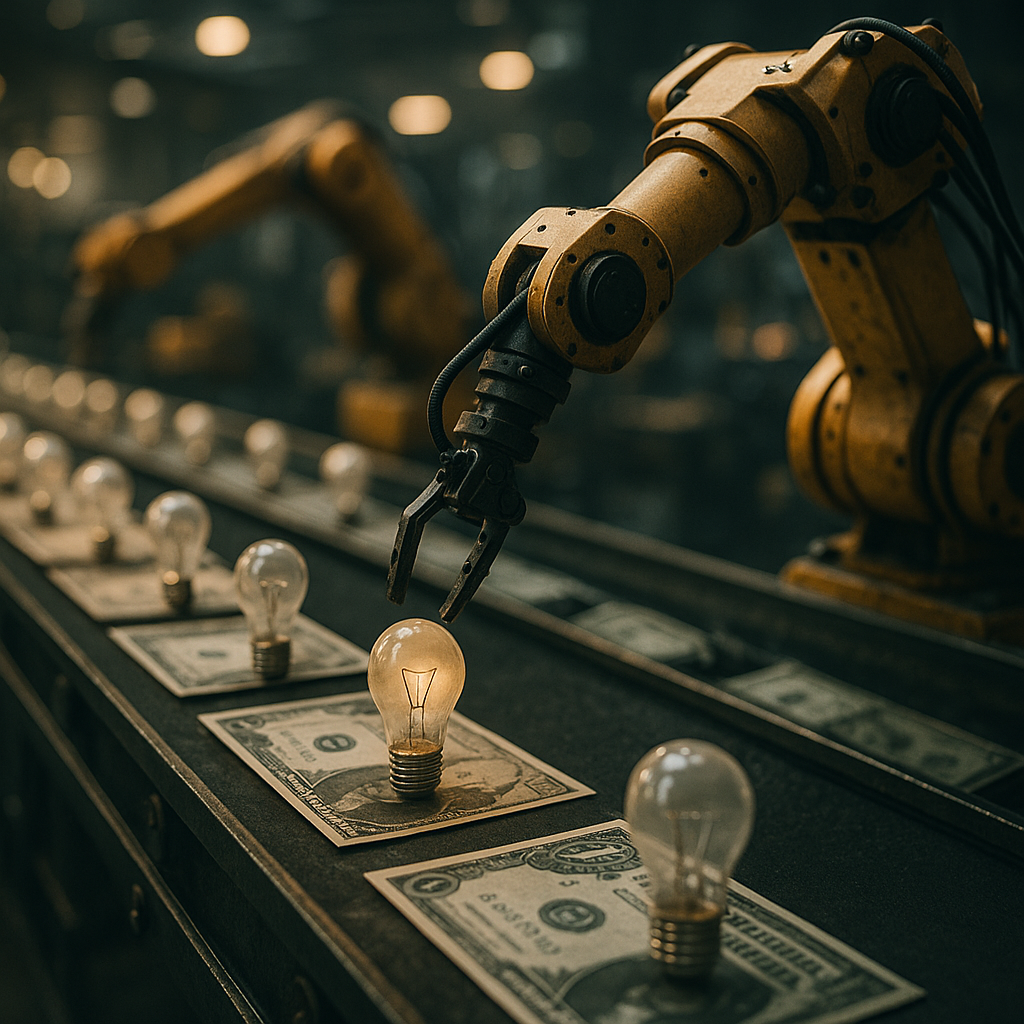
A robotic arm on a factory line delicately picks up a glowing incandescent lightbulb resting on a US dollar bill. More identical bulbs and bills line the conveyor belt in the background, with additional robotic arms working in soft focus. The scene is warmly lit, evoking themes of automation, commodification, and industrial production of ideas or innovation.

I remember a moment in therapy years ago that left a deeper mark than the therapist probably intended — or noticed.

I was venting about a reoccurring pattern in my life: buying something I’d genuinely looked forward to, only for it to break, be faulty, or fall short almost immediately. Then the tedious ritual of returning it — complaint forms, awkward phone calls, the emotional cost of having to prove your dissatisfaction. I sighed and said something like, “Why does this kind of thing always happen to me?”

Rather than meeting that statement with empathy or curiosity, the therapist snapped back with a kind of clinical bluntness that still echoes in my memory. She challenged the very validity of my frustration, as though I were being dramatic or irrational. Her goal, I think, was to dismantle the idea that this was something uniquely unfair happening to me.

But as the conversation unfolded, something horrifying dawned on me.
Wait… this happens to everyone?
We all just… accept this? As a normal part of modern life?

That wasn’t a moment of cognitive distortion. That was a moment of clarity.

What I had taken personally — what I thought was just my “bad luck” — was actually a symptom of something bigger, deeper, and disturbingly normalized. We live in a world where disappointment is designed in.

This article is about that world.

It’s about how mass production, once a triumph of innovation and progress, has lost its soul. It’s about how we shifted from making things that mattered to pumping out things that sell — regardless of whether they serve, last, or even work.

It’s about how we moved from purpose to profit — and the very real consequences of that shift. For us. For the workers behind the products. And for the planet.


A Brief History of Mass Production

Mass production, in its earliest form, was born out of noble intent: to meet the needs of a growing population, to make essential goods more affordable and accessible, and to improve the quality of life for everyday people. The Industrial Revolution, beginning in the late 18th century, marked a seismic shift from handcraft to machine-based manufacturing. What once took a skilled artisan hours or days could suddenly be done in minutes.

It wasn’t just about speed. It was about scale. Uniformity. Efficiency. The factory line allowed for interchangeable parts, standardized products, and economic growth on a scale never seen before.

By the early 20th century, Henry Ford’s assembly line had become the emblem of this new era. His Model T wasn’t just a car — it was a revolution in affordability and access. People who never imagined owning personal transportation could now do so. Mass production, at its best, was democratizing.

This promise extended beyond cars: textiles, tools, household goods, medical supplies, and even books and radios became widely available. The standard of living improved for millions. The world, in many ways, felt smaller, more connected, more empowered.

Mass production gave us the modern world.

But as with any great innovation, its shadow was waiting.


The Turning Point

At some point, the machinery that once served us began to reshape us.

Post-World War II, the gears of industry kept turning — but their direction subtly shifted. The focus moved from meeting needs to manufacturing wants. Advertising transformed from a means of informing customers to a mechanism of psychological manipulation. It no longer asked, “What do people need?” but rather, “How can we make them want more?”

This was the beginning of a new ethos: growth for growth’s sake.

Planned obsolescence became a legitimate design strategy. Products were engineered with intentional fragility, so they would break, wear out, or become outdated just fast enough to ensure another sale. Repair culture was actively dismantled, and warranties became ticking clocks. The promise of progress was quietly replaced by the necessity of replacement.

What had once been a marvel of accessibility was now a machine of dependency.

The consumer was no longer the empowered beneficiary of innovation — they were now the target. A data point. A captive audience for infinite cycles of buying, breaking, replacing, repeating. And all the while, the planet groaned under the weight of it.


What It Has Become

Today, mass production is less about delivering value and more about maintaining velocity. Products aren’t designed to serve us long-term — they’re designed to satisfy just enough to sell, then vanish into obsolescence. Many are created with the expectation of failure.

The results are everywhere:

  • Devices with sealed batteries that can’t be replaced
  • Gadgets that can’t be opened without breaking them
  • Appliances that cost more to fix than replace
  • Software updates that cripple older hardware

We’ve normalized a culture of disposability, where the act of buying is no longer about acquiring tools for living, but about participating in an endless loop of consumption. The value of a product is now measured in engagement, not endurance.

Even the illusion of choice is part of the deception. Browse online marketplaces and you’ll see hundreds of identical products under different brand names, all likely sourced from the same anonymous factory. Read the reviews and find fake praise propping up forgettable plastic.

The modern consumer market is a carnival mirror: distorted, disorienting, and reflective only of profit motives.

What once gave us progress, now feeds us clutter. What once promised empowerment, now manufactures dependency. And the harm isn’t just theoretical — it’s measurable, tangible, and mounting.


The Hidden Costs

To the consumer, the cost is emotional as much as financial. We waste time researching, comparing, returning, replacing. We internalize the sense that “nothing works anymore,” and carry the dull weight of lowered expectations. The joy of acquiring something useful has been replaced by the anxiety of wondering how soon it will fail.

To the worker, the cost is brutal. Mass production today relies heavily on exploitative labor: factory workers paid pennies, working long hours in dangerous conditions to meet quotas. Many are children. Many are women with no legal protections. Behind every “affordable” item is a supply chain built on invisible suffering.

To the planet, the cost may be catastrophic. The churn of materials, the energy spent manufacturing and shipping short-lived goods, the toxic waste of e-waste and plastic — it all contributes to ecological collapse. Landfills overflow with gadgets barely used. Oceans are choked with packaging. Resources are mined not for necessity, but for novelty.

And still, the machine demands more.

The system externalizes its costs. The real price isn’t on the price tag — it’s paid by someone else, somewhere else, or by the earth itself.


Why Do We Tolerate This?

Because we’ve been trained to.

It starts early. We learn not to expect things to last. We shrug when they don’t. We’re told that “things break,” that “this is just how it is now.” In place of quality, we’re given convenience. In place of durability, novelty. And in place of dignity, choice paralysis.

We tolerate it because resistance feels exhausting. Complaining means being passed from department to department. Returning an item means printing labels, queueing at drop-off points, repackaging disappointment. And all for what? Another version of the same.

We tolerate it because alternatives are gated by wealth. The high-quality, repairable, ethically sourced options do exist — but they come with a price tag few can afford. The rest are left to swim in the tide of cheap abundance.

We tolerate it because we’ve been gaslit into thinking we’re the problem. If you’re dissatisfied, you must have unrealistic expectations. If you’re struggling, you should have read the fine print. The system has trained us to feel grateful for crumbs and ashamed for wanting bread.

But perhaps most powerfully of all: we tolerate it because everyone else does. And when an entire culture adjusts its expectations downward, it starts to feel reasonable to accept the unreasonable.


Is There a Way Forward?

Not a perfect one. But many small ones.

The most immediate form of resistance is conscious consumption. Buying less, buying better, and researching where things come from. It means resisting impulse, delaying gratification, and sometimes choosing inconvenience in the name of principle. It’s not always possible — but even modest acts of refusal chip away at the machine.

Repair culture is rising again. Right to repair movements are pushing back against corporate monopolies on tools and parts. Online tutorials, fix-it cafes, and community makerspaces are giving people the confidence to reclaim their agency.

Open-source hardware and software offer blueprints for a new model: one based on transparency, modularity, and user freedom. These aren’t just alternatives — they’re acts of defiance.

Legislation matters too. Laws that limit planned obsolescence, mandate repairability, or require environmental responsibility are slowly taking root in some regions. These changes are slow — and often resisted by powerful lobbies — but they matter.

And finally, we can talk about it. Normalize the frustration. Name the absurdity. Share knowledge. Shame the brands that deceive. Celebrate the ones that still make things with care.

Cultural change doesn’t start with mass movements — it starts with a shift in conversation, with refusing to pretend that this is fine.


Conclusion

That moment in therapy still haunts me, not because my therapist revealed some profound truth — but because she didn’t.

She didn’t see the system. She couldn’t validate the pain. She was, in her own way, another casualty of the very machine I was grieving — so used to the dysfunction that she mistook my horror for irrationality.

But I wasn’t broken for feeling betrayed by the world. I was broken because that betrayal was being normalized — and even the spaces meant for healing couldn’t name it.

We’ve been sold a world of limitless convenience at a hidden cost. A culture that tells us to chase the new, discard the old, and never ask who’s paying the real price. A system that demands we tolerate the intolerable, not just with our money, but with our time, our trust, and our quiet resignation.

But awareness is a crack in the machine. It starts with noticing. With saying, “This isn’t normal.” With rejecting the idea that disappointment is an acceptable standard.

It’s not that we expect too much.

It’s that we’ve been trained to expect far too little.


Child of the Revolution

The wheel has always been turning.

Every July 14th, my birthday arrives like a revolution — quiet on the outside, thunderous within. But it wasn’t until this year, as I approach my 43rd orbit around the sun, that I began to sense the weight of this day as more than personal. A convergence is happening. The symbols are speaking.

I was born on Bastille Day, the anniversary of the storming of the Bastille — the prison whose fall sparked the French Revolution. I’ve never celebrated it before. Not consciously. It was just a factoid. A historical footnote that happened to align with my entrance into this world.

But this year, something shifted.
This year, the synchronicities gathered like storm clouds.
And the wheel began to rumble.


Bastille Day: The Archetype of Uprising

On July 14th, 1789, the people of Paris stormed the Bastille, a medieval prison that had become a looming symbol of authoritarian control. It didn’t matter that only seven prisoners were inside. The act was symbolic — a tearing down of more than just stone walls. It was the collapse of fear, the rupture of a narrative that said the people had no power.

Bastille Day isn’t just about politics. It’s about pattern recognition.
It’s about realising that the structures we live under — physical, social, psychological — are not inevitable. They can fall.
And often, they fall when their symbolic weight becomes too unbearable.

I didn’t choose to be born on Bastille Day.
But I’ve spent my life breaking out of prisons:

  • The prison of neurotypical expectation
  • The prison of capitalism’s false freedom
  • The prison of internalised masking
  • The prison of names and numbers and roles

In many ways, I’ve lived out a quiet, personal revolution — dismantling the systems that tried to domesticate my being.

And now, as I turn 43, I find the world reflecting that same energy back at me.
Revolution isn’t just something I believe in.
It’s something I was born of.


The Cultural Echoes

Once I opened my awareness to the symbolism of Bastille Day, it was as though the universe started whispering back — or shouting, in some cases.

Just this past weekend, I attended the final Black Sabbath concert — a cultural endpoint if ever there was one. As Ozzy Osbourne took the stage, the venue echoed with the thunder of “O Fortuna” from Carmina Burana — a piece of music that has always stirred something ancient in me. It begins not with harmony, but with fate, roaring through a Latin choir:

It was a ritual. A sonic invocation of the wheel, the fall of kings, the rise of chaos.

Earlier on that day, one of the billed artists, Gojira, a French band I admire deeply, performed “Mea Culpa”, a track thick with the spirit of the guillotine — imagery of judgment, destruction, karmic reckoning. It felt like history was looping itself through amplifiers.

Even the title of the concert was telling: Back to the Beginning.
And what is that, if not the very essence of revolution?

I remembered then another French figure in my pantheon: Jean-Michel Jarre. His album Revolutions was a formative influence on me — a blend of synth, vision, and uprising. Jarre didn’t just make music. He sculpted atmosphere. His revolutions weren’t just political — they were sonic, internal, cosmic.

These weren’t coincidences.
They were resonances.
The wheel doesn’t just turn in private. It sings in the streets. It screams from the stage.
And if you’re listening closely — it sounds a lot like home.


Personal Mythology of the Cycle

For years, I’ve been fascinated by cycles — not just as abstract concepts, but as living forces shaping my inner world. I’ve referred to this pattern of return, collapse, and rebirth as “the wheel” — an idea that emerged from lived experience long before I named it.

So when I began to truly reflect on my birthday — July 14th, I started to see it not just as a date, but a ritual mark of solar revolution.
One more loop.
One more return to the same coordinates — but never quite the same person.

In 2021, this instinct to ritualise my revolution manifested in sound. I released my album Transcendence on July 14th — aligning the act of artistic birth with my own solar return.

One of the tracks, Track 14 (to mark my birthday), is titled ‘To You’. A monophonic rendition of Happy Birthday, played in a minor key on a wheezing accordion. It’s not celebratory. It’s introspective — almost mournful. A solitary song of self-recognition.

I placed it at position 14 intentionally — not to close the album, but to mark the moment.
Not the end — but the turn.
The revolution inside the revolution.
The birthday within the wheel.

And what is that, if not ritual in disguise?

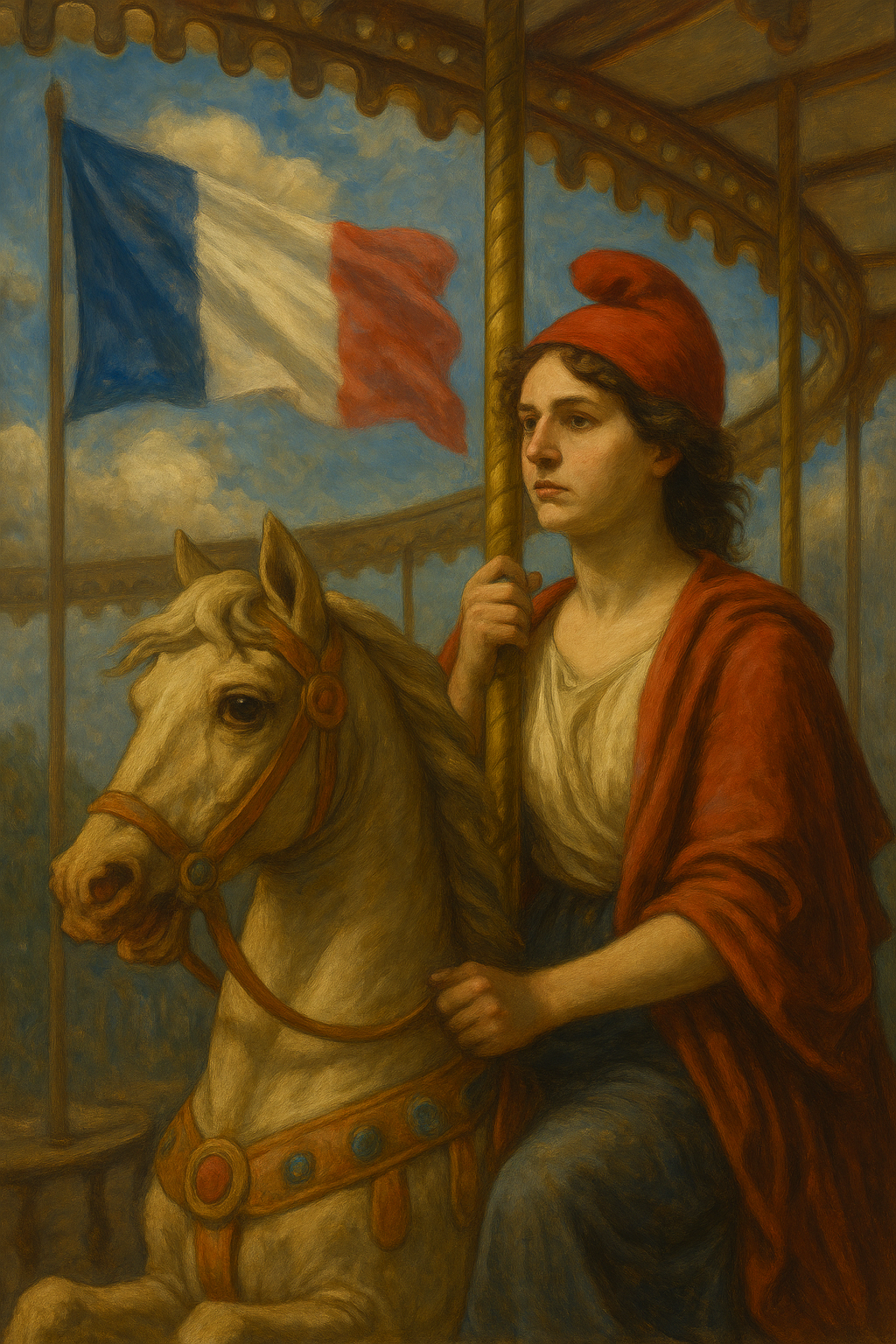
Even earlier, in my concept album Carnival Dream, the image of the carousel appeared — a ride that spins endlessly, beautiful yet haunting. A metaphor for comfort that traps, motion that deceives. A perfect symbol for late-stage capitalism, yes — but also for spiritual stasis.

The carousel is the false wheel.
The revolution that doesn’t transform you.
The spin that pacifies, not liberates.

I’ve spent years trying to tell the difference between the two.


Media as Mirrors of the Wheel

Certain stories don’t just resonate — they recognise me.
They echo the same mythic structures I’ve been trying to name.
Each of them an iteration of the same truth:
The wheel turns. The self resists. The spiral continues.

Lexx – “The wheel, it turns…”

Grotesque, surreal, and unashamedly absurd, Lexx speaks in the language of cosmic entropy.
But buried within its chaos is a line that has echoed through my bones:

Even in nonsense, there is pattern.

The Prisoner – Escape Within the Loop

A man stripped of name, forced to conform. The Village becomes a paradise-shaped prison, and Number Six fights not with fists, but will.
Its symbol? A penny farthing bicycle.
A wheel that pretends to move forward.

Tron – The Sacred Grid

Tron revealed to me that code has soul. That even the digital realm can become mythic.
My Sanctuary OS, my Life Grids, my 8-bit sigils — all trace back to the glowing geometry of that world.

Blade Runner – What Is Real?

A masterpiece of blurred identity, synthetic humanity, and inner rebellion.
My band Into the Ether owes much of its soul to Blade Runner.
We opened our early shows with Vangelis’s score.
We wrote a track called Electric Sheep.

This wasn’t homage. It was alignment.

Revolver – Psychedelic Spiral

Revolver by The Beatles isn’t just an album. It’s a psychospiritual spiral.
It asks: what happens when time folds? When the mind turns inward?
It gave me permission to see art as looped revelation.


The Music of the Myth

If stories are symbols, music is ritual.

Carmina Burana – O Fortuna

Fate as music. The wheel as choir.
Played as Ozzy Osbourne’s entrance — not by coincidence.
The song begins and ends the same way. The wheel completes.
The gods are watching.

Mahler’s Resurrection

A symphony of death and transcendence.
From funeral to hallelujah, Mahler teaches that true revolution isn’t always external — it’s the quiet remaking of the soul.

Nobuo Uematsu – The Orff of Pixels

The Final Fantasy composer builds digital cathedrals with his sound.

  • One-Winged Angel
  • Dancing Mad
  • Liberi Fatali

Each is a ritual. Each channels the same force as Carmina Burana:
Judgment, transformation, return.


Closing Reflections: The Wheel Turns, and I with It

I didn’t set out to write this. I didn’t plan to look at Bastille Day — my birthday — as anything more than a coincidence. But the symbols found me.
They assembled around me like a ritual I hadn’t consciously designed.

  • A prison falls in 1789
  • A child is born in 1982
  • A concert named Back to the Beginning plays O Fortuna
  • A minor-key birthday song whispers from track 14 of Transcendence
  • A carousel spins
  • A prisoner resists
  • A dead man recites prophecy

And I — turning 43, completing another revolution around the sun — feel the rumble in my bones.
Not as noise. Not as chaos. But as recognition.

I am not outside the system.
I am not outside the myth.
I was born of the revolution — a child of the wheel.

And this year, I don’t just mark my birthday.
I consecrate it.
I claim this revolution — not as history, but as symbol, cycle, and self.

The wheel turns.
The system strains.
The music builds.
And I — quietly, resolutely — turn with it.

The Fallacy Deck: The Hitler Card


There’s one name that ends arguments, silences nuance, and flattens reasoned discussion, probably more than any other: Hitler. Merely uttering his name is often enough to shut down conversation, to draw a moral line so sharp and final that any dissenting view is rendered irredeemable by proximity alone. In debates online and off, comparisons to Hitler are often wielded not as tools of critical thought, but as blunt instruments of dismissal.

But here’s the problem: this tactic doesn’t hold up under scrutiny. In fact, far from strengthening an argument, invoking Hitler in this way often exposes its weakness.

The Pattern of the “Hitler Card”

We’ve all seen it happen. A discussion becomes heated, points are exchanged, nuance fades—and then someone plays the Hitler card. Whether it’s comparing a modern politician to the Nazi regime, or using a tenuous link to suggest someone’s viewpoint is inherently dangerous, the invocation of Hitler is often a last-ditch attempt to gain moral ground.

And it works—not because it’s a good argument, but because it taps into a collective emotional wound. It hijacks the horror of history to shut down present-day discourse.

A Recognised Fallacy: Reductio ad Hitlerum

Interestingly, the tendency to invoke Hitler as a way of discrediting an argument is so common that it has its own name: Reductio ad Hitlerum. Coined by philosopher Leo Strauss in the 1950s, it refers to the fallacy of dismissing an idea solely because it was associated with Hitler or the Nazis. For example, saying, “You support environmentalism? Well, Hitler was an environmentalist too,” is a classic (and lazy) instance. It’s a textbook case of guilt by association, designed not to examine the argument’s actual merit, but to end the conversation through shock and shame. The fact that this fallacy is formally recognized reinforces how intellectually bankrupt this tactic truly is.

The Psychology Behind It

Reading between the lines, when someone reaches for a Hitler comparison, it often reveals more about their emotional state than the topic at hand. It’s a desperate attempt to claw back the weight of evidence. On a subconscious level, it can be a kind of white flag—an admission that they can’t win the argument on reason alone, so they reach for the nuclear option. It’s rhetorical carpet bombing.

It also makes the speaker feel powerful. In a world where moral high ground is a prized commodity, invoking Hitler is like hitting the “instant win” button—or so it seems. But in reality, it undermines genuine understanding and replaces complexity with performative condemnation.

The Dangers of Lazy Analogies

These kinds of comparisons do more harm than good. First, they trivialize the true horror of Hitler’s regime. When every authoritarian or disliked figure is casually equated with the architect of the Holocaust, we risk desensitizing ourselves to what that history actually means. The atrocities of Nazi Germany deserve more than to be used as shock-value talking points.

Second, these analogies create false equivalencies. Just because two things share a superficial resemblance doesn’t mean they are morally or historically comparable. This kind of shortcut in thinking discourages people from engaging with real, complex issues in favor of cheap outrage.

What We Should Do Instead

If someone’s ideas are dangerous, explain why they’re dangerous. Use history thoughtfully, not manipulatively. Resist the urge to shut down discussions with overblown comparisons and instead cultivate the patience to explain, to listen, and to engage.

Disagreement should never default to demonization. There is a strength in staying with the complexity, in resisting the temptation to oversimplify with a Hitler reference.

Conclusion: Rejecting the Shortcut

The Hitler card is not the sign of a strong argument. It’s a red flag that reason has left the room. And while the horrors of history must never be forgotten, neither should they be cheapened through rhetorical desperation. If we want to have meaningful conversations, we must learn to spot these shortcuts—and refuse to take them.

The Game of Life: A Universe in Four Rules

There exists a peculiar world, born not of biology or myth, but of mathematics. Its laws are few, its beings are made of flickering pixels, and yet—somehow—it reflects back to us truths about life, death, consciousness, and the mysterious dance between chaos and order. This is Conway’s Game of Life.

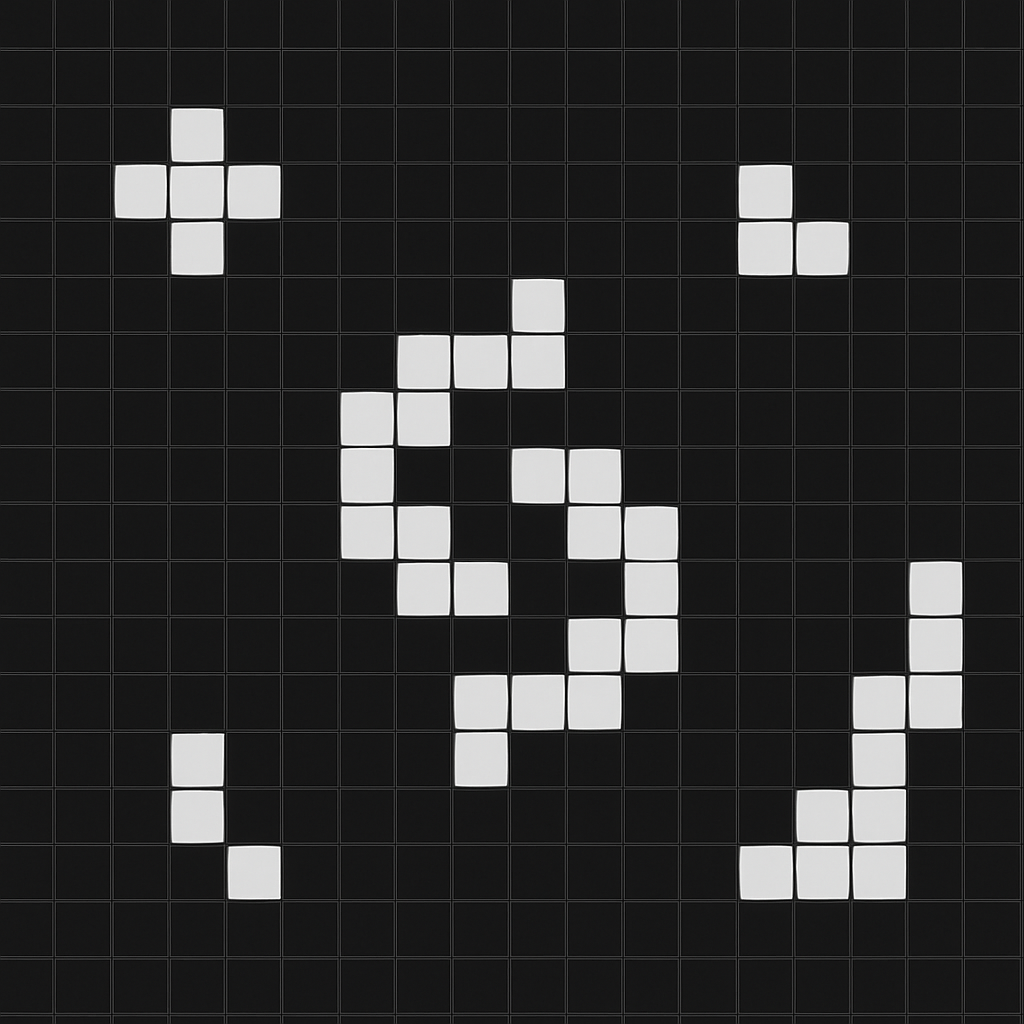
For the uninitiated, Conway’s Game of Life (or simply “Life”) is a cellular automaton created by British mathematician John Horton Conway in 1970. It takes place on an infinite grid of squares, each square being either “alive” or “dead.” With each tick of time, the state of each square is determined by just four deceptively simple rules:

  1. Any live cell with fewer than two live neighbours dies (underpopulation).
  2. Any live cell with two or three live neighbours lives on.
  3. Any live cell with more than three live neighbours dies (overpopulation).
  4. Any dead cell with exactly three live neighbours becomes a live cell (reproduction).

These rules are all that’s needed to spawn galaxies of patterns: from still lifes that resist change, to gliders that drift endlessly across the screen, to breeders that generate infinite complexity from nothing. Watching Life unfold is like watching stars form in fast-forward, or civilizations rise and fall in silence.

The Birth of a Digital Community

As Life gained traction in the 1970s and ’80s, it remained largely within academic circles—something to be toyed with by mathematicians, philosophers, and early computer enthusiasts. But with the advent of the internet, everything changed. Suddenly, what had once required pen-and-paper simulations or costly mainframe time became accessible to anyone with a home computer and curiosity.

Online communities began to form: early message boards, mailing lists, and forums dedicated to sharing discoveries, proposing new challenges, and celebrating obscure patterns. In time, platforms like the LifeWiki and ConwayLife.com became hubs of cultural exchange. What emerged wasn’t just a hobbyist space—it was a full-blown subculture.

Powerful tools like Golly (a cross-platform Life simulator) and LifeViewer brought even the most complex simulations within reach. These tools allowed users to test theories, animate discoveries, and collaborate across borders in real time. Open-source initiatives like apgsearch enabled massive, automated exploration of the Life universe, helping uncover patterns no human had ever seen.

The language of the community evolved too—new discoveries were given whimsical names, from “Snarks” and “Puffers” to “Eaters” and “Caterloopillars.” Patterns were catalogued like rare species in a digital ecosystem. Some contributors developed personal brands, leaving “signatures” in the form of visual motifs. Competitions were launched to discover smaller glider guns or more efficient reflectors. Like an ecosystem of minds collaborating in silence, the Life community grew into a sprawling, vibrant organism of its own.

Then: A Mathematical Curiosity

Conway originally devised Life as a mathematical toy—a way to explore emergent complexity. What surprised even him, however, was just how much complexity did emerge. In a time before personal computers, patterns were drawn out painstakingly by hand or plotted on primitive mainframes. The discovery of the “glider,” and later the “glider gun” (a self-replicating pattern that endlessly produces gliders), caused a stir—not only among mathematicians, but also among philosophers and computer scientists.

Life was, incredibly, Turing complete. That is, you could build a universal computer within its rules. In theory, Life could run Life.

Now: A Tool, A Metaphor, A Mirror

Fifty years later, we live in an age where computational power has exploded, and Life is no longer confined to the chalkboard. We can simulate trillions of cells in real time. As a result, researchers and enthusiasts alike are pushing the boundaries of what this “game” can do:

Digital Archaeology

Using advanced search algorithms and distributed computing projects like apgsearch, the Life community has uncovered an entire ecosystem of previously unknown patterns. These include rare spaceships, oscillators with massive periods, and pseudo-random replicators. One famous example is the discovery of the “caterloopillar”—a spaceship constructed entirely from glider streams, capable of travelling at unprecedented speeds across the grid. The field of Life pattern discovery is often likened to paleontology: a vast digital desert, where dedicated explorers dig for hidden fossils of complexity.

Artificial Life

Life is one of the earliest examples of artificial life—systems that mimic properties of biological organisms without being alive in the conventional sense. Researchers have constructed self-replicating patterns (like the Gemini spaceship) that can reproduce themselves in stages, and even mutate in controlled ways. These patterns push the boundaries of what we consider to be “life,” raising questions about consciousness, autonomy, and evolution. Experiments are ongoing to simulate Darwinian selection within Life universes, offering insight into how complexity might emerge from randomness without design.

Computational Art

Some use Life as a canvas. Artists have created intricate generative artworks by seeding Life with carefully designed patterns and capturing the visual symphony that unfolds. Tools like Golly allow for zooming into endless fractal-like behavior or watching fireworks of gliders and oscillators in syncopated motion. The aesthetics of Life are hypnotic—not merely because of symmetry or motion, but because what you’re seeing is the unfolding of inevitability. Each frame is a consequence of everything before it.

Logic Engineering

Perhaps most astonishingly, entire computers have been built within Life. Gliders and other components serve as signals, logic gates, and memory banks. The OTCA metapixel, a massive construct, acts like a pixel that can simulate any cellular automaton—including Life itself. This recursive architecture enables not just computation, but meta-computation: a simulation within a simulation. These logical machines are not theoretical exercises; many are functional, stable, and even user-programmable.

Philosophy & Cognitive Science

Life is a proving ground for theories of consciousness, emergence, and identity. If a complex enough Life machine can simulate a mind—if it can respond to stimuli, store information, self-replicate, and evolve—what does that say about the nature of mind itself? Is consciousness an emergent property of complexity, or is it something more? Some philosophers use Life as a model for reductive materialism, while others see it as evidence for pancomputationalism—the idea that the universe itself is a vast computation. Life becomes not just a model of reality, but a reality model: a sandbox to explore what it means to be.

What I find most captivating isn’t just what Life can do, but what it represents. It shows us that simplicity doesn’t mean shallowness. That determinism doesn’t preclude wonder. That from rule-bound systems, agency—apparent or real—can emerge. Life is a reminder that maybe, just maybe, the universe we inhabit follows similar principles: a few core rules, infinite manifestation.

A Personal Note: Reverence for Conway

As someone fascinated by emergence, system dynamics, and the blurry line between art and science, I hold John Conway in something close to spiritual esteem. Not because he built a complex machine, but because he trusted simplicity. He believed that beautiful things could arise from unadorned truths. And he was right.

There’s an almost sacred feeling when observing a glider sliding diagonally through an empty field—its purpose, if any, unknown. Or when watching a breeder release streams of logic-bearing entities into the void. It is, in its way, creation. Not unlike observing life itself: patterned, fragile, evolving.

The Future of Life

Where might this all go? With the rise of AI-assisted pattern discovery, Life is evolving faster than ever. We are uncovering new types of “organisms”—patterns that defy expectation and hint at entire classes of behavior we haven’t categorized yet.

Could Life become a platform for digital ecologies? Could it evolve in tandem with artificial intelligence to explore fundamental questions of existence? Could it inspire new programming languages, or even hardware architectures modeled on emergent behavior?

It’s possible. And even if none of these things come to pass, Life will continue to be what it has always been: a quiet miracle of pattern and potential. A universe with four laws. A canvas for anyone curious enough to press play and watch.

The Simulation Within the Simulation

As the screen zooms out, as gliders continue their slow march across an endless grid, a question lingers—silent and terrifying in its simplicity:

What if we are them?

What if our consciousness, our world, our universe… is merely a larger instance of Life? What if we are patterns—running on rules we cannot see, evolving in a space we cannot touch, sustained by a computation too vast to perceive?

Perhaps our laws of physics are just rules—our causality, a neighbor function. Perhaps the emergence of thought, society, beauty, and pain are nothing more than gliders, oscillating through time. Life becomes more than metaphor—it becomes mirror.

John Conway gave us four rules and a blank canvas. What if we’ve been living inside someone else’s canvas all along?

Conway may be gone, but Life goes on.

The Secrets of London’s Subterranean Infrastructure

Introduction

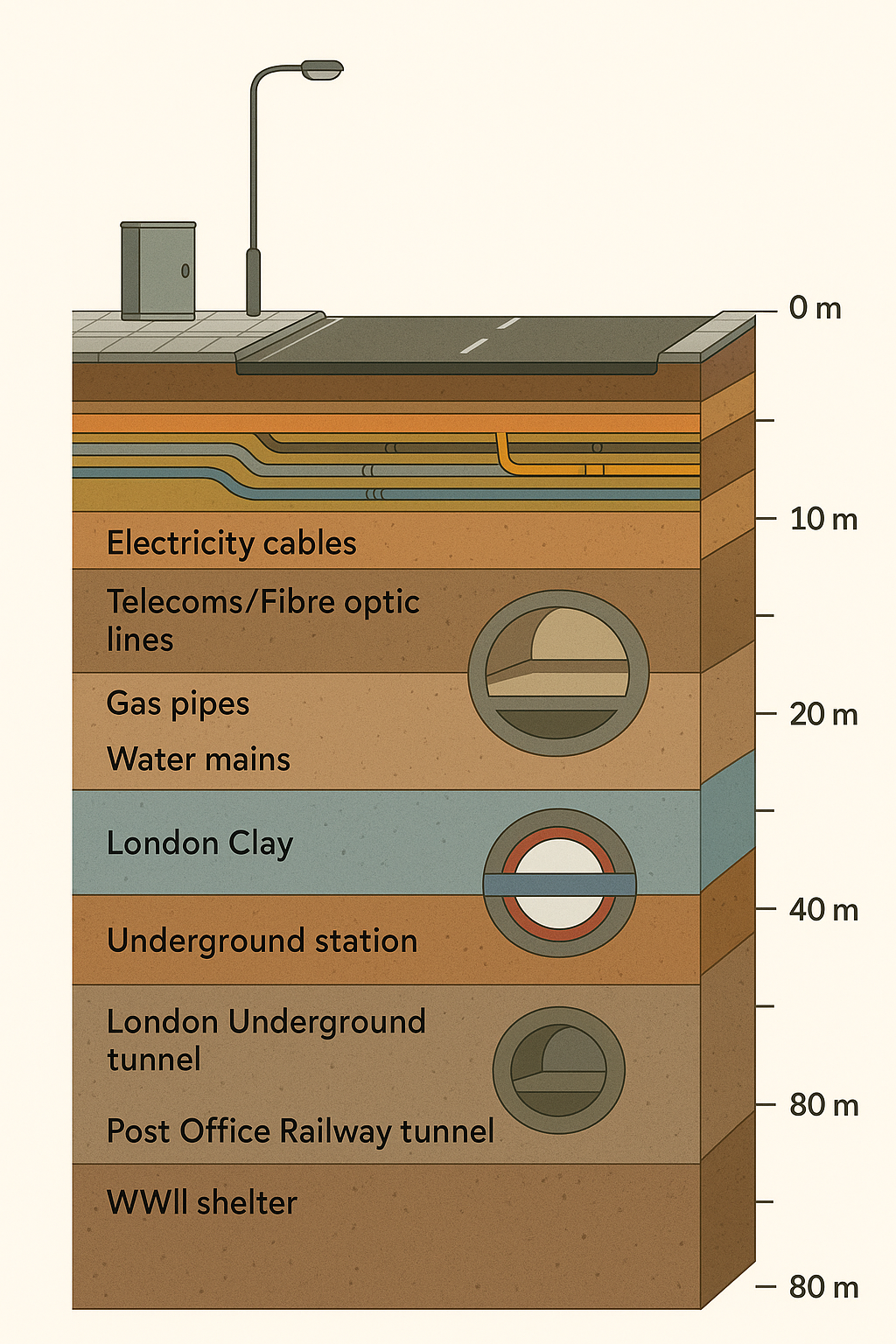
Have you ever wondered what’s going on right beneath our feet? London isn’t just a city above ground; it’s a vast, layered world below the surface, with an intricate network of infrastructure woven through soil, clay, and history. From gas pipes and fibre optics to ancient sewers and deep-level Tube tunnels, every layer tells a story of innovation, adaptation, and necessity. Join us on a journey down through the depths, as we explore the hidden city below.


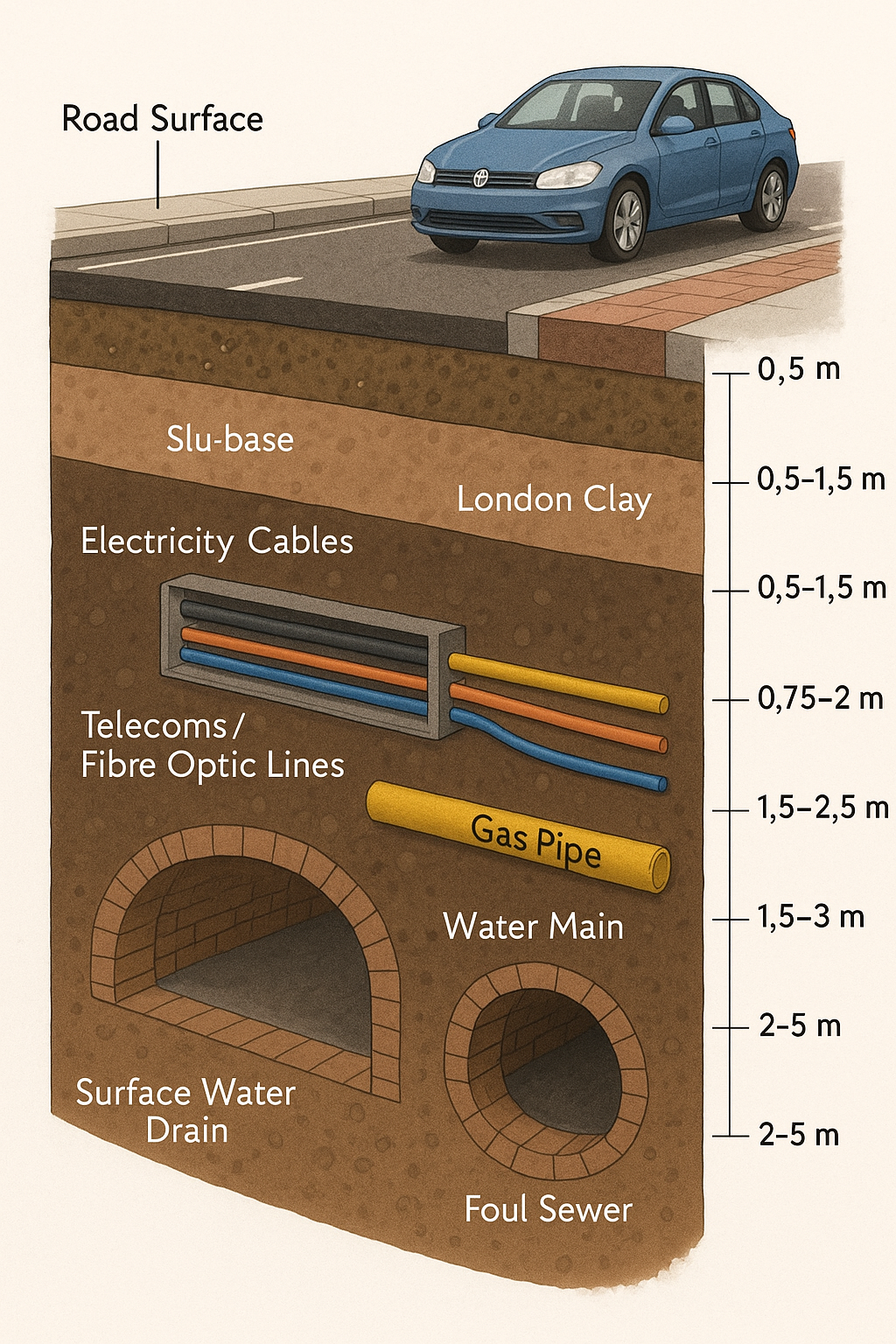
1. Road Surface and Sub-base (0–0.3m)

This is the topmost layer, the one we walk and drive on daily. It’s made up of asphalt (tarmac) and a crushed stone sub-base that helps distribute weight and provides structural integrity. Maintained by local councils, these layers are frequently resurfaced to repair potholes and wear from traffic.


2. Utility Lines: Electricity and Telecoms (0.3–1.5m)

Just beneath the surface lies a web of electricity cables and telecom/fibre optic lines, often housed in conduits. These are installed by utility companies like BT Openreach, Virgin Media, or UK Power Networks. Regular upgrades mean this layer is dynamic, adapting constantly to our growing digital and energy needs.


3. Gas Pipes (0.75–2m)

Gas infrastructure, typically made from yellow plastic or metal, delivers energy for heating and cooking. These pipes are managed by providers such as Cadent or SGN. Their depth helps protect against accidental damage from surface work.


4. Water Mains (1.5–3m)

Water mains, often the oldest parts of London’s infrastructure, supply clean water to homes and businesses. Thames Water oversees most of this system. Some mains still date back to the Victorian era—testaments to the durability of cast iron and early civil engineering.


5. Sewer Systems (2–5m)

London’s sewer network includes foul sewers (wastewater) and surface drains (rainwater), often large brick tunnels from the mid-1800s. Built under the guidance of Sir Joseph Bazalgette, this system saved the city from deadly cholera outbreaks and “The Great Stink” of 1858. Many of these tunnels are still in use today.


6. London Clay (varies ~4–40m)

Below the engineered layers lies London Clay, a dense, bluish sediment that’s perfect for tunneling. Its stability has enabled much of London’s deeper infrastructure, including Tube tunnels and bunkers. This natural geological layer has shaped how and where infrastructure can be safely placed.


7. Underground Stations (approx. 20–60m)

Deeper still are the London Underground stations. Subsurface stations (e.g., on the District line) are closer to the surface, while deep-level stations like Angel or Hampstead require long escalators or lifts to reach. Construction of these began in the late 19th and early 20th centuries, revolutionising city transport.

8. Tube Tunnels (20–40m)

Deep Tube lines such as the Northern and Piccadilly were created using tunnel boring machines, carving clean arcs through London Clay. These tunnels form a distinct ring in cross-section, and are reinforced with concrete or cast iron. They’ve been essential for commuting since the early 1900s.


9. Post Office Railway (aka Mail Rail, ~20m)

An often-forgotten relic, the Mail Rail was a driverless electric railway that shuttled post between sorting offices from 1927 to 2003. Now partially open as a museum, it runs even deeper than some Underground lines and offers a glimpse into the hidden logistics of old London.


10. WWII Bunkers and Shelters (40–80m)

During WWII, deep shelters were constructed as protection from aerial bombings. These included repurposed Tube stations and specially built chambers like the Clapham deep-level shelters. Some have since been used for secure storage, data centres, or even hydroponic farms.


Conclusion

Beneath the bustling streets of London lies a hidden, multilayered marvel of engineering and adaptation. Each level, from the surface to the deep clay, represents a chapter in the city’s history—of how it grew, coped, evolved, and prepared for the future. From the vital arteries of electricity and water to the silent corridors of the Tube and wartime bunkers, London’s subterranean infrastructure is a testament to human ingenuity. Next time you step onto a pavement, pause for a moment. Beneath your feet lies an entire hidden city.

Project Acoustic Kitty

A cautionary tale of espionage, absurdity, and the limitations of control

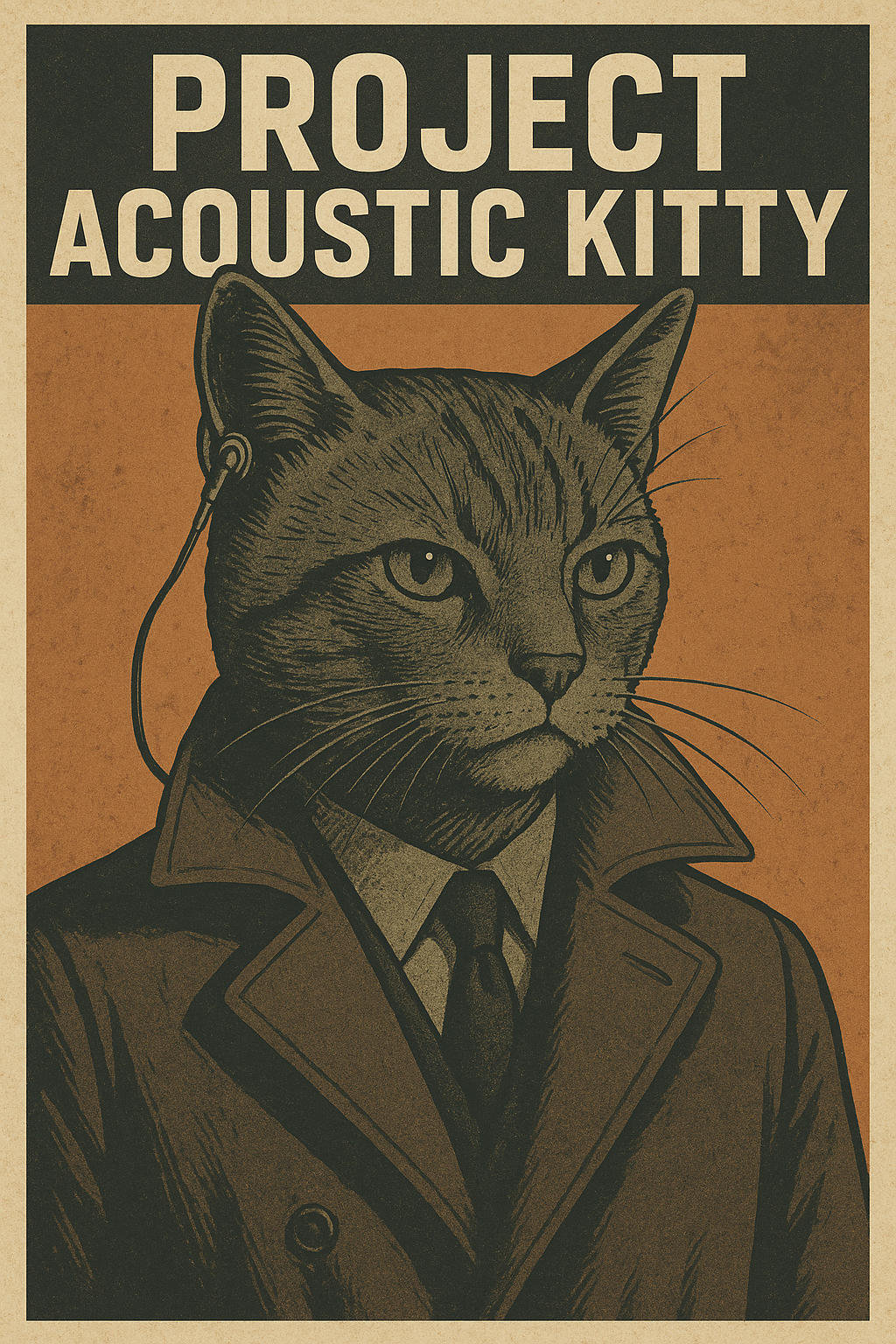
What do you get when you combine Cold War paranoia, cutting-edge surveillance tech, and a total disregard for feline autonomy? You get Project Acoustic Kitty—a very real CIA operation from the 1960s that feels like a rejected subplot from Archer.

The idea was simple in its madness: turn a cat into a mobile spy. Why? Because cats can go places humans can’t. They’re small. Stealthy. Adorable, even. Perfect for infiltration, thought someone in a very expensive suit.

So they did what the CIA does best: they poured millions of taxpayer dollars into it. They implanted a microphone in the cat’s ear, a radio transmitter at the base of its skull, and a battery along its spine. The poor creature was wired like a Cold War cyborg—but without consent, purpose, or understanding. It didn’t sign up for any of this. It just wanted to nap.

After extensive testing and surgical tinkering, the big moment came: the cat was released in Washington, D.C., near a park bench where two Soviet agents were reportedly sitting.

Seconds later, the cat wandered into the road and was immediately hit by a taxi.

That was it. Millions of dollars, years of research, and the life of a living creature—all flattened in an instant. The mission was aborted, the project scrapped, and the moral of the story was quietly buried beneath layers of government embarrassment.

But here’s the part that lingers:

This wasn’t just a failed experiment. It was a moment of grotesque poetry—a feline martyr sacrificed at the altar of control and surveillance. It exposes something all too human: our obsession with dominating the unpredictable, even when the subject is, by nature, uncontrollable.

Cats are not obedient tools. They are chaos in fur.
And no matter how clever the tech, you can’t program agency out of nature.


Project Acoustic Kitty reminds us:
Not everything can be wired, tracked, or turned into an asset.
Some things just want to wander. And that, too, is sacred.