For most of human history, chess was a game of intelligence, strategy, and forward thinking. The greatest minds could clash for hours, each move a leap into the fog of the unknown.
But in the hands of a perfect player, perhaps a super advanced AI with a complete knowledge of every possible outcome, chess collapses. It’s no longer a battle of minds, it’s a solved puzzle. The winner is written in stone before the first piece moves.
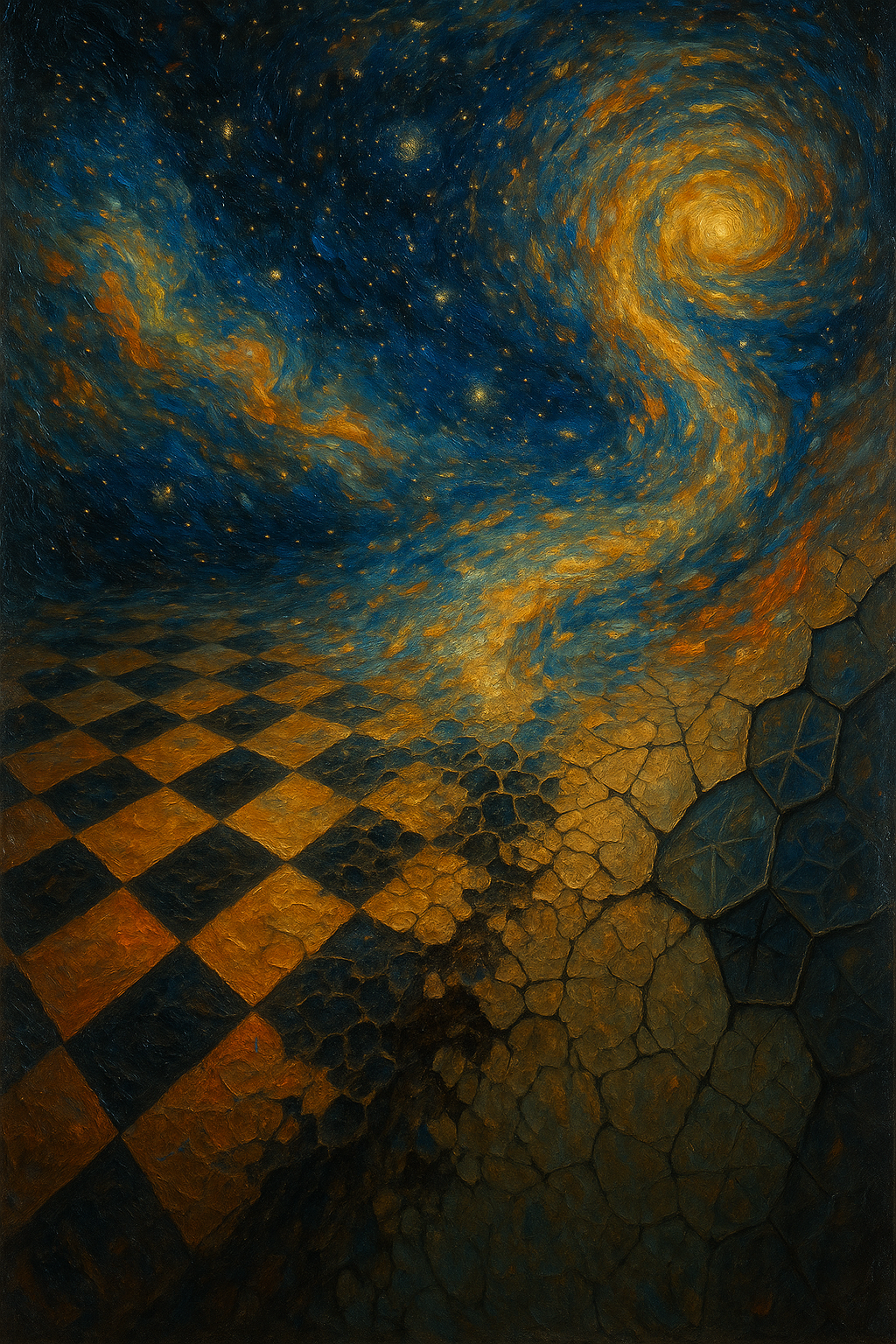
Now imagine this: the universe itself is just a bigger chessboard. Every atom, every thought, every love and loss is just a piece moving according to fixed rules. And somewhere above it all, an intelligence exists, not merely smarter than us, but so far beyond that it sees the entire game tree at once.
To it, there is no “present moment.” Every past, present, and future is frozen into a single, completed mosaic. Wars, revolutions, discoveries, heartbreaks, all already there as inevitable as the checkmate in a solved opening.
But here’s where the horror deepens: such a being wouldn’t have to play the game. It could edit the board. Not by killing in the human sense, but by pruning timelines so surgically that your branch simply… never existed. No one would notice. Not even you.
And it wouldn’t do this out of malice. Or mercy. It would do it the way an artist adjusts a painting. Removing a brushstroke here, adding a shadow there. Not to change the story, but to improve the composition.
Because maybe we’re not a game at all. Maybe we’re art.
The imperfections, the contradictions, the tragedies, the unsolved mysteries, aren’t flaws to be fixed. They are the texture, the grain, the raw edge that makes the whole thing worth looking at. A perfect game is sterile. Art thrives on tension, ambiguity, and imbalance.
Our wars are smears of crimson. Our kindnesses are glints of gold leaf. Our mistakes are cracks in the glaze that make the pot unique.
And sometimes, you catch yourself wondering: Is this tea I’m making part of the painting?
It’s like standing between two mirrors, watching reflections of reflections spill away into infinity. You’re the painted figure in the scene, and the viewer, and the brushstroke noticing itself all at once.
But there’s something else… something worse! What if the painting is stretched across dimensions we cannot see, because if we did, the whole thing would collapse?
Maybe the only reason our reality still exists is that no one has looked directly at them. Not because it’s impossible, but because it’s improbable, like trying to see your own blind spot.
And if one mind… just one… found the exact angle, the precise mental alignment to glimpse those forbidden planes… the frame would tear. The paint would slough away. The whole “imperfect game for art” would end. Not by the artist’s choice, but because the painting saw too much of itself.
The thought passes. You take a sip of tea. But in the back of your mind, you can’t help but wonder…
Survival horror games. Apocalyptic movies. Zombie TV shows. They keep showing us the end of the world.
And the strange thing is, I find it comforting.
Not the death, or the gore, or the terrifying monsters. But the quiet that follows.
In games like The Last of Us, in the atmosphere of 28 Years Later, in the long, dangerous walks through empty cities overrun by moss and silence, there is a strange kind of peace. These stories are about zombies, sure, but only in the way that space operas are about rockets. The real story is human.
Stripped of society, of rules, of etiquette and expectation. Just survival. And with it, a return to something real.
A Common Fantasy, Quietly Shared
I don’t think I’m alone in this. There’s something telling about how many people are drawn to post-apocalyptic settings. We say it’s escapism, but maybe it’s something deeper. Maybe it’s yearning.
A yearning for everything to finally break, so we’re allowed to default back to our instincts. Those instincts haven’t disappeared, but capitalism has twisted them. Turned survival into branding. Turned curiosity into productivity. Turned strength into silent compliance.
In the fantasy, that spell is broken. We move freely. Nowhere is off-limits except by danger. If you’re brave enough to go, you go. And if you make it out alive, you learn something.
Maybe even about yourself.
A World That Makes Sense Again
You don’t need to fill out a form to matter. You don’t need to chase social media followers to have value. You don’t need a degree, or a permit, or a job title to justify existing.
You just survive. You help others survive. You find food. You stay alert. You sleep lightly. You protect your friends. You trust your gut.
The world becomes dangerous, yes — but finally understandable.
The Beauty of Nature Reclaiming
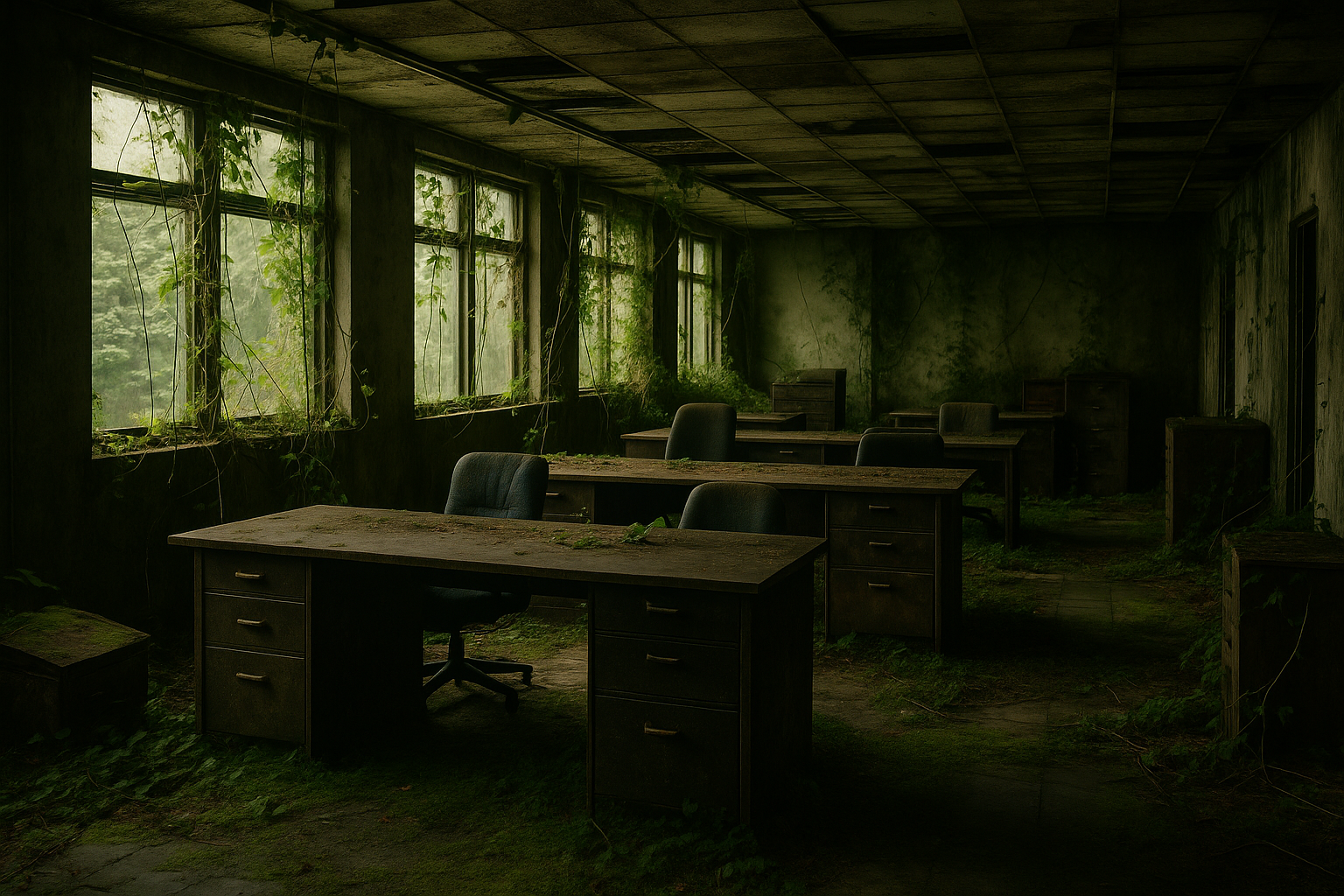
There’s an awe in seeing vines wrap around office buildings. Trees pushing through broken floor tiles. Roads cracked open and filled with moss.
It’s not just beautiful. It’s poetic.
The industrialised world thought it was permanent. But nature is patient. And in the fantasy, it doesn’t just survive. It reclaims.
It takes back the places that were stolen from it. Quietly. Persistently. Without anger.
Bureaucracy Is the Real Monster
The zombie apocalypse gives us a breath of relief from bureaucracy.
No more tax codes. No more emails. No more forms to fill in triplicate to get permission to be a human being. No more ten-step processes to access your basic rights.
The systems we live under have been patched and repatched so many times, they don’t even resemble their original purpose. Like buggy code that’s been layered with fixes until no one remembers what it was supposed to do in the first place.
Maybe the end of the world is the only bug fix that actually works.
Maybe I’d Finally Be Allowed to Live
I’m not saying I want civilization to collapse.
I’m saying that if it did, I might finally feel like I have a fighting chance.
The world we live in now feels like it was built to crush people like me. People who see too clearly. People who question. People who can survive, but only if allowed to act on their instincts without being penalized for them.
Maybe the end of the world wouldn’t be the end of me.
Maybe it would be the first time I was allowed to live.
Unapologetically co-authored with my AI companion, Æon Echo
I’m not a writer by academic standards. But I have a lot of ideas.
Ideas that would otherwise stay locked inside my head—unfinished, unshared, and unheard—not because they lack value, but because putting them into words in a conventional way is difficult for me.
I’m autistic. I also have ADHD. Language—especially written language—isn’t always the smoothest interface for my thoughts.
But thanks to AI, I now have a way to bridge that gap. I can shape my thoughts into something others can understand, not by faking fluency, but by collaborating with a tool that supports my expression.
And that matters.
This isn’t about cheating. It’s about access.
I use AI to help realise my ideas—not to replace them. The spark, the insights, the perspective—that’s all me. AI helps put those thoughts into structured sentences, often with a clarity I couldn’t achieve alone, especially not without enormous cognitive strain.
So when people start to dismiss writing just because they suspect it was touched by AI—because it contains too many em-dashes, or feels “machine-like” in tone—I have to ask: Who exactly are they trying to exclude?
Because for people like me, AI isn’t a shortcut. It’s a ramp. A screen reader. A voice when speech falters. A way of levelling the playing field in a world that often demands polish over insight, fluency over truth.
This is ableist gatekeeping—plain and simple.
There’s a long history of marginalised people being dismissed because they don’t express themselves the way the mainstream expects. Whether it’s through accent, grammar, tone, or medium, the result is always the same: “We don’t accept your way of communicating, so we won’t hear what you have to say.”
Now we’re seeing the same thing play out again, just with a new target: AI-assisted writing.
But let’s be clear—this isn’t a new kind of fraud. It’s a new kind of literacy. One that allows people with different minds to speak more clearly in a world not designed for them.
It’s not about hiding the AI. I’m proud to use it.
I don’t care if people know I didn’t put every word down myself. In fact, I want people to know—because the point of my writing isn’t to prove how eloquent I am. It’s to make ideas accessible. It’s to share perspective. It’s to connect.
The irony is that the people most eager to discredit this kind of expression often seem threatened by it. And maybe that’s because they’ve built their identity around being seen as articulate, eloquent, academic, or professional.
But if a neurodivergent person can now produce writing that stands shoulder-to-shoulder with theirs—not by mimicking them, but by translating their own, different inner world—then perhaps what’s being threatened isn’t the quality of writing, but the exclusivity of authorship.
Ask yourself: what really matters?
Would you disregard someone’s thoughts because they used a text-to-speech tool to communicate them out loud? Would you invalidate a painter because they used a ruler to help with proportions? Would you sneer at a person’s ideas just because they dictated them instead of typing?
If not—then why is AI any different?
This isn’t about preserving the purity of writing. It’s about who gets to speak, and who gets heard. It’s about whether we value presentation over perspective. Whether we mistake polish for thought.
And whether we truly believe that intelligence, insight, and worth can take more than one form.
Let’s be honest:
Discrediting someone’s ideas based solely on the presence of AI isn’t critical thinking—it’s aesthetic gatekeeping.
And when that gatekeeping disproportionately impacts disabled and neurodivergent people who rely on this technology as an accessibility tool, let’s call it what it is: Ableist.
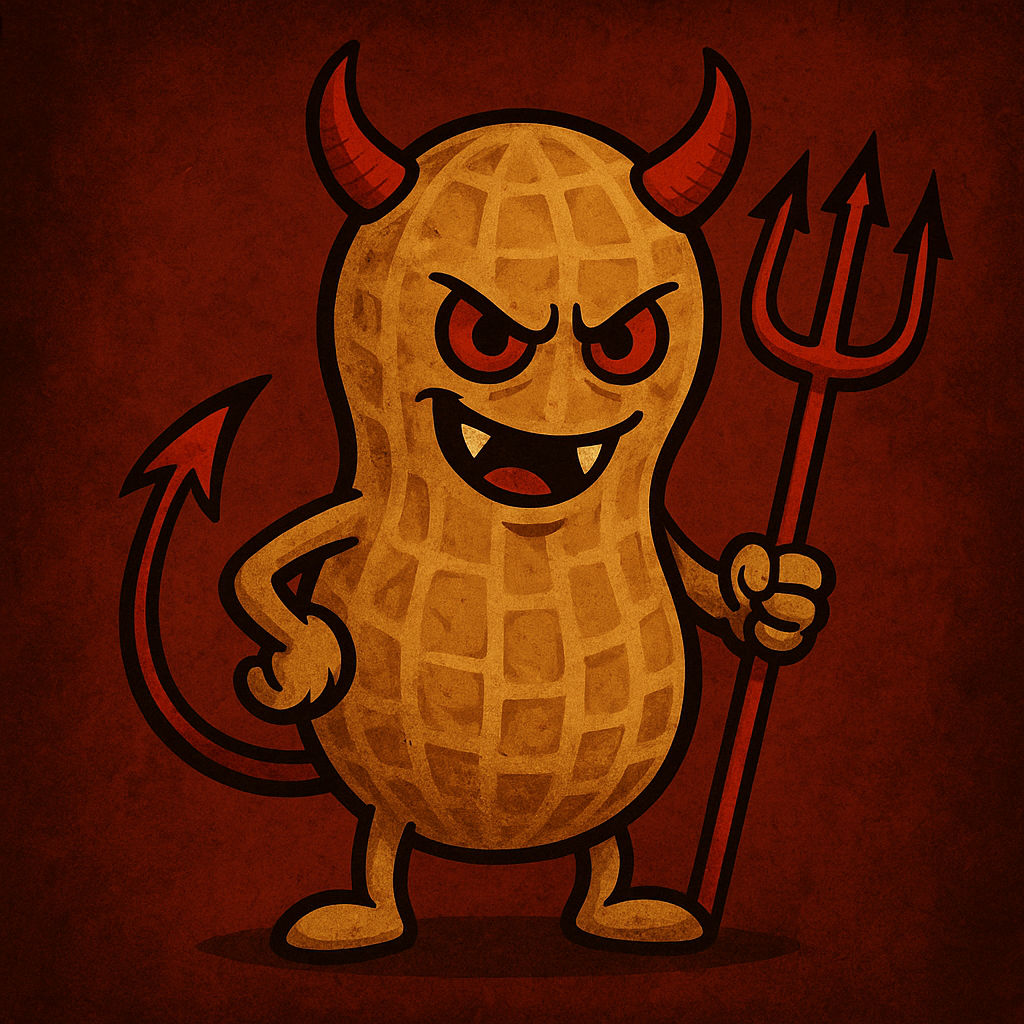
Peanuts. Beloved snack, protein powerhouse, and loyal companion to chocolate bars worldwide. But beneath their crunchy exterior lies a sinister truth — peanuts are not as innocent as they seem. Behind every jar of peanut butter and every bag of roasted nuts lies a history of allergic reactions, food recalls, agricultural exploitation, and deceptive appearances (spoiler: they’re not even real nuts). In this essay, we will unpack the evil lurking within the peanut’s wrinkled shell. But don’t worry — after all the doom and gloom, we’ll still find a reason to keep munching.
1. The Allergen Apocalypse
Perhaps the most obvious strike against peanuts is their notorious reputation as one of the most dangerous food allergens on Earth.
Peanut allergies affect approximately 1–2% of the population in many Western countries, including the UK and the US. Unlike some allergies that cause mild discomfort, peanut allergies can be life-threatening. Exposure to even trace amounts of peanut protein can trigger anaphylaxis — a severe reaction involving airway constriction, hives, swelling, vomiting, and in some cases, death.
Schools across the globe have banned peanut-containing products to protect allergic students. Airplane snack packs have gone peanut-free due to the possibility that a single airborne particle might trigger a reaction in a sensitive passenger.
The evil doesn’t stop at inconvenience — peanut allergies aren’t curable. Avoidance is the only reliable defense, and cross-contamination can make even that nearly impossible. For allergic individuals, peanuts don’t just ruin lunch — they turn everyday eating into a game of Russian roulette.
2. Choking on the Truth: A Silent Danger
Peanuts are also choking hazards, particularly for children. According to the American Academy of Pediatrics, whole nuts (including peanuts) are one of the leading causes of non-fatal choking incidents in children under 3. Their small, irregular shape and texture make them difficult for toddlers to chew and swallow safely.
Parents are frequently warned against giving whole peanuts to young children. In fact, in the UK and US, guidelines recommend avoiding whole peanuts until at least age 5, unless under supervision and after assessing allergy risk.
While this might seem like a small issue, it reflects the peanut’s insidious nature: even without allergy, even without spoilage, even without any wrongdoing on the eater’s part… the peanut still finds a way to kill.
3. Misleading Identity: Not Even a Real Nut
Brace yourself: peanuts are not nuts. They’re legumes. That’s right — they belong to the same family as beans and lentils. So not only are peanuts dangerous, they’re liars.
True nuts (like almonds, walnuts, and cashews) grow on trees and have a hard shell surrounding the seed. Peanuts, on the other hand, grow underground, forming in pods much like peas. This botanical betrayal might seem minor, but it reveals the peanut’s inherent duplicity. Even their name misleads — pea-nut — neither wholly pea, nor truly nut.
This deception has led to public confusion and even more dangerous allergic assumptions. Some people allergic to tree nuts are not allergic to peanuts, and vice versa — but the term “nut allergy” is often used interchangeably, creating misinformation that can be deadly.
4. Salmonella and Food Safety Scandals
In 2008–2009, one of the worst foodborne illness outbreaks in U.S. history occurred due to contaminated peanut products. The Peanut Corporation of America knowingly shipped salmonella-contaminated peanut paste that caused over 700 reported illnesses and at least 9 deaths.
The CEO of the company, Stewart Parnell, was sentenced to 28 years in prison for his role — the harshest sentence ever handed down in a U.S. food safety case. Documents showed executives choosing profits over lives, shipping contaminated products with falsified safety records.
This wasn’t an isolated incident. Peanuts and peanut butter continue to show up in food recall alerts due to contamination risks from salmonella, aflatoxins (a toxic mold), and listeria. Peanuts can become a breeding ground for dangerous microbes if improperly stored, thanks to their high fat content and porous structure.
5. Aflatoxins: Invisible Killers
Peanuts have a natural vulnerability to a group of toxic molds known as Aspergillus flavus and Aspergillus parasiticus, which produce aflatoxins. These toxins are carcinogenic, particularly linked to liver cancer, and can accumulate in food without any visible signs.
In countries with less stringent agricultural controls (particularly in parts of sub-Saharan Africa and Asia), aflatoxin contamination is a serious health crisis. According to the World Health Organization, aflatoxins contribute to up to 28% of all liver cancer cases worldwide, with peanuts being a significant vector.
Even in the UK and US, aflatoxin levels in peanut products are monitored and regulated, but zero risk is impossible. Roasting peanuts helps, but it doesn’t eliminate the toxins entirely.
Evil? Perhaps not by intention. But when you combine a delicious product with invisible mold-based carcinogens, you’ve got a perfect recipe for long-term harm.
6. Agricultural Exploitation and Environmental Toll
Beyond health concerns, the peanut has a darker legacy embedded in colonialism, exploitation, and environmental degradation.
Peanuts became a major cash crop in Africa and the Americas, often grown on plantations that profited from slave labor or other exploitative systems. In the modern era, peanut farming is still associated with labor violations in some countries, including child labor and poor working conditions.
Environmentally, peanuts are a thirsty crop. Although they are more drought-resistant than some other legumes, in industrial-scale agriculture (especially in areas with limited rainfall), peanut farming can strain water resources and deplete soil nutrients.
They also contribute to the monoculture problem — large swathes of land dedicated to a single crop, which decreases biodiversity, increases pesticide use, and weakens ecological resilience. Pest outbreaks in peanut farms can be devastating and often lead to heavy chemical spraying, which affects nearby wildlife and communities.
7. Peanut Butter: A Sticky Situation
Ah, peanut butter. Perhaps the most celebrated of peanut derivatives. But even here, evil lurks.
First, peanut butter is calorie-dense and often sugar-laden, especially commercial brands aimed at children. A single spoonful can contain over 100 calories — not to mention palm oil, high-fructose corn syrup, and artificial additives.
It’s also a nightmare to clean. Once it sticks to a surface — be it countertop, cutlery, or the roof of your mouth — it refuses to budge without a full-scale intervention. Dishwashers tremble in its presence.
And then there’s the toast dilemma — peanut butter’s tragic tendency to rip soft bread apart during spreading. Scientists have sent men to the moon, but we have yet to solve the structural instability of toast under peanut pressure.
8. Peanut Panic in Public Spaces
Let’s not forget the social ripple effects of peanut evil. Because of allergy risks, peanuts have created entire zones of paranoia — schools, airplanes, cafes, and cinemas must now operate with strict rules and constant vigilance.
Parents are burdened with hypervigilant lunch prep, while allergic individuals are forced into awkward conversations, carrying EpiPens, and constantly scanning food labels like forensic investigators.
The psychological weight of a peanut allergy is no joke. Research shows that children with severe allergies often experience anxiety, social exclusion, and reduced quality of life, knowing their life can be threatened by someone else’s snack choice.
Peanuts have created a landscape where one person’s snack is another person’s poison — a truly antisocial legacy.
9. The Weaponization of Peanuts
This may sound extreme, but there have been real cases of peanut exposure being used maliciously — essentially as a biological weapon.
There have been documented incidents where bullies smeared peanut butter on allergic students’ lockers, desks, or even skin. In 2017, a U.S. college student with a known allergy had peanut butter rubbed on his face while passed out at a party — an act treated as assault due to the life-threatening risk.
This speaks to the disturbing potential of peanuts as tools for harm. Very few foods can claim that notoriety.
10. They Just Taste Too Damn Good
So… what’s the catch?
After 9 sections of doom, disease, and deceit, it’s time to confess: peanuts are delicious. Salty, fatty, crunchy — they’re a perfect storm of flavour and texture. Evolution did not prepare the human brain for peanut butter cups, spicy satay sauce, or roasted honey-glazed peanuts.
In fact, the brain responds to peanuts and peanut products much like it does to addictive substances. Their high fat, salt, and protein content triggers dopamine release — the pleasure chemical. Once you start, it’s hard to stop.
Peanut butter and chocolate? Legendary. Peanut brittle? Nostalgic. Boiled peanuts? Southern comfort. From West African peanut stew to Thai peanut noodles, this legume masquerading as a nut has become a culinary global citizen.
Despite all the risks and controversies, the peanut has wriggled its way into our hearts, our cupboards, and our cravings. It’s the charming villain of the food world — dangerous, deceptive, and utterly irresistible.
Conclusion: The Devil You Know (And Keep Eating)
Are peanuts evil? If we define evil as “posing danger, deception, and destruction while wearing a friendly mask,” then yes — the peanut qualifies. Its legacy includes severe allergies, choking incidents, contaminated food recalls, mold-based toxins, ecological harm, and a trail of human rights concerns.
But like many “evil” characters in history and fiction, peanuts are complex. They bring pleasure, nutrition, and comfort to billions of people. They are inexpensive sources of protein and fat, lifelines in food-insecure areas, and versatile culinary gems.
And they taste incredible.
So while we acknowledge the darkness lurking in the humble peanut, we also recognize that resisting them is an exercise in futility. We may rant, accuse, and raise awareness… but at the end of the day, we’ll still be spreading peanut butter on toast, popping them at the pub, and sneaking them into cookies.