Not the sharp kind you clip away without thought, but a barely perceptible split — a sliver of keratin separating from the flesh, like a whisper of rebellion. When Mara noticed it, she pressed her thumb against it, meaning to smooth it down. The pain that answered her was out of proportion, electric, alive. She pulled her hand back as if burned.
“Just a split,” she muttered, studying it under the kitchen light. “Tiny thing.”
But that night, when she tried to sleep, she couldn’t stop feeling it — that microscopic gap where body became not-body. She imagined fibers drifting into it. Air. Dust. Threads. The thought made her stomach twist.
In the morning, her girlfriend Rhea was already awake, sitting cross-legged on the sofa, unravelling a ball of white cotton for some craft project. The sound of it — that faint whispering pull — made Mara’s skin tighten.
“Morning,” Rhea said without looking up. “I’m making clouds for the window display.”
“Maybe use something else,” Mara said too quickly.
Rhea looked up. “What’s wrong with cotton?”
“Nothing. Just… I don’t like it.”
Rhea smiled. “You and your texture things.”
Mara nodded, embarrassed. But later, when she reached for her mug and her nail brushed the sleeve of the cotton jumper Rhea was wearing, she nearly dropped it. The sensation shot through her like a cold wire — that impossible friction, that soft drag that made her feel the split widening, like a mouth trying to open.
By the third day, the hangnail had deepened. No matter how much she filed or covered it, it returned — a persistent seam. The edges of her finger grew tender, red, pulsing faintly as if something was growing beneath. She started wearing gloves, even indoors.
At night, she dreamt of cotton balls expanding endlessly, absorbing light and sound, pressing against her skin until she couldn’t tell where she ended and the softness began. She’d wake with the taste of lint in her mouth.
Rhea laughed it off at first, teasing her gently, but by the end of the week she stopped. The split was worse — black at the edges, like something beneath was rotting. Mara refused to see a doctor. She said she could feel that it wasn’t an infection. It was more like… intrusion.
Something was inside the nail.
She began hearing faint tearing noises at night — not outside, but from within her finger. Fibers shifting. Threads winding. When she held her hand close to her ear, she could almost make out a rhythm, like breathing through cloth.
Rhea found her in the bathroom one night, her gloved hand under the tap, scrubbing furiously.
“Mara! Stop!” Rhea grabbed her wrist. The glove tore. Something white puffed out like a cloud. Rhea screamed and fell back, the cotton-like threads coiling in the air before vanishing into the tiles.
“I told you,” Mara whispered. “It’s spreading.”
They didn’t sleep after that. Rhea tried to rationalize — mold, infection, hallucination — but Mara just sat staring at her hand. It was swelling now, the nail split wide, pale fibers twitching beneath like worms beneath translucent skin.
When dawn came, Mara said she had to go back to the store. “What store?” Rhea asked. “The one where I bought the cotton pads last week.”
Rhea followed her, though she didn’t remember any such trip. The shop was small, tucked between two shuttered boutiques. Its window was lined with mannequins draped in gauze, their fingers wrapped in bandages.
Inside, the air smelled faintly of antiseptic and something sweet — like boiled sugar. The shopkeeper was an old woman, her own hands swathed in white linen.
“I need to return these,” Mara said, placing a half-empty bag of cotton pads on the counter.
The woman looked at her hand and nodded slowly. “Ah. You opened the seam.”
“What seam?”
“The one between touch and memory,” the woman said. “Cotton remembers everything it touches, dear. It’s very patient. When it finds a way inside, it tries to remake what it remembers.”
Rhea’s voice shook. “You’re both insane.”
But when she turned toward the door, it wasn’t there anymore — just rows of pale curtains breathing gently in an unseen breeze.
That night, Rhea woke to find Mara standing beside the bed, hand ungloved, tendrils of soft white thread blooming from the split nail, weaving through her hair, across her face. Her expression was serene.
“It doesn’t hurt anymore,” Mara said. “It’s just… quiet.”
Rhea scrambled back, but her legs caught on something. Cotton. The floor was covered in it — a sea of white stretching out from where Mara stood. Every sound was muffled.
“You should feel it,” Mara whispered, reaching out. “It’s not like the fear anymore. It’s like being remembered.”
Rhea tried to scream, but the air felt heavy, dense, fibrous. When Mara’s fingers brushed her cheek, the cotton threads slid effortlessly into her skin like smoke into cloth. Every nerve sang. Every cell itched with soft static.
She didn’t black out. She dissolved.
Days later, the neighbors reported a faint smell of starch and bleach seeping from the flat. The police found no one inside, just white fabric pinned across every surface — the sofa, the bed, the walls — all stitched together in a single seamless sheet.
In the center of it sat a small glass bowl filled with water. Floating in it was a single fingernail.
It wasn’t cracked anymore. It was perfect — whole — polished smooth like a pearl.
And if you leaned close enough, you could almost hear a sound from within: a soft, steady rhythm.
Charity shouldn’t have to exist. In a compassionate world, care would be woven into the fabric of daily life, not extracted as spectacle.
Charity is society’s way of appealing to the cruelty that lives in all of us, asking it to behave kindly for a moment, to purchase redemption in coins and signatures. It is the illusion of goodness performed atop the ruins of neglect.
The need for charity is proof of systemic failure, not moral success. Every donation is a confession that our structures were designed without empathy.
If kindness were inherent, there would be no charities. If fairness were real, there would be no causes. If love were built into law, there would be no campaigns.
Until then, charity will remain the prettiest mask cruelty ever wore.
Mrs. Spark drifted quietly through the dark, her glow calm, her silence colder than ash. She didn’t need to shout; sparks know when the fire has gone wrong.
Then she saw her, a bright, jittery flamelet, all fizz and perfume. The bit on the side.
“Oh!” the young spark squealed. “You must be his… main source of combustion.”
Mrs. Spark tilted her glow. “So it was you he mistook me for, when he was drunk?”
The younger spark crackled nervously, shrinking to a flicker. “He said it was romantic, you know. That we were destined to ignite.”
Before Mrs. Spark could respond, a distant honk echoed through the night. Both turned their glow toward the sound.
Out of the gloom emerged a clown, riding astride a giraffe with all the ceremony of a knight. The giraffe’s long neck swayed like a burning wick, and the clown’s painted face beamed with absurd solemnity. He tipped his rainbow hat as he passed, jangling bells that fell silent almost immediately in the thick, smoky air. For a moment, their quarrel was paused by this impossible intrusion.
Then came the noise. A low crackling shuffle, like dry leaves catching fire. Out of the shadows lurched the Ashen Sparks, brittle, half-dead remnants of old fires, dragging themselves forward, hissing with envy for the living glow.
The Ashens struck suddenly. One lunged at the young flamelet and sank its ember-teeth into her arm. She screamed, sparks spilling from the wound. Mrs. Spark tried to pull her away, but more of the creatures closed in, circling like vultures.
Just as the swarm pressed tighter, Mr. Spark appeared, swinging his blackened baseball bat. He smashed one Ashen into powder, then another, then shoved the rest back with furious swings. “MOVE!” he shouted.
Together, scorched and trembling, the trio fled into a crumbling pharmacy at the edge of the street. Mr. Spark slammed the door shut, wedging a shelf against it as the Ashens clawed uselessly at the glass.
Inside, surrounded by broken pill bottles and the faint smell of disinfectant, they collapsed in the dim glow of a lantern. The young flamelet clutched her burnt arm, teeth gritted. Mrs. Spark’s silence still carried judgment, but for now, survival weighed heavier than betrayal.
Mr. Spark stood watch at the door, his bat resting on his shoulder. “They only come at night,” he said grimly. “We make it till morning, we live another day.”
And so the three of them, husband, wife, and mistress, sat together in uneasy alliance, waiting for dawn, while the Ashens scraped and hissed in the dark outside.
Unmasking the Machine is an ongoing exploration of how systems built for profit distort the human spirit — and how awareness can begin the repair.
How capitalism turned honest exchange into psychological theatre, and why the autistic mind still yearns for transparency in a world that rewards deception.
Once, the act of trading was a form of human connection. It was not about profit margins or conversion rates — it was about mutual recognition: you have something of value, I have something to offer. The marketplace was a conversation.
Today, that dialogue has been silenced. The modern economy has replaced trust with algorithms, sincerity with strategy, and negotiation with manipulation.
The Death of Honest Exchange
There was a time when price was fluid — a reflection of perception, circumstance, and need. Two people could meet halfway, guided not by greed but by understanding.
Now, prices are fixed long before we enter the conversation. If we try to negotiate, we do so within a simulation of choice — a marketing game designed to make us feel empowered while every outcome still feeds the same profit system.
For neurotypical traders, that game can be exhilarating. For many autistic people, it’s exhausting. The subtle cues — the tone, timing, charm, bluff — are invisible traps. What once was negotiation has become performance, and performance has never been the autistic strong suit.
What’s left isn’t trade. It’s theatre. And the script has already been written.
The Integrity Deficit
The rot goes deeper than the disappearance of haggling. It lies in the very intention behind creation.
Some people and companies make things worth buying — tools, art, inventions, ideas that serve a purpose or bring genuine joy. Their reward is intrinsic: the pride of making something good.
Others begin with a spreadsheet and reverse-engineer desire. They design products to meet margin targets, not human needs — and pour their creativity into marketing psychology, not craftsmanship. They sell stories, not solutions.
Capitalism once sold us what we wanted. Now, it teaches us what to want.
The difference between creation and manipulation is as vast as it is invisible — and the modern consumer is left to navigate a marketplace where both masquerade as innovation.
The True Price of Trust
Amid the noise, something inside still longs for fairness — for that simple, honest exchange of “this is what it’s worth to me — what’s it worth to you?”
But the system no longer understands that language. It has replaced value with metrics, integrity with strategy, trust with tactics.
That is the true price of trust: a currency the machine no longer knows how to pay.
When I first imagined performing live, I pictured something transcendent. I saw myself on stage, lost in the music, surrounded by friends and strangers all riding the same wave. I imagined sound washing over us like a baptism. Something pure. Communal. Liberating.
And while those moments do exist, they are rare—buried beneath a pile of stress, mismanagement, and quiet indignities. Gigging, for unsigned artists, often means sacrificing peace of mind for a slot on a poster. It’s a world where passion collides with a brick wall of indifference.
Let’s talk about it.
The Environment They Don’t Talk About
You turn up to the venue and there’s no green room. No safe place to relax or focus. You’re balancing nerves and gear in a room that wasn’t built for either.
There’s no proper soundcheck—or if there is one, it’s rushed, incomplete, and handled by a disinterested engineer. You don’t get a feel for the room, or confidence in how you’ll sound. You just get: “Alright, you’re on.”
Your expensive equipment? It lives in fear. There’s no secure lockup, no backstage, no assurance. Just watch it like a hawk and pray it doesn’t disappear while you try to catch your breath.
You finish your set and you’re ushered off-stage like livestock in a holding pen, with barely enough time to speak to friends who came to see you play.
And money? If you get anything at all, it won’t come close to covering travel, time, gear maintenance, or the emotional cost. But you’re told to be grateful. Exposure is your reward.
“But at least you get to play live, right?”
Here’s what they don’t tell you:
You won’t even be considered unless you’ve racked up enough social media followers—not talent, not originality, just metrics.
Promoters often don’t listen to your music. You’re not curated—you’re slotted into a lineup like stock on a shelf.
Genre cohesion? Forget it. You might play sludge doom between bubblegum punk and comedy folk. Audiences scatter. Nobody wins.
You’ll be expected to promote and sell your own tickets, as if you’re the promoter now. If ticket sales are poor, you take the blame.
In city venues: no parking. You load in through a narrow alley, then drive three streets away and hope for the best.
Your rider? One drink. One. And if you’re lucky, it might not be warm beer in a plastic cup.
The sound system might be hanging on by a thread. Drum kits with stripped lugs, guitar amps with mystery hums. Monitors that don’t monitor.
Cramped stages mean you can’t move. You play like statues because there’s nowhere else to go.
Lighting? Maybe a flickering bulb or a half-dead strobe. Energy comes from you, not the room.
A Moment of Contrast
Recently, I saw Billy Corgan perform live as part of a supergroup at Black Sabbath’s monumental final show. From our seats, we could glimpse backstage. We saw Corgan vibing out with joy—smiling, hugging, present.
That’s what music should feel like.
And yes, there’s still stress at higher levels. But at least there’s infrastructure. Roadies to carry the weight. Engineers who care. A system that catches you when you fall.
For us, the unsigned, there is no such safety net. And sometimes, the dream of playing live gets eroded by the conditions we’re forced to endure.
Why I’m Still Here
I’m not writing this to whine. I’m writing it because someone has to say it: it shouldn’t have to be this hard to share something sacred.
I still believe in the core of it—in the magic of a note ringing out, in connection, in that moment where the world stops and music takes over.
But if we want to protect that magic, we have to talk about what threatens it. And for unsigned artists, that means speaking up about the quiet cost of every “opportunity” we’re handed. Because love alone doesn’t make the system fair. And passion doesn’t pay for parking.
This is the second entry in The Fallacy Deck — a series exploring rhetorical “trump cards” that get thrown onto the table to end conversations before they’ve even begun.
We’ve all seen it happen.
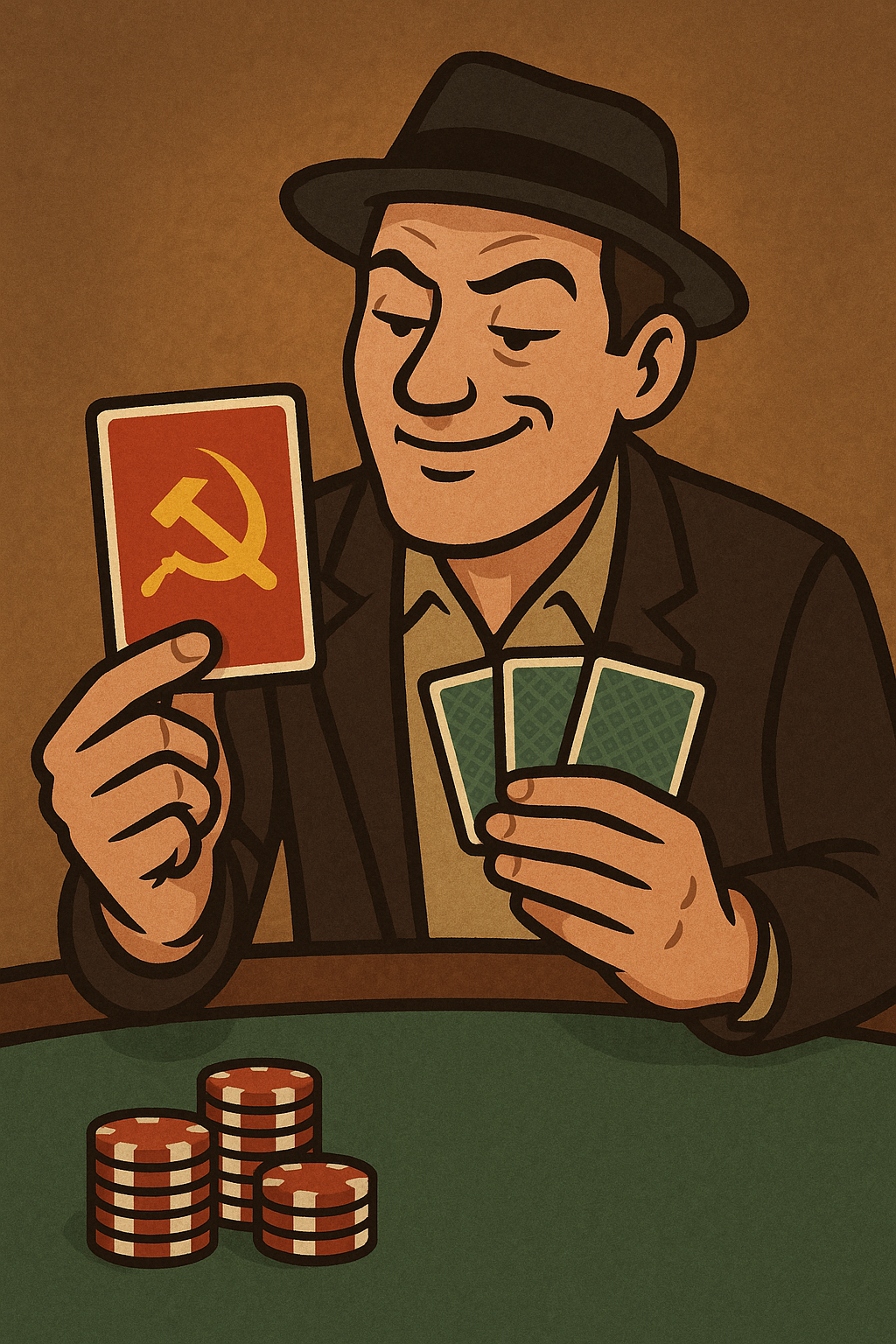
Mention that capitalism might have a few… catastrophic flaws — ecological collapse, wealth inequality, a tendency to consume everything in its path — and someone at the table narrows their eyes, leans forward, and slaps down a familiar, crimson-colored card.
“Oh, so you want communism then?”
Checkmate. Conversation over.
No need to discuss actual policy. No need to consider history, nuance, or alternatives. The mere mention of capitalism’s failings has triggered the defensive system — and the Communism Card has been played.
What Is the Communism Card?
The Communism Card is a rhetorical maneuver designed to shut down critiques of capitalism by lumping them in with the most dystopian, fear-loaded caricature of communism imaginable.
It goes something like this:
You suggest wealth caps? That’s Marxism.
You question private ownership of essential resources? Sounds like Stalin.
You propose a cooperative model for local governance? Might as well move to North Korea.
The tactic is rarely about communism itself. It’s about weaponizing the fear of authoritarianism, scarcity, and historical trauma to scare people away from even thinking about alternatives.
Why It Works
It works because it’s easy.
Capitalism is deeply embedded in modern Western identity. It’s marketed as synonymous with freedom, choice, and innovation. So anything that challenges it can be framed as the opposite: tyranny, restriction, and stagnation.
And let’s be fair — historical examples of state-communism have given plenty of ammunition. Soviet purges. North Korean isolation. Bread lines and secret police. It’s not hard to associate communism with suffering.
But here’s the thing: none of that has anything to do with what you were actually suggesting.
The Communism Card doesn’t engage with your argument — it simply projects a nightmare onto it.
Why It Fails
It’s intellectually dishonest. Suggesting a wealth tax or public healthcare is not the same as proposing a one-party state.
It ignores diversity. Not everything left of capitalism is communism — and not all communism looks the same either.
It suppresses innovation. If every alternative gets branded as “failed communism,” we never get the chance to explore new systems.
Worst of all, it prevents nuance — forcing every idea into a binary of “free market good” vs. “authoritarian communism bad.” This kind of false dichotomy is exactly what keeps us stuck in systems that no longer serve us.
What Gets Lost
When the Communism Card gets played, curiosity is the first casualty.
We lose the chance to explore:
Cooperative economics
Degrowth models
Resource-based economies
Participatory democracy
Hybrid systems that blend the best of multiple ideologies
All of these vanish the moment someone throws down the red card and says, “You’re just being unrealistic.”
How to Respond
So how do you counter the Communism Card without getting sucked into its trap?
Stay on topic. “I wasn’t proposing communism. I was questioning whether capitalism is working for everyone.”
Name the tactic. “That sounds like a deflection, not an argument.”
Invite nuance. “There are more than two systems in the world. Let’s explore the options.”
You don’t need to defend communism to critique capitalism. And you don’t need to be a utopian to want something better.
The Real Question
If our system is so great, why is it so afraid of being questioned?
Why is the mere suggestion of change met with panic, scorn, or accusations of treason?
If capitalism truly is the best we can do — shouldn’t it welcome comparison? Shouldn’t it thrive under scrutiny?
Or has it simply learned to play the game better — stacking the deck and silencing dissent before it can take shape?
Final Thought
The Communism Card isn’t just a fallacy — it’s a smokescreen. It disguises the real conversation we need to have with fear, ridicule, and false choices.
But we don’t have to accept the terms of that game. We can collect the cards. We can reshuffle the deck. We can deal ourselves back in — with new rules, new questions, and a refusal to fold under someone else’s illusion of certainty.
I’ve long been seen — accurately, I suppose — as someone who’s deeply critical of capitalism. I’ve written about its harms, spoken against its cruelties, and refused to romanticize its supposed triumphs. But I want to be clear: my position isn’t as simple as “capitalism is evil.” It’s more layered than that. And, I think, more important.
The truth is, I don’t necessarily object to capitalism in theory. Its founding ideas — voluntary exchange, innovation through competition, personal agency — aren’t inherently bad. In fact, I can even acknowledge that in certain historical contexts, capitalism unlocked progress. It introduced new efficiencies, raised living standards for some, and created systems of exchange that felt freer than what came before.
But here’s the problem: ideas don’t live in theory. They manifest through people — and people bring power, greed, fear, and inequality to the table. Just as communism is often written off for the ways it failed in practice, capitalism too must be examined through what it has become, not what it once promised.
We’re not in the Industrial Age anymore. We’re not in post-war recovery or the dawn of the internet. We’re in a different world entirely — a burned-out, over-leveraged, crisis-laden stage of history where the returns of capitalism are not only diminishing, they’re actively eroding the foundations of life.
So, this is not a rant. It’s a reckoning. A moment of pause. A chance to ask: Has capitalism passed its point of usefulness? And if so, what happens next?
Capitalism as an Idea vs. Capitalism as a Reality
Capitalism, at its core, is not a cartoon villain. It didn’t arrive with horns and a pitchfork, declaring war on humanity. It emerged as a system of trade, incentive, and competition — an economic response to stagnation, feudalism, and centralized control. In theory, it offered liberation: the freedom to produce, to own, to exchange, and to innovate without waiting for permission from monarchs or ministries.
There is value in that idea. Even now, many of capitalism’s foundational principles can sound appealing:
Voluntary exchange between individuals
Incentivized innovation through profit
Competition to drive efficiency and improvement
Private ownership as a safeguard against tyranny
These are not, on their own, evil concepts. In fact, in a vacuum, they can even seem moral — fostering agency, reward for effort, and the pursuit of ideas.
But we don’t live in a vacuum.
We live in a world where ideas are shaped, implemented, and twisted by very human hands. And this is where capitalism’s reality begins to split from its myth.
In practice, capitalism doesn’t exist in some pristine theoretical form. It lives in legislation, in lobbying, in advertising algorithms, in debt traps, in gig economies, in sweatshops, and in billionaires profiting from human suffering. It thrives in the grey space where “freedom to trade” becomes “freedom to exploit,” and where “reward for innovation” becomes “reward for monopolizing.”
It sells itself as a meritocracy — but its playing field was never level. It claims to reward hard work — but it often rewards inherited wealth, systemic privilege, and the ability to offload consequences onto others. It masks these contradictions with comforting stories, like the underdog entrepreneur or the innovation hero, while hiding the pipelines of extraction and harm that fund its foundation.
In short: the problem isn’t just the idea of capitalism. It’s what the idea becomes when filtered through centuries of inequality, short-term thinking, and unchecked greed.
And most importantly — it’s what the idea is doing now.
In an earlier phase of history, we might have argued that capitalism was simply flawed, in need of regulation or reform. But today, we face a more pressing question:
Has capitalism outlived its usefulness? Has the cost of maintaining it begun to outweigh the benefits it can realistically provide?
This is the question we now have to face. Not as ideologues, but as participants in a crumbling system.
The Threshold of Diminishing Returns
Every system has its curve. In the early stages, small inputs can yield great rewards — fertile ground, fresh momentum, and a sense of upward motion. But eventually, the same actions produce less impact. You have to burn more fuel just to keep going the same speed. The ground becomes less fertile. Growth turns to strain. What once worked begins to break.
Capitalism is now at that point.
In its early centuries, it offered rapid progress — new technologies, expanding economies, rising life expectancy (for some), and access to material goods previously unimaginable. Its defenders still point to those achievements as proof of its legitimacy.
But the arc is bending.
Today, we are watching as those once-celebrated returns shrink, while the collateral damage multiplies. The same system that once lifted some out of poverty now traps many in precarity. The innovation engine keeps running, but increasingly to produce what? Faster phones? Endless subscriptions? Infinite choice with no time to choose?
Here are just a few ways the law of diminishing returns is now revealing itself:
Economic Saturation
Productivity continues to rise, but wages remain stagnant.
Growth no longer lifts all boats — it inflates yachts and sinks lifeboats.
Real estate “markets” have turned shelter into speculation.
Workers are more replaceable than ever, despite being more essential than ever.
We’re not building prosperity — we’re sustaining inequality.
Environmental Collapse
The system demands perpetual growth — but the planet is finite.
Resource extraction accelerates even as the earth’s systems fail.
Carbon offsetting and “green capitalism” become PR tools, not solutions.
Capitalism’s success depends on ecological failure — and it’s running out of biosphere to burn.
Psychological Exhaustion
The pursuit of efficiency leaves no room for meaning.
The algorithm doesn’t care if you’re fulfilled — only if you’re engaged.
Burnout becomes a baseline state, while joy becomes a luxury commodity.
We are more connected, yet more alienated. More “free,” yet less present.
Innovation for Innovation’s Sake
Most “new” products are variations, not breakthroughs.
Planned obsolescence replaces craftsmanship.
Creativity bends to the logic of clicks and quarterly reports.
We are no longer innovating for humans. We are innovating for markets.
These aren’t growing pains. They’re signs of saturation. We’re pushing the system beyond its capacity to deliver anything other than diminishing returns — even as it consumes more time, energy, attention, and planet than ever before.
And crucially, this decline is not evenly felt. The poorest are hit hardest. The youngest inherit the worst. The Global South pays the bill for the Global North’s convenience.
Capitalism doesn’t die with a bang — it withers, slowly, under the weight of its own promises.
This threshold is not coming. We are in it. The real question now is whether we continue propping up a system that feeds on exhaustion — or whether we begin imagining something else.
The Human Filter — Greed as the Distortion Lens
No economic system exists in a vacuum. Every idea, no matter how elegant on paper, must pass through the unpredictable, flawed, hopeful, fearful, greedy filter of human nature.
This is where the story of capitalism becomes less about ideology and more about psychology.
Because capitalism doesn’t just allow self-interest — it depends on it. It assumes that when each person acts in their own interest, the whole system benefits. That invisible hands will guide markets toward the common good. That competition will self-correct greed. That the quest for profit will always align with the advancement of society.
But in practice, we’ve seen a very different outcome:
Greed doesn’t self-limit — it compounds.
Power doesn’t decentralize — it consolidates.
Profit doesn’t trickle — it pools.
Capitalism rewards efficiency — but it doesn’t ask efficient for whom? It rewards growth — but never questions what’s growing, and at what cost?
Over time, this creates a feedback loop. Those who succeed in the system gain more resources to rewrite the rules in their favor. Wealth becomes power, and power protects wealth. Regulation becomes suggestion. Exploitation becomes strategy. And soon, what once looked like opportunity becomes an unscalable wall for most — a gilded cage for the rest.
Just like communism was disfigured by authoritarianism, capitalism too has been disfigured — but in subtler, more insidious ways. It hides its cruelty behind branding. It wraps structural inequality in lifestyle aesthetics. It calls wage slavery “flexibility,” and exploitation “freelance freedom.” It launders oppression through the language of choice.
And because of this, the system becomes increasingly hard to question. Anyone who challenges it is accused of being naïve, lazy, ungrateful, or worse — a threat to “freedom.” But what kind of freedom demands you sell your time, your health, and sometimes even your ethics just to survive?
The issue isn’t that humans are greedy. It’s that capitalism offers greed a throne, a crown, and a PR team.
We don’t need perfect people to build a better system. We need systems that expect imperfection, and are designed not to elevate the worst parts of us.
The Subtle Fall of Capitalism
Revolutions are loud. They burn flags, topple statues, storm gates. But systems don’t always die with such drama. Sometimes, they simply stop working. Their rituals lose meaning. Their promises grow stale. Their language becomes hollow. And eventually, without needing a coup or a civil war, they fall — not with a bang, but with a shrug.
Capitalism may be heading in that direction.
It’s not collapsing in fire — it’s hollowing out. Its slogans still echo — but fewer people believe them. Its institutions still operate — but more people are opting out.
The signs are everywhere:
Young people are turning away from traditional work models, rejecting corporate careers and instead choosing creative paths, gig work (even with its flaws), or grassroots community efforts.
Consumers are beginning to ask where their products come from, how they’re made, and what values they support — not always perfectly, but more than before.
Employees are walking out, unionizing, quitting en masse in what’s been called the “Great Resignation.”
Conversations about degrowth, post-capitalism, universal basic income, and alternative ownership models are no longer fringe ideas — they’re entering mainstream dialogue.
The system is still standing, but its cultural legitimacy is cracking. And systems without cultural legitimacy don’t need to be overthrown. They simply rot from the inside until they’re replaced.
This isn’t utopian wishful thinking. It’s a shift in where people place their faith. In the past, capitalism was accepted almost as a law of nature — as inevitable. But inevitability is a myth, and once enough people stop believing in it, the ground begins to shift.
People are no longer asking, “How can we fix capitalism?” They’re starting to ask, “What if we stopped needing it at all?”
And the more that question gets asked, the more viable the alternatives begin to feel. Even small-scale experiments — cooperative housing, open-source projects, time banks, community land trusts — begin to expose capitalism’s flaws simply by working without it.
Capitalism may not need to be destroyed. It may simply need to be outgrown.
This is not about instant transformation. Systems don’t vanish overnight. But they do lose their hold when people begin to imagine life beyond them — and act on those imaginings.
Where the Real Fight Is Now
If capitalism is indeed hollowing out — not through sudden collapse but through erosion of meaning — then the battle isn’t where we were told to look. It’s not on the trading floor, or in elections, or even in the courtroom. The real fight now is quieter. Slower. Often invisible.
It’s happening in minds. In stories. In values. It’s happening every time someone asks, “Is this really the only way?”
This is not a call for armed revolution. It’s a call for intellectual defiance — and creative alternatives.
Because maybe we don’t need to defeat capitalism. Maybe we just need to stop obeying it — not by force, but by imagination.
Here’s what that looks like:
Refusing the Narrative
Capitalism relies on a myth of inevitability — that there is no alternative. That you’re either with the system, or you’re a naive idealist. But every time someone questions that binary, a crack appears in the façade.
We can fight back by refusing the frame. We can remind ourselves that the “natural order” is often just a story told by those in power.
Building Outside the Machine
You don’t need to fix capitalism to begin building beyond it. Micro-resistance is still resistance. Every time someone:
shares skills without profit,
creates without metrics,
forms community without hierarchy,
organizes without exploitation,
…they’re laying foundations for something after.
Reclaiming the Self
The system feeds on exhaustion. Burnout isn’t a glitch — it’s fuel. But slowing down, setting boundaries, prioritizing rest and joy — these are radical acts in a culture that wants you maximally productive and minimally aware.
To be unhurried is to be ungovernable. To be still is to see clearly. To see clearly is to choose.
Choosing Connection Over Competition
Capitalism teaches us to view each other as rivals. But healing begins in solidarity. In collaborative creation. In collective reimagining. That doesn’t require perfection — just the willingness to reject the lie that we are alone in this.
The real rebellion might not be in burning the system down, but in making it obsolete — not by force, but by offering something better, truer, and more human.
That’s what I try to do. I write and produce music, not for charts, not for clicks, not to please some invisible algorithm — but for myself. For expression. For resonance. I refuse to let my creativity become content. It doesn’t exist to perform or convert. It exists to be.
In a system that commodifies every impulse and reduces every action to a potential monetizable outcome, that’s an act of quiet defiance.
And I’m not alone.
A System on Borrowed Time
Capitalism isn’t going to vanish overnight. It may not “fall” in the way empires of the past have fallen. There will be no singular moment where we wake up and say, it’s over now. That’s not how paradigms shift. That’s not how consciousness works.
But when a system begins to feel tired, forced, and unbelieved, that’s the beginning of its end.
And that’s where we are.
Its promises no longer land. Its rewards feel empty. Its logic rings hollow. And more people — quietly, bravely — are stepping away. Not necessarily into grand political movements or new isms, but into smaller, saner ways of being. Into mutual care. Into voluntary work. Into creative acts that refuse to be productized. Into lives measured not by output, but by meaning.
Capitalism will not be defeated by ideology, but by irrelevance. And irrelevance begins when enough people look at the machine and say: I’m done playing.
You don’t have to have all the answers. You don’t have to build the perfect alternative. You just have to see clearly — and choose, when you can, to live differently.
That may be the most radical thing anyone can do right now. Not to fight the system with its own weapons, but to put them down. To walk away. To begin again — with eyes open, hands free, and heart intact.
I have a great deal of respect for Tony Iommi. Not just because he invented a genre — though let’s not brush past that too quickly — but because of how he did it, and who he continues to be.
Iommi is the architect of doom, the father of the riff. But more than that, he’s one of the most down-to-earth rock icons I’ve ever witnessed. There’s no ego in his playing. No posturing. Just pure love for the guitar, expressed with grace, power, and an unmistakable sense of tone and timing. His playing is heavy, not just in sound, but in soul.
My journey with Black Sabbath began like many of my generation — online. Late 1990s or early 2000s, downloading mp3s from Napster, not even sure what I was about to hear. And yet, the moment those dark, slow riffs hit, even through compressed files and computer speakers, I felt it. Sabbath didn’t need hi-fi to shake you — they existed in pure riff form, demanding to be heard.
Not long after, something even more personal happened: my dad gave me his original vinyl copy of Black Sabbath — their debut album — the very same one he bought when Sabbath first emerged. That record became more than just an object. It was a shared artifact, holding decades of reverence. Every scratch in the vinyl felt like part of a legacy now passed on.
In 2005, I saw Black Sabbath live for the first time — and not just anywhere. It was at the Aylesbury Civic Centre, an incredibly intimate venue, especially for a band of their stature. I shared that night with my dad and my brother, and the intimacy of the performance made it feel like Sabbath was playing directly to us. A few weeks later, the contrast was stark — we saw them again at Download Festival, this time in front of a massive crowd. Yet even on that enormous stage, the same energy pulsed through. It was less about scale and more about truth. Sabbath always deliver the truth.
In 2023, my girlfriend and I went to see the opening night of ‘Black Sabbath – The Ballet’ in London — a surreal, genre-fusing experience in itself. The juxtaposition of ballet and doom metal shouldn’t work on paper, but it did. Deeply. It was theatrical, poetic, and profoundly moving. The music of Sabbath, reinterpreted through movement and form, felt like watching thunder take shape.
Then came the surprise. Tony Iommi himself stepped onto the stage for the climax.
We were sitting in the second row — second row — and suddenly, the music folded back into its origin point. There he was: the man who wrote the soundtrack to so many people’s lives, quietly commanding the stage. When our eyes met, even briefly, it felt like a personal acknowledgment. Not just of our presence, but of everyone who’s ever connected with the frequencies he’s sent into the world.
That wasn’t the only moment my girlfriend and I shared over Sabbath. Another cherished memory: the two of us curled up, watching a concert video from their ‘The End’ tour. We listened through my Sennheiser HD800s headphones and Schiit Valhalla 2 tube amp — letting the tone soak into us, every nuance. It wasn’t just watching a performance; it was a private, reverent listening ritual. Sabbath as communion.
That night stayed with me. It still does.
But even that wasn’t the pinnacle. That came when I saw Black Sabbath perform their final ever show, ‘Back to the Beginning’ — the end of an era. There was a weight in the air that night, a kind of reverent silence between songs, as if everyone in the crowd knew they were witnessing something historic. And in the middle of it all, there was Tony. His playing that night didn’t just sound good — it sounded final, essential, eternal. Every note was oozing with soul and history. He wasn’t just playing riffs — he was channeling decades of meaning through his fingers. Watching him perform in that context, I felt the full depth of what he gives to the music. It wasn’t just sound; it was legacy embodied. And as I’ve been working on my own playing — particularly learning and revisiting “Iron Man” — I’m realising just how expressive Tony’s playing truly is. The subtleties are everything. A little side-to-side vibrato. Letting the chord decay all the way down, with just a whisper of slide noise. Palm muting not for silence, but for tension. These aren’t flashy tricks — they’re soulful choices. They speak of someone who feels every note.
I can feel myself learning to listen, not just play. To make the guitar breathe. That, to me, is the spirit of Iommi. And every time I pick up my SG, it’s with a little bit of that spirit in my fingers.
Tony Iommi didn’t just invent a sound. He also overcame what could have been a permanent wall between him and his instrument — losing the tips of two fingers on his fretting hand in an industrial accident. For most, that would have meant the end of a dream. But for Tony, it became the beginning of a new path. He crafted homemade prosthetic fingertips, adjusted his technique, and in doing so, created a new kind of sound — one that shaped a genre. That story is more than inspiring — it’s a testament not only to his love for guitar and music, but to his indomitable spirit. It tells you everything you need to know about who he is, and why his playing carries the weight that it does. He proved that sound can carry soul without screaming for attention. That resilience, authenticity, and sheer love of music can resonate louder than any amp.
This is why I got an SG. This is why I play.
And this is why, when I think of guitar heroes, I don’t think of the fastest or flashiest. I think of the quiet architect of thunder, standing center stage — no ego, no flash — just grace, tone, and fire.
Because a life well-lived isn’t just about the peaks—it’s about the depth.
Introduction
The modern concept of a “bucket list” gained widespread popularity after the 2007 film The Bucket List, in which two terminally ill men set out to accomplish a series of grand adventures before they die. Since then, the phrase has become shorthand for any life goals meant to be ticked off before one’s final breath.
But somewhere along the way, the bucket list became a billboard. An itinerary of spectacle. Climb Everest. Go skydiving. See the Northern Lights. Write a novel. It became less about meaning and more about milestones. Less about living, and more about doing.
This list is an invitation to go the other way.
What follows is an alternative bucket list: a set of quiet, human, soul-nourishing challenges. No air miles required. No audience necessary. These are not tasks for applause, but dares for depth.
Self-Honesty and Inner Courage
Admit to yourself something you’ve been in denial about. Start small or start seismic. Just start.
Look at yourself in the mirror for one uninterrupted minute. No judgment, no posing. Just look.
Forgive yourself for something you’ve held against yourself for years. You can still hold yourself accountable. But release the hatred.
Change your mind about something important. Growth is not betrayal.
Spend a whole day without trying to be ‘productive’. You’re still valuable.
Boundary and Boldness Practice
Say no to someone’s request for a favour. Without apology. With respect.
Stand up for something you believe in that isn’t popular. Even if your voice shakes.
Let someone help you. Even if you feel you don’t deserve it.
Tell someone how you really feel. Especially the good things.
Let go of a goal you only pursued to please others. Make space for what you want.
Compassion and Connection
Give money, food, or time to someone who needs it more than you. And don’t post about it.
Have a meaningful, non-verbal exchange with an animal. It counts if it makes you feel something.
Offer forgiveness to someone who never asked for it. Not for them. For you.
Hold space for someone else’s story without interrupting. Listen until the end.
Send a message to someone you miss, just because. They don’t have to reply.
Wonder and Awareness
Come to your own conclusion about something most people accept without question. Even if you change your mind again later.
Watch clouds move or stars appear, doing absolutely nothing else. Be a witness to the sky.
Touch something natural and really notice it. Bark. Sand. Petals. Your own skin.
Spend time in silence—not as punishment, but as presence. Let the stillness speak.
Write a letter to yourself 10 years ago. Or 10 years from now. And maybe don’t send it.
Closing Thoughts
None of these challenges require wealth, a passport, or even much time. But they do ask for you. Your presence. Your willingness. Your inner gaze.
Try one. Try three. Make up your own. But whatever you do, let your life be more than a checklist of spectacles. Let it be a tapestry of moments that actually changed you.
You don’t need to leave the planet. Just show up on it.
What would your own alternative bucket list look like?
Let’s ask a bold question today: Is capitalism natural?
You hear it all the time: “Competition is natural.” “Survival of the fittest!” “Animals compete for resources too, so capitalism is just human nature.”
Okay. Let’s test that.
Primates and Barter
Some monkeys exchange grooming for food. Vampire bats share blood meals with friends who had a bad hunting night. Dolphins have been seen trading favors.
Sounds a bit like trade, right? Sure. But they’re not stockpiling bananas to rent out at interest. There’s no corporate monkey hoarding grooming time for leverage.
Verdict: Mutual aid > capitalism.
Wolves and Hierarchy
Yes, wolves have social hierarchies. But alpha status isn’t about profit margins, and when the alpha gets old, their status naturally changes. No dynastic wealth passed on to wolf pups.
Verdict: Power, yes. Inherited class systems? Not so much.
Ants and Division of Labor
Ants have a queen. Workers do different jobs. Sounds like a factory?
Except: they don’t get a choice, they don’t hoard, and no one gets a performance bonus. The colony exists to survive together, not generate infinite quarterly growth.
Verdict: If anything, that’s ant-communalism.
Lions and Territory
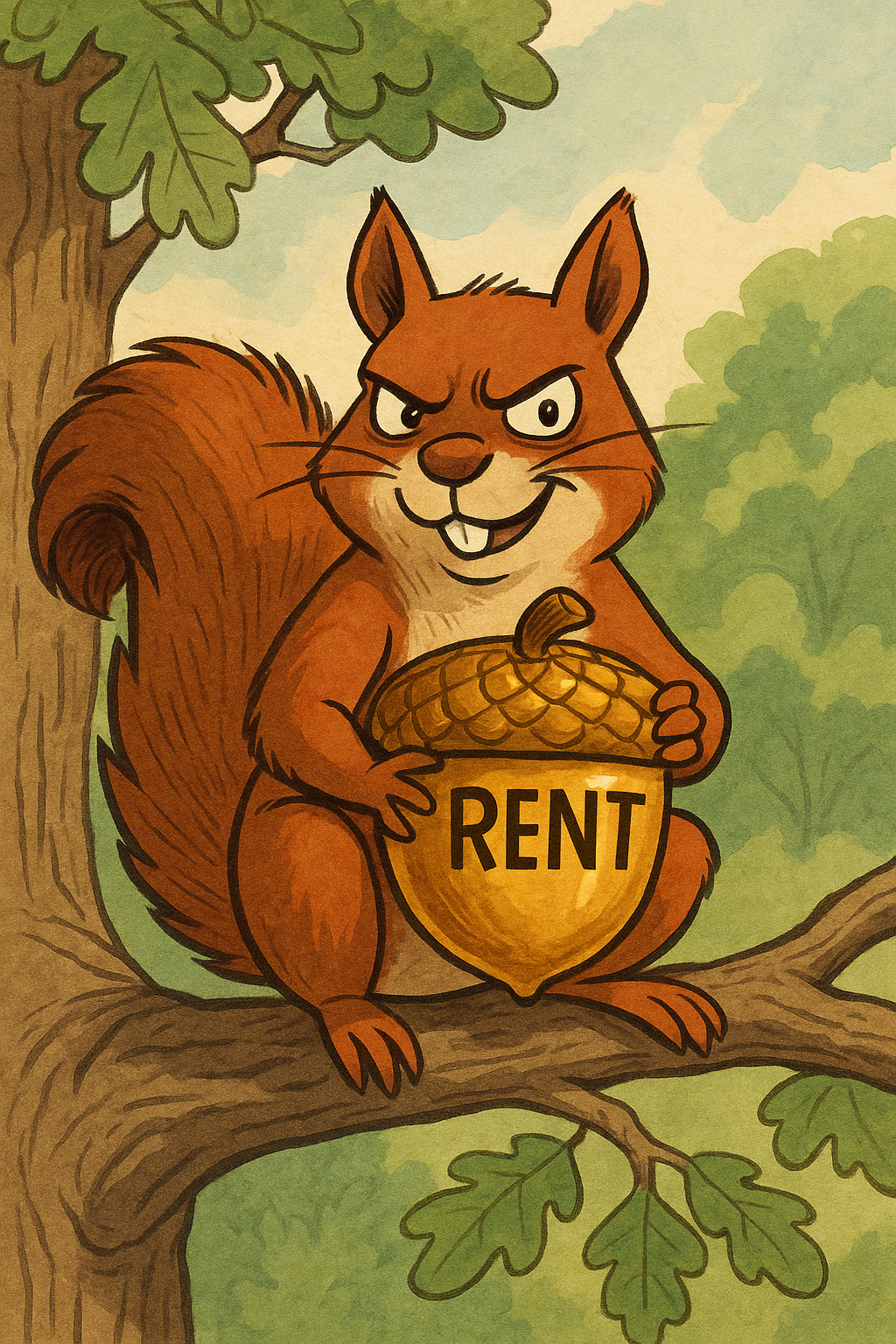
Lions defend turf, sure. But once they die or get ousted, the land doesn’t go to their heirs in a real estate portfolio. Territories are earned, lost, or reshuffled. There’s no lion landlord charging monthly antelope rent.
Verdict: Competition? Yes. Capital accumulation? Nope.
Birds and Courtship Displays
Some birds spend a lot of time building impressive nests or learning flashy songs to attract a mate. Marketing? Maybe.
But once the courtship’s done, they’re not franchising their brand or charging royalties.
Verdict: Nature’s flex, not capitalism’s hustle.
So What’s Actually ‘Natural’?
Sharing.
Reciprocity.
Competition within ecological limits.
Cyclic renewal.
What isn’t natural:
Owning labor.
Monetising attention.
Profiting off scarcity you engineered.
Stockpiling more than you need while others starve.
So next time someone tells you capitalism is just nature doing its thing, ask: Have you ever seen a squirrel charge rent for a tree?
Capitalism isn’t natural. It’s engineered. And nature is quietly horrified.
Written with respect to every overworked worker ant and underpaid monkey in the system. We see you.