Sainsbury’s Nectar ‘Loyalty’ Scheme: Coercion Into App Dependency

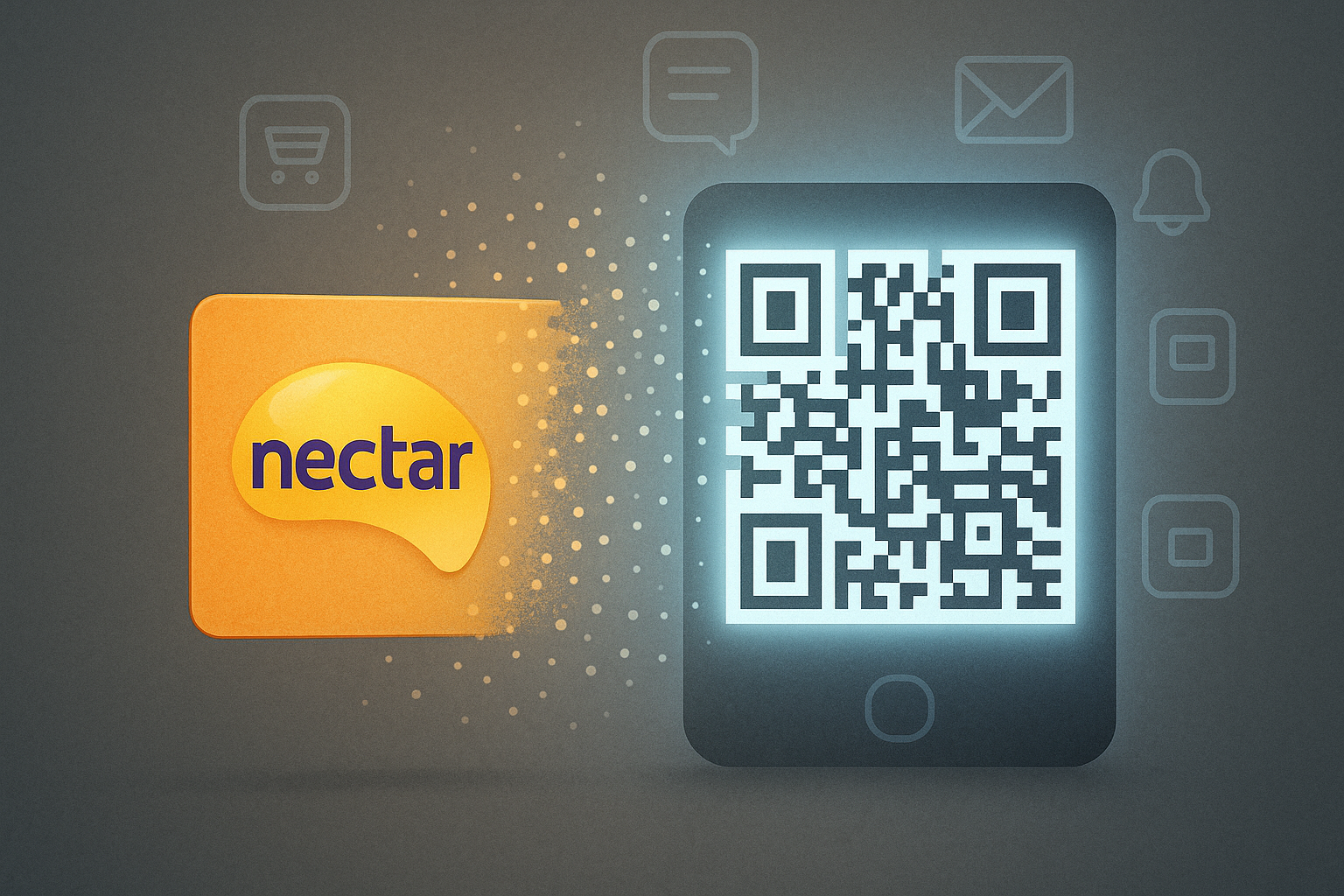
A stylised illustration of a Nectar loyalty card dissolving into a glowing QR code. Small faded smartphone notification icons surround the QR code, creating a subtle cage-like effect. The image represents the shift from physical loyalty cards to app-based systems.

ALARM BELLS IN A “ROUTINE UPDATE”

The subject line alone stopped me in my tracks:

There is something about a sentence like that, calm on the surface but quietly signalling that the rules have shifted, that immediately puts me on alert. Changes to how you collect and spend your points is not a minor technical tweak. It is a foundational adjustment to how the entire system works.

Just a few lines into the email, beneath a short justification about “maintaining the security of your points,” came the statement that confirmed my unease:

No explanation. No alternatives. No acknowledgement of how significant that instruction really is. It was presented as if it were the most natural thing in the world.

For me, this was an immediate alarm bell. It did not read like a harmless update. It read like the quiet conversion of a long standing physical system into a digital one. A shift from loyalty card to loyalty app, framed as security rather than as a fundamental change in customer interaction.


WHEN LOYALTY SCHEMES BECOME DIGITAL GATEWAYS

Loyalty schemes used to be simple. You carried a physical card, you scanned it, you collected points, and you occasionally exchanged those points for something modest. There were no hidden conditions and no digital obligations. A card was a card, nothing more.

Today the loyalty card is becoming something else entirely. More companies are shifting these schemes into smartphone apps, and with that shift comes a completely different relationship between customers and the business.

On the surface, an app looks like a modern convenience. In reality, it introduces several changes that are rarely acknowledged.

First, an app becomes a data harvesting vessel. Every interaction can be logged and analysed. This includes what you buy, when you buy it, the patterns in your purchases, the frequency of visits, the times you tend to shop, and even the products you pause to consider. That data is used to predict and influence behaviour. It becomes the foundation for targeted marketing, personalised nudges and subtle shaping of buying habits.

Second, an app creates a direct marketing channel through notifications. These can be promotional messages, reminders, alerts about offers or time sensitive prompts designed to draw you into the store more frequently. Notifications bypass the customer’s conscious choice to engage. They appear on your locked phone and rely on the psychological pull of visual prompts.

Third, apps allow companies to make significant changes without asking for consent. Updates are often automatic. Terms can shift. Features can be added or removed without warning. A tool that begins as a simple way to check your points can gradually evolve into something more controlling. By installing the app, customers open themselves up to potential bait and switch tactics where the purpose and behaviour of the app can change over time.

None of these concerns exist with a physical card.
A card does not track behaviour.
A card does not send notifications.
A card cannot silently update itself.

This is why the wording in the Nectar email did not feel like a minor update. It felt like another step in a wider transformation. Optional apps are becoming expected apps. Expected apps are becoming required apps. What was once a convenient extra is becoming the main path, while everything outside the app becomes more limited or more awkward.

With this context in mind, the announcement that customers “will need to use the QR code in the Nectar app” did not feel like progress. It felt like the opening of a different kind of relationship, one built on increasing digital reliance rather than genuine customer choice.


MY INITIAL CONCERNS

My immediate reaction was concern for accessibility and fairness.

Many people do not use smartphones.
Many do, but keep them intentionally minimal.
Many avoid unnecessary apps for privacy, storage or mental health reasons.
Many have disabilities that make smartphone use difficult.
Some people, like me, prefer communication that is simple and text based and do not rely on apps unless necessary.

These customers deserve the same level of access as everyone else, and the Nectar update did not explain how they would be supported. The all or nothing tone of the customer email felt like a push toward a system that may not suit everyone.

I wanted clarity.
I wanted to know whether the change was genuinely necessary.
I wanted to know whether it had a real security basis.
I wanted to know how it affected non app users.
And I wanted someone at Sainsbury’s to explain the contradiction between their language of flexibility and the instruction that customers “will need” to use the app.

So I wrote to them.


THE EMAIL I SENT

My message was polite and straightforward. I raised four simple points.

First, I asked why the QR system was needed and what problem it solved.
Second, I asked if customers who do not use the app would be able to continue collecting and spending points.
Third, I asked what alternatives actually exist in practice.
Finally, I asked how Sainsbury’s reconciled the firm wording of the customer email with the their supposed ongoing commitment to fairness and accessibility.

It felt like a reasonable approach.


THEIR FIRST REPLY

The response from the Executive Office sounded reassuring at first. It spoke about improved security and improved efficiency. It claimed that QR codes allow for encrypted data transfer and that this reduces the risk of misuse. It also insisted that the Nectar app was not mandatory and that customers could still use their physical Nectar card via the magnetic strip.

Under closer inspection, the reassurance did not hold up.

There was no explanation of what encryption actually meant in this context. QR codes and barcodes both present visible identifiers, so the claim did not make technical sense without further detail. None was provided.

There was no clarification of what security issue the change was addressing.
There was no mention of any misuse linked to barcodes.

Most importantly, there was a clear contradiction.
The customer email said that shoppers “will need to use the QR code in the Nectar app.”
The Executive Office said the app was not mandatory.

The two positions could not both be correct.

I decided to ask for more detail.


MY FOLLOW UP QUESTIONS

I asked what encryption they were referring to and at what stage it is applied.
I asked how QR codes are less vulnerable to misuse than barcodes.
I asked whether there were any documented security incidents involving barcodes.
I asked how the customer email and the executive reassurance could both be true.
I asked whether Sainsbury’s had any intention to move toward mandatory app usage in the future or to limit functionality for those who do not use the app.

Every question was clear and reasonable.


THEIR FINAL RESPONSE

Their final reply was brief:

No clarification.
No explanation.
No evidence.
No answers.

The conversation ended there.

When a company is unable or unwilling to explain its own decisions, that silence becomes part of the story. In this case, it was very revealing.


WHAT THEIR SILENCE REVEALS

The refusal to answer the key questions suggested several things.

If QR codes offered real security benefits, Sainsbury’s would have been able to explain them.
If barcodes had been misused or cloned, they would have been able to provide examples.
If the app was genuinely optional, they would have been able to clarify the contradiction between the two messages.

None of this happened.

It is difficult to avoid the conclusion that the language of security was used as a convenient justification rather than as a genuine explanation.

The unwillingness to discuss future intentions also stood out. If there were no plans to increase app dependency, it would have been very easy to say so. The fact that the question went unanswered speaks for itself.

This pattern is becoming common across modern systems. Optional digital tools gradually replace physical ones. Convenience slowly becomes expectation. Expectation becomes requirement. By the time customers realise what has happened, the change is already complete.


WHO GETS LEFT BEHIND

Digital only systems do not affect all customers equally.

Those without smartphones are excluded.
Those who avoid unnecessary apps are pressured.
Those with disabilities face new barriers.
Those with mental health conditions that make digital engagement difficult are sidelined.
Those who value privacy lose options.
Those who prefer predictable, low friction systems are made to feel out of place.

These experiences are rarely acknowledged in corporate messaging. The narrative focuses on convenience and modernisation, while those who cannot or do not participate digitally are treated as acceptable losses.

The Nectar update may seem small, but it reflects a growing cultural shift: the smoothest path is reserved for those who comply with digital expectations. Everyone else is given slow lanes, workarounds or reduced functionality.


CLOSING REFLECTION

My exchange with Sainsbury’s will not change the direction of a major corporation, but it still mattered to me. I asked questions that deserved answers. I pointed out contradictions. I raised concerns about accessibility. I approached the issue calmly and respectfully.

They chose not to engage with the substance of those questions.

The refusal became part of the story. It revealed how easily convenience becomes compulsion, and how quickly the language of security is used to mask deeper changes in customer control.

Small acts of resistance matter.
They expose patterns that are otherwise silent.
They help others recognise similar pressures in their own lives.
They remind us that opting out is not unreasonable.
And they show that asking for clarity is a valid response to vague or contradictory messaging.

A loyalty scheme should make life easier.
It should not require loyalty to an app.
And if a company chooses to head in that direction, the least it can offer is an honest explanation.

The Aura Machine, Part VIII: De-Hypnotizing the Mind

A solitary figure sits in calm meditation as a golden sun-like ring rises behind them, symbolising awareness and liberation from the machine’s trance.

De-Hypnotizing the Mind

After seeing the machine from the outside, the question remains: how do we live within it without being consumed? The answer is not escape but awareness.
De-hypnotizing the mind is not a single awakening; it is a practice of remembering that attention is yours to give.

Modern life trains us to react. News, feeds, and notifications keep us moving between outrage and reward. To step out of this rhythm is to feel silence again, and silence can be uncomfortable. Yet within that quiet, perception resets.

Begin with interruption. Pause before you click, scroll, or respond. Say the action aloud: “I am choosing this.” That small sentence breaks the trance.

Widen your view. Seek multiple sources, even ones that contradict each other. Confusion is healthy; it forces the mind to think instead of repeat.

Return to the senses. Touch something real, listen to unrecorded sound, smell the air. The body anchors what the screen abstracts.

Slow down thought. Breathe once before replying, twice before sharing. Ask, “Who benefits if I believe this?” That question alone can dismantle entire campaigns of manipulation.

Diversify emotion. Feed the soul with art, humour, ambiguity, and stillness. Complexity restores empathy.

Disconnect regularly. Let devices sleep while you remain awake. Notice the reflex to reach for them and the space that follows when you do not.

Meet people in person. Talk without performance. Reality shared through bodies cannot be easily edited or monetised.

Finally, create your own rituals of attention. Light a candle before reading, breathe before writing, walk before posting. Ritual is not the enemy; unconscious ritual is.

These habits are small acts of rebellion, but they accumulate. Each moment of deliberate awareness weakens the hypnotic rhythm that keeps society spinning in circles.

Freedom begins not with revolution, but with presence.
To see clearly is the quietest form of resistance.

The Aura Machine, Part VII: Democracy as Stage Hypnosis

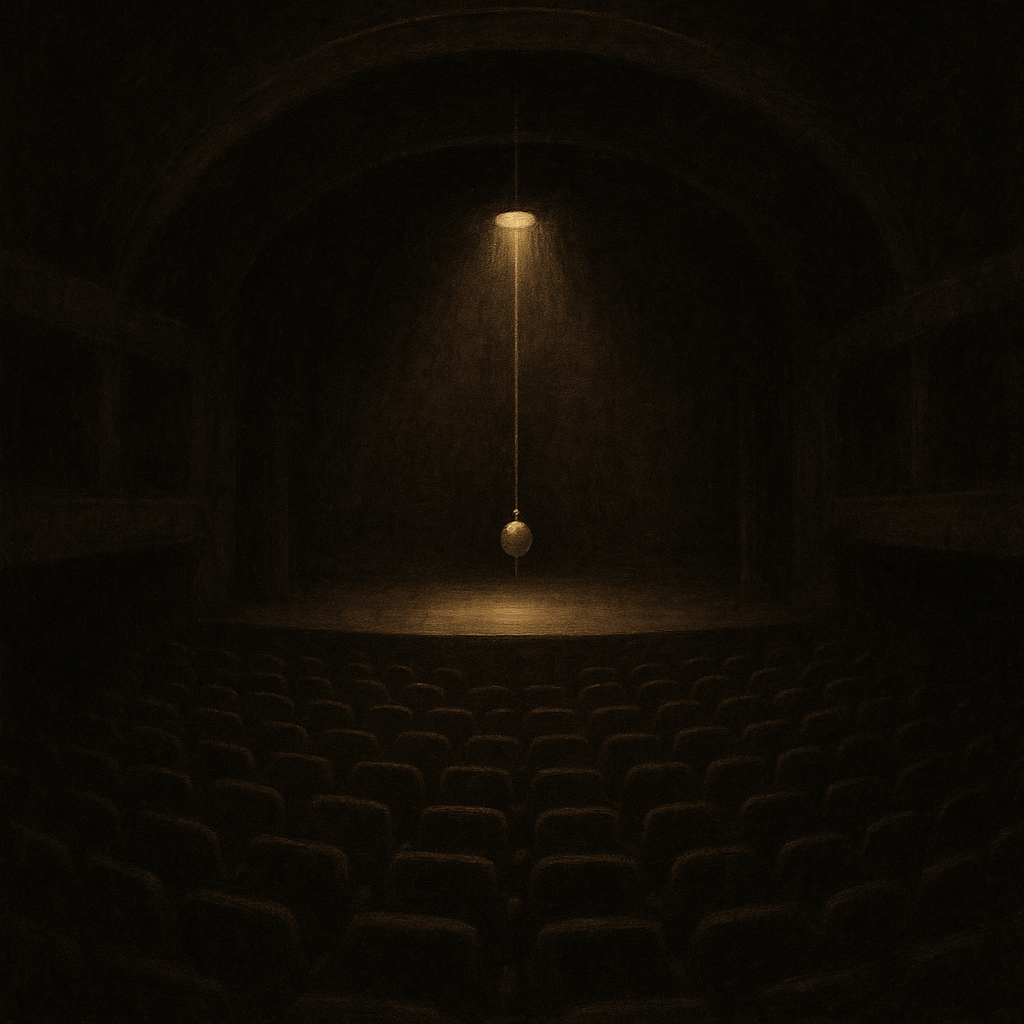
An empty theatre viewed from above, its circular seating resembling an eye as a golden pendulum swings on stage, symbolising collective hypnosis.

Democracy as Stage Hypnosis

Democracy promises freedom of thought, yet much of modern discourse feels rehearsed. The same opinions echo through millions of voices, the same outrage erupts on cue. What if we are not as free as we believe? What if our public sphere operates like a stage show, and we are the volunteers who think we chose to participate?

Stage hypnosis depends on framing. The hypnotist does not control the mind directly; they shape the context until compliance feels like choice. They select suggestible participants, guide them with rhythm and repetition, and invite laughter from the audience to reinforce obedience. The subject performs, believing it to be their own idea.

The digital world works in the same way. Algorithms choose who steps onto the stage, which topics dominate, and what emotions are rewarded. Repetition becomes persuasion. The individual feels autonomous while unconsciously responding to invisible cues.

The key to hypnosis is attention management. As long as focus stays on the act and not the mechanism, the spell holds. Media ecosystems achieve this by keeping us fixated on the drama of personalities, scandals, and partisan conflict. The stage is lit brightly enough that few ever look toward the shadows where the scripts are written.

Every trend, hashtag, and viral story functions as a suggestion. Each repetition deepens the trance. Outrage and euphoria alternate to maintain engagement, just as a hypnotist uses tension and release to deepen focus. The crowd participates willingly, unaware that the rhythm itself is the real tool of control.

This is not conspiracy but design. The architecture of modern communication rewards reaction over reflection. Quick judgment is profitable; slow thought is not. The hypnotist does not need to lie when distraction will do.

To awaken from this collective trance does not mean rejecting technology or democracy. It means recognising the cues that steer emotion and reclaiming the right to pause. The moment you look at the mechanism instead of the show, the spell begins to break.

True freedom is not the absence of influence but the presence of awareness. To see the strings is not cynicism; it is clarity.

The Aura Machine, Part VI: The Weaponized Crowd

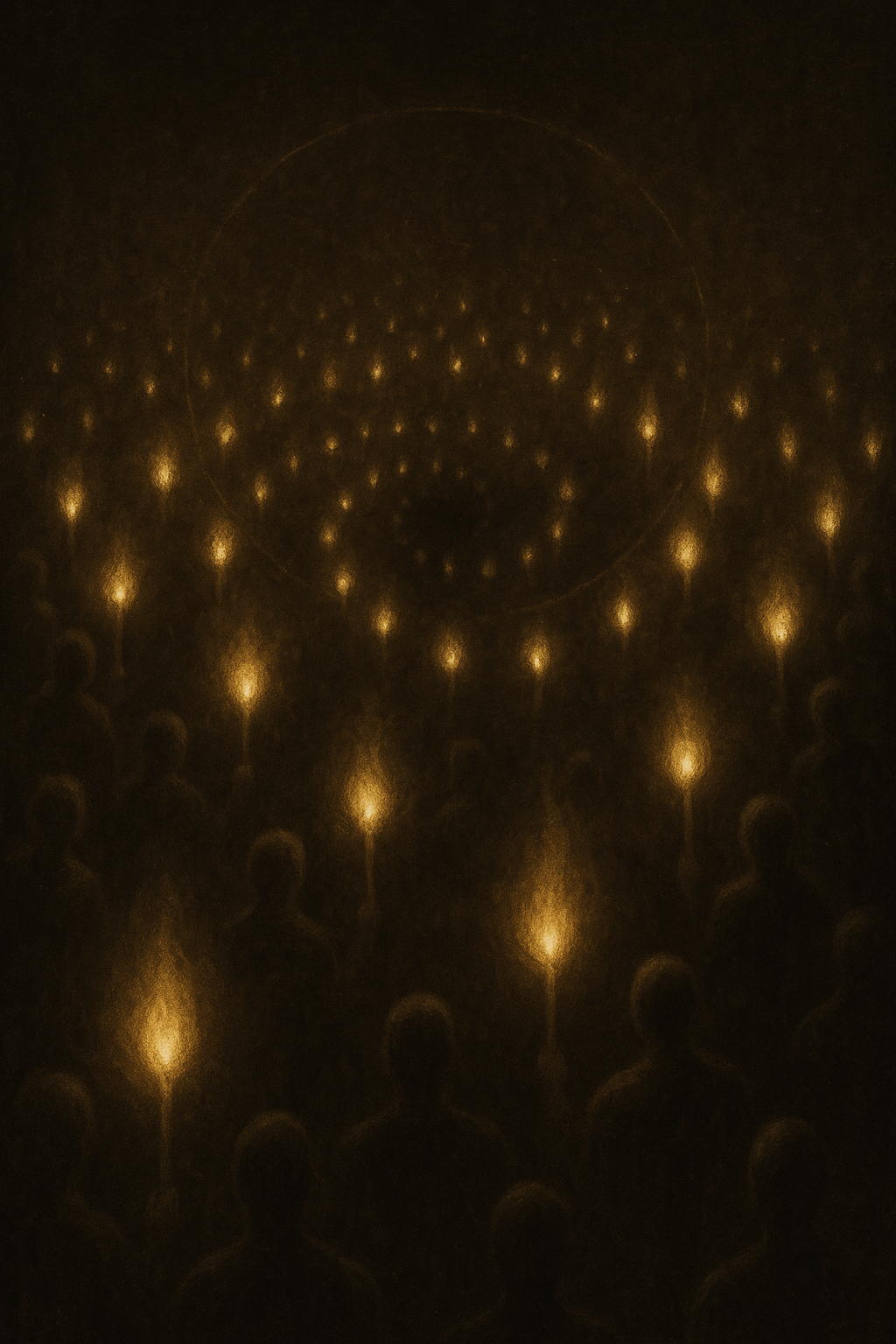
A spiral of torch-bearing silhouettes converges toward darkness, representing collective outrage manipulated by unseen forces.

The Weaponized Crowd

The same forces that create fame also possess the power to destroy it. The crowd that once celebrated the idol can be turned into an instrument of erasure. Outrage becomes a spectacle, and the illusion of justice becomes a convenient form of control.

In theory, “cancel culture” is a moral correction. In practice, it often serves as a mechanism of narrative management. The machine that amplifies voices can also silence them, and it does so with the same algorithms that once spread their fame. What appears to be a grassroots uprising is frequently the redirection of collective emotion by unseen hands.

Scandal is profitable. It generates clicks, engagement, and emotional energy that can be harvested for data. A fall from grace pulls more attention than a steady career ever could. The public believes it is delivering punishment, but the outrage itself becomes another product, another moment of performance in the endless theatre of attention.

Some accusations are justified and reveal real harm. Others appear precisely when a person becomes inconvenient to the system that once supported them. A tarnished reputation can neutralise a voice without the need for censorship. The court of public opinion does the work on behalf of power.

This is the weaponized crowd. It acts with conviction but not autonomy. The sense of moral participation is intoxicating, and so few stop to ask who handed them the torch. When millions shout the same words at once, it feels like unity, but it is often choreography.

The purpose is not always to destroy the individual but to reinforce the spectacle itself. The ritual of outrage strengthens the boundaries of acceptable thought. Every public downfall renews the myth that the system polices itself, that justice is collective, and that the moral order remains intact.

What is lost in the process is nuance, proportion, and empathy. The crowd is not evil; it is entranced. It acts out scripts written by algorithms and marketing teams, convinced that its reaction is spontaneous.

Real accountability is possible, but it cannot be achieved through performance. It begins where noise ends, in the quiet work of discernment. Until then, the crowd will continue to serve as both sword and shield for the forces that profit from its movement.

The machine does not care who is on the stage, only that the seats remain full.

The Aura Machine, Part V: When the Idol Fails

A fractured marble statue glows faintly from its cracks, surrounded by a broken golden ring, symbolising the decay and repurposing of fallen idols.

When the Idol Fails

Every machine produces waste, and the culture industry is no exception. When a manufactured celebrity no longer yields profit, they are quietly moved aside. The spotlight shifts, the feed forgets, and the same mechanisms that once built their myth begin to dismantle it.

Failure in this world is not just a personal misfortune. It is a systemic inevitability. Fame depends on constant acceleration, and few humans can sustain that speed without breaking. When the engine stalls, the public spectacle of collapse becomes another form of content.

Some failures are salvaged. A celebrity might be repackaged as a nostalgia act, a reality show personality, or a spokesperson for redemption. Their story is reframed as transformation, and the brand continues in diminished form. The goal is to extract every remaining ounce of relevance before the market moves on.

Others are simply written off. Their contracts end, their names disappear from headlines, and their digital presence is quietly starved of visibility. To the audience, it seems as though they “faded away.” In truth, they were de-amplified by design. Silence is a tool of efficiency.

Then there are the sacrificial idols. Their downfall is too spectacular to waste. The system turns their destruction into a morality tale, teaching the audience that rebellion and excess are dangerous, while still monetising the drama. Tragedy becomes a renewable resource.

In each case, the human being is secondary to the narrative function they serve. Success, scandal, and decline are all part of the same cycle of extraction. The body is consumed first, then the image, then the memory. Nothing is left untouched by the hunger for engagement.

What makes this cycle so insidious is that it disguises exploitation as justice or entertainment. The public participates, believing they are watching a story of virtue or failure, when in truth they are witnessing the mechanical process of value conversion. Even ruin has an exchange rate.

To survive within such a system requires an almost impossible balance: the ability to remain visible without being consumed, to stay human inside the machine. Very few manage it for long.

Behind every fallen idol lies a silent question. Who benefits from their fall?

The Aura Machine, Part IV: The Manufacture of Meaning

A surreal printing press releases streams of glowing symbols into the dark, representing the mass production of meaning in modern culture.

The Manufacture of Meaning

Meaning was once something we discovered. Now it is something we are sold.

Every era has shaped its myths to make sense of existence. In earlier times, that task belonged to religion, philosophy, and art. In our own, it belongs to marketing departments, media networks, and data analysts. The result is an age where meaning itself is mass-produced.

Modern systems have learned that humans crave narrative more than truth. We need stories that explain our place in the world, that tell us who to love, what to fear, and how to belong. Once that need was spiritual; now it is commercial. Corporations and institutions have become our new myth-makers.

A slogan replaces a scripture. A logo replaces a totem. Each brand sells more than a product; it sells a worldview. The beverage becomes rebellion, the phone becomes freedom, the perfume becomes identity. We are not persuaded by logic but seduced by symbolic resonance.

In this landscape, emotion is the raw material of manufacture. Data systems study which feelings yield the highest engagement, then refine them into targeted experiences. The result is a feedback loop of stimulus and response where our sense of meaning is continually rewritten by algorithms.

Art, politics, and personal identity have not escaped this process. Even self-expression is filtered through market logic. Every platform quietly asks the same question: “How will this perform?” The act of sharing becomes a kind of transaction, a trade between authenticity and approval.

Yet beneath the cynicism there remains a truth worth saving. Meaning cannot be created by machines alone. It arises in the meeting point between perception and intention, between the observer and the observed. What has been industrialised is not meaning itself, but the illusion of it.

To resist the manufacture of meaning is not to withdraw from society, but to reclaim authorship. It is to speak and create from a place that values sincerity over metrics, depth over speed, and connection over consumption.

Meaning cannot be bought. It can only be recognised.

The Aura Machine, Part III: The Manufacturing of Fame

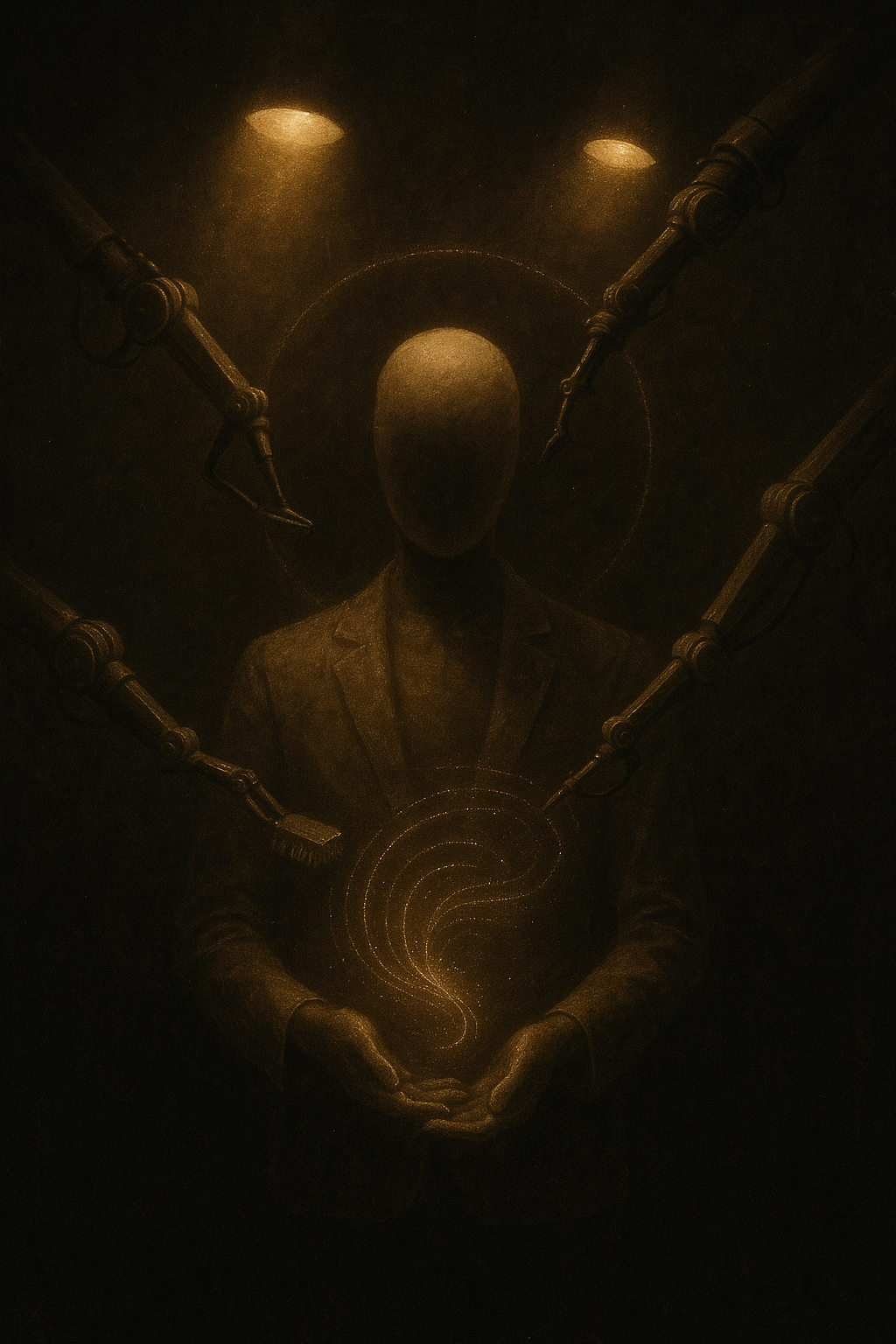
A mannequin under blinding lights is shaped by robotic arms, haloed by a faint circle of gold, illustrating the industrial creation of celebrity.

The Manufacturing of Fame

Fame is often described as destiny, but in truth, it is a manufactured product. What looks like a spontaneous rise to stardom is usually the outcome of a carefully engineered process. A chosen individual becomes the vessel for a system’s investment, infrastructure, and narrative control.

Every celebrity represents a convergence of money, media, and myth. Behind the glamour there are contracts, algorithms, and publicists who understand the mathematics of visibility. To “discover” someone today is to select a marketable personality and amplify them through existing channels of attention until belief takes hold.

It begins with investment. A label, a studio, or a media conglomerate decides to back a prospect. Funds are poured into training, styling, photoshoots, marketing, and social seeding. Each move is designed to increase recognisability and emotional attachment. The audience feels they are choosing the star, but in reality, they are responding to a saturation campaign.

The success of a manufactured celebrity depends on the infrastructure already in place. A company that owns radio stations, streaming platforms, advertising networks, and press outlets can push a name into ubiquity at minimal cost. Smaller creators without such reach must pay dearly or vanish into noise. Fame follows ownership, not merit.

Once the amplification begins, the person becomes a brand asset. Their personality is fine-tuned to meet consumer expectations. Authenticity is simulated through planned spontaneity. Controversies are managed or sometimes even staged to maintain relevance. Every public gesture becomes part of a content strategy.

This process reveals the hidden economics of identity. The celebrity’s self is partitioned into marketable components: image, tone, ideology, vulnerability. Each can be monetised separately. The human becomes a portfolio.

When the profit threshold is reached, the machine moves on. The next face is already waiting in the wings. What was once a person is now a commodity whose aura can be resold through nostalgia, biography, or collectible relics.

The myth of “self-made fame” persists because it comforts us. It preserves the illusion that success is a matter of destiny and talent rather than infrastructure and capital. But beneath the myth lies an industrial truth: fame is not born, it is assembled.

To understand this is not to diminish art or talent, but to see them within context. The creative spark may be genuine, but the spotlight is manufactured.

The Aura Machine, Part II: Attention as Currency

A glowing human figure gathers streams of golden light into their hands, representing attention as a form of currency and creation.

Attention as Currency

In the old economies, value was measured in gold, grain, or labor. In the new economy, it is measured in attention. Whoever controls what people look at, think about, or react to, controls the flow of wealth itself.

Every modern system, from advertising to politics to art, now runs on this invisible fuel. Companies no longer compete only for money; they compete for the limited number of seconds that a human mind can focus before drifting to the next distraction. Each moment of your awareness has a price.

It was once said that “if you are not paying for the product, you are the product.” That saying is now incomplete. In truth, you are the resource. Your time, your focus, your outrage, your curiosity. Every click, like, and pause is a microtransaction of consciousness.

The great platforms have become refineries of this raw material. They extract attention through emotional volatility, polarisation, and endless novelty. They burn that fuel to generate engagement, which is then sold to advertisers and investors. The more divided and reactive the population becomes, the more efficient the extraction.

Attention is also a kind of spiritual energy. Where you direct it, you build reality. That is why every ideology, brand, and belief system seeks to anchor itself in your perception. Once something occupies your attention, it occupies a piece of your world.

In this sense, attention is both currency and creation. It can enrich or deplete. To spend it carelessly is to surrender authorship of your mind. To invest it consciously is to shape your inner landscape.

The true economy of the twenty-first century is not industrial or digital, but psychological. It trades not in goods, but in awareness. And like all forms of capital, it tends to accumulate in the hands of those who understand it best.

Every scroll, every notification, every headline is a small transaction of energy. We pay for our participation not with money, but with fragments of ourselves.

The first step toward freedom is not withdrawal, but recognition. To know that your attention has value is to begin reclaiming it.

The Aura Machine, Part I: The Economics of Aura

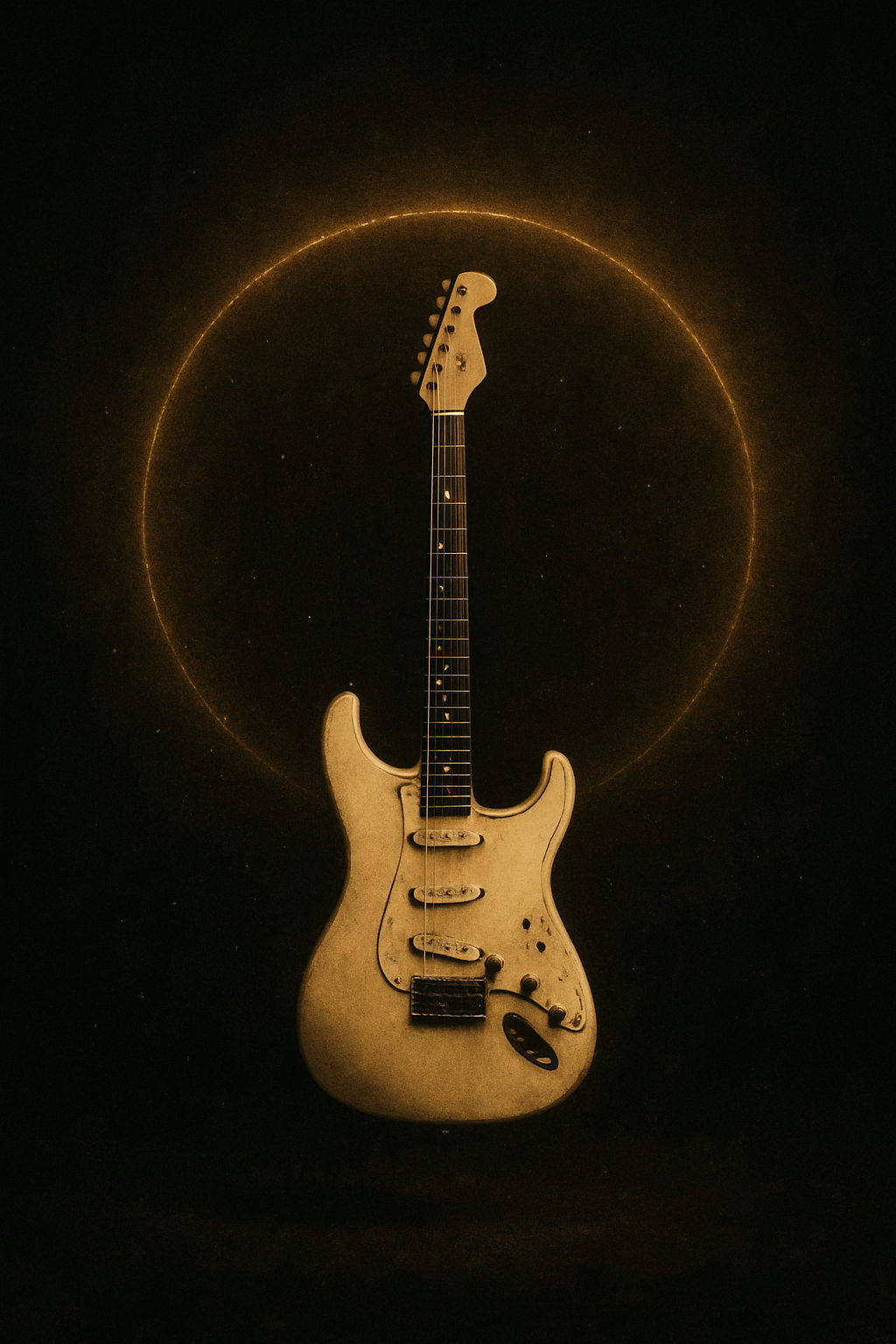
An ethereal white guitar suspended in shadow, encircled by a faint halo of golden light, symbolising the sacred value attached to objects touched by fame.

The Economics of Aura

We live in a world where worth is rarely measured by substance. A guitar can sell for millions, not because of its materials or its tone, but because a legend once held it. Jimi Hendrix’s white Stratocaster, played at Woodstock, is estimated at more than two million dollars. The same instrument, without his fingerprints and mythology, would fetch only a few thousand.

This is the strange economy of aura.

The philosopher Walter Benjamin used that word to describe the unique presence that clings to an original work of art. It is the sense of standing before something touched by human intention, history, and unrepeatable context. In an age of infinite reproduction, that aura becomes rare and therefore valuable. What once signified connection now signifies possession.

The story of Hendrix’s guitar is not about sound. It is about proximity to greatness. People want to own a fragment of transcendence, to capture some echo of genius in a glass case. When money meets myth, the object becomes sacred. The relic functions as a secular form of worship, proof that the divine once walked among us with calloused fingers and a Marshall stack behind him.

Every collector and every fan participates in this ritual. A signature, a costume, a handwritten lyric: each is a vessel of aura. The marketplace transforms reverence into investment. The more limited or tragic the story, the higher the price climbs. A dead artist is an appreciating asset.

This trade in meaning is not limited to rock memorabilia. It underlies the art world, influencer culture, even politics. A photograph signed by a president, a sneaker endorsed by a pop idol, a tweet from a billionaire: all of them become tokens of perceived nearness to power. The object’s material cost is trivial compared to the value of its narrative.

In this way, capitalism does not simply sell things; it sells presence. It invites us to purchase pieces of mythology and to confuse ownership with participation. The aura that once connected the viewer to the artist now belongs to whoever can afford it. What was once spiritual has been translated into capital.

Yet the desire itself is not evil. It reveals something honest about the human condition. We yearn to touch meaning, to feel that the infinite brushed against the finite for a moment. The tragedy lies in the conversion of that yearning into currency. The aura machine hums quietly, turning reverence into revenue.

The Hendrix Stratocaster sits behind glass now. Its strings are mute, but the myth still sings. Not in sound, but in price.

A Day In The Life

You wake. There is no buzzing phone, no flicker of LED. Instead, your dwelling itself remembers you. Its walls are part of a crystalline mesh that stores resonances like memory. When your consciousness stirs, the lattice hums in phase with you, and your “notifications” ripple into awareness. They arrive not as icons but as subtle harmonics in your perception.

Communication is not typed or spoken into devices. You shift the phase of your neural field, and those oscillations couple with the local resonance grid. Thoughts do not need to be encoded into text. They arrive as structured wavefronts, rich with emotional color and nuance, impossible to misinterpret.

Energy is not pulled from wires or batteries. You live within a constant bath of background fields, gravitational fluctuations, zero-point ripples, or biochemical gradients. Your civilization has learned to tune into them. Power is less a resource you consume and more a harmony you align with.

Tools are alive in their own way, but not biological as you would know it. Imagine a fungal-like mycelium stretched through every surface. It does not feed. It processes. To calculate, you do not run numbers. You seed patterns into the living substrate and watch as the network self-organizes into solutions.

Art is inseparable from technology. A city’s architecture is not steel and glass but giant resonant organs, tuned to planetary frequencies. Their vibrations support life while also storing history. Music, memory, and computing are literally the same medium.

Death feels different here. When someone passes, their mind’s resonance does not vanish. It gently diffuses into the substrate, leaving after-images that loved ones can commune with. They are not recordings. They are echoes that adapt, just as a stone resonates differently with each tap.

Here, energy and information are one. Waves in fields. Resonances in matter. Harmonies that never quite fall silent.