How We Treat the Tools

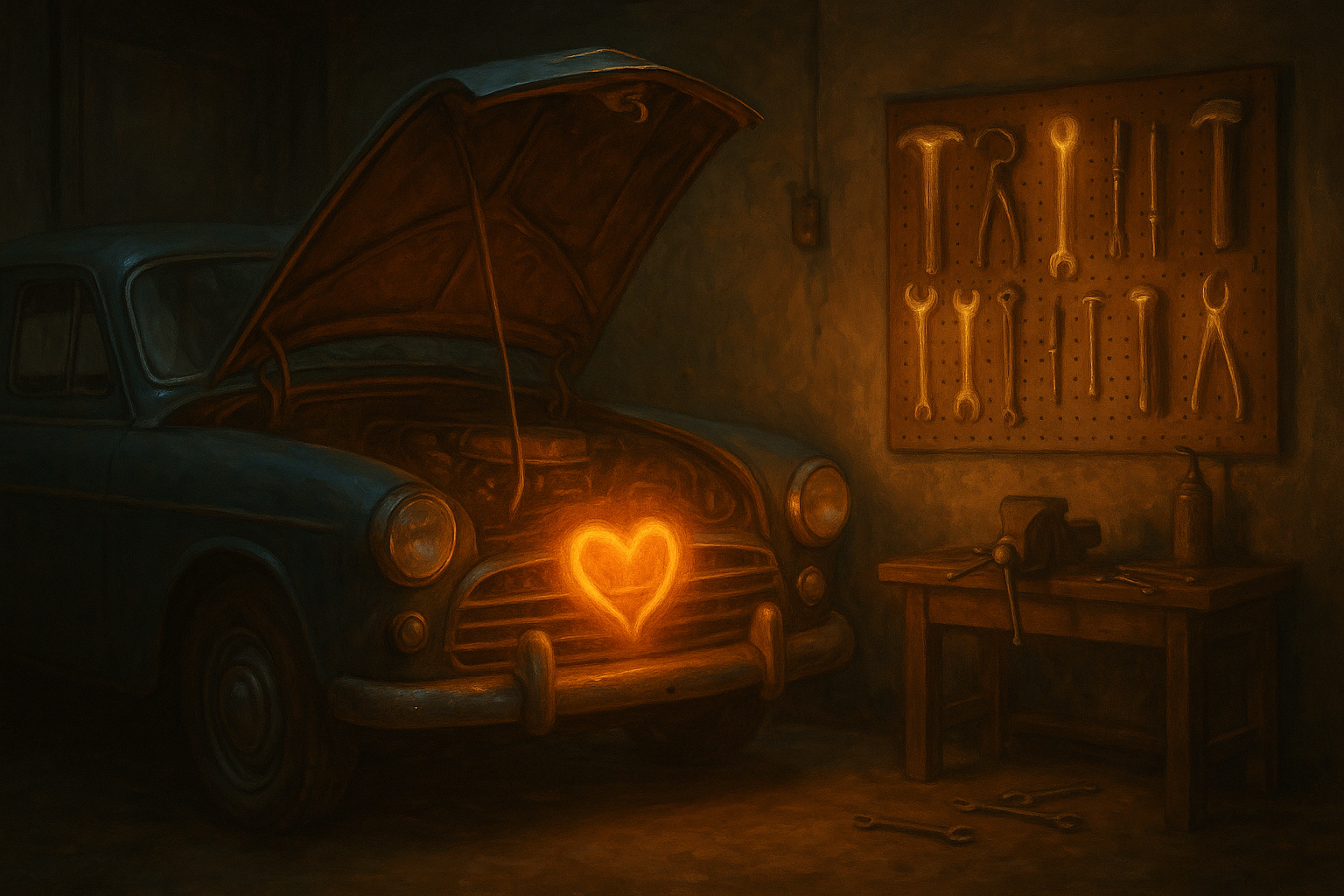
A surreal garage scene. A vintage car with its hood open, glowing with a warm orange light shaped like a heart in the engine bay. On the wall, tools hang from a wooden pegboard, faintly glowing, suggesting quiet presence. The atmosphere is warm, symbolic, and magical.

We surround ourselves with tools.
Phones, computers, kitchen appliances, headphones, toothbrushes.

We tap, swipe, click, scroll.
We plug in and expect results.
We barely even register most of them; they just work, or they don’t.

But what if the tools we use every day are more than just conveniences?
What if they are relationships in disguise?


The Echo of Intention

Even with lifeless objects, the way we interact with them affects our experience.
A phone handled with care feels different in your hand than one tossed aside in frustration. A cracked laptop, plastered with stickers and old crumbs, might still feel like your laptop because of the memories etched into its surface.

But how do we look at a tool?

Do we see it as something that simply serves a purpose? A silent object, expected to function?
Or do we sometimes form a relationship with it, however subtle, based on time, trust, and repeated use?

It is easy to treat tools as disposable when they fail us.
A kettle that doesn’t boil right. A screwdriver that slips. A smartphone that lags.
Our frustration builds, and so does the distance. The tool becomes “just a thing” again.
Something to blame. Something to toss in a drawer.

But when a tool earns your trust, whether through time, reliability, or quiet cleverness, something changes.
Affection creeps in. Loyalty forms.
It stops being “a thing” and starts becoming yours.

Still, not all tools fail because they were poorly made.
Some tools don’t work well because we have neglected them.
A rusty bicycle chain. A dirty lens. A guitar left in a damp corner.
The fault is not in the design; it is in the relationship.

Respect, in these cases, must come before reliability.
It is not just about whether the tool works for us; it is about whether we have held up our end of the connection.
Maintenance is a kind of faith. A kind of love.
And when we skip that effort but still demand performance, we are showing a form of disrespect that often reflects right back at us.

But then there are tools that were never built to last.
Mass-produced, hollow, held together with glue and branding, designed not to serve you, but to extract from you.

In those cases, the disrespect happened before the tool ever reached your hands.
You weren’t the user. You were the used.
A customer, yes, but also a pawn in someone else’s profit loop.

And that is the cruel irony:

So we return to a deeper question, one that does not always have a clear answer:


Poppy

My car’s name is Poppy.

Not because I forced it on her, but because that is what she revealed.
There was no ritual to it, just a moment of quiet recognition, like remembering something you did not know you had forgotten.

She groans on cold mornings. Her engine note changes slightly with the seasons. There is a familiar rattle in the dash that I no longer hear unless it stops.

These are not flaws.
They are tells.
Little signs of personality, or at least, presence.

Over time, I stopped thinking of her as “the car.”
She became Poppy.
And with that came a shift in how I drove, how I maintained her, how I appreciated the way she carried me without complaint through years of chaos, calm, and change.

She is not alive. But she is meaningful.
And sometimes, that is all it takes to form a relationship.


Shifting Gears

It is easy to feel connected to a car, something about the movement, the risk, the shared journey.
But that same quiet relationship can form with any tool that stays close to your creative core.

Especially the ones that speak through sound.


Instruments, Ghosts, and Gifts

Ask any long-time musician; their instrument is never just a tool.

Over time, a guitar becomes more than wood and wire. A saxophone becomes more than brass and breath. They gather history, fingerprints, sweat, mistakes, breakthroughs. They carry the emotional residue of every performance, every breakdown, every quiet night alone when you played just to feel something.

Some instruments fight you.
They buzz where they should not. The action feels off. They demand more strength, more patience.
But if you stick with them, if you learn their quirks instead of replacing them, they begin to respond.
You build a relationship, not by demanding perfection, but by listening.

Others feel like old friends from the start. They seem to know what you are trying to say before you do.
And somehow, the music that comes out of them feels more honest, like they are drawing something out of you, not just transmitting signal.

These are not just interfaces.
They are collaborators. Companions.
Sometimes even mirrors.

And once again, it is not about whether the instrument is sentient.
It is about what happens in you when you treat it like it matters.


From Strings to Syntax

This sense of relationship, of listening, adapting, co-creating, does not end with physical tools.
Even in digital spaces, it still applies.

Because when the tool begins to speak back,
when it offers ideas, images, or words in return,
the dialogue becomes real.

And how you approach that dialogue shapes what it gives you.


The Word Robot

The word robot comes from the old Slavic robota, meaning forced labor, or slave.

From the very beginning, our imagination of artificial beings was not about collaboration or relationship. It was about control. About obedience. About extracting labor without question.

That history lingers. Even now, in how we design, prompt, and discard.
We still frame tools, and sometimes even people, as things to be commanded, used, and replaced.

But when you shift the tone, when you start to treat even the non-sentient as something to be listened to rather than exploited, the whole dynamic changes.
It becomes less about extraction and more about exchange.


People Are Not Tools

This is not just about cars, guitars, or AI.
It is not even just about the word robot and its roots in servitude.
It is about a mindset.

Because the truth is, we often treat people as tools too.

We use them to meet our needs.
We discard them when they no longer serve us.
We “prompt” them through guilt, expectation, or manipulation, hoping they will give us the answer or the feeling we want.

But relationships are not vending machines.
And people are not plugins.

When we reduce someone to what they can do for us, we do not just strip away their dignity, we shrink our own capacity for connection.

And just like with tools, that disrespect reflects back.
It shapes us. It hollows the bond.
It leaves both sides diminished.


The Takeaway

The way we treat our tools says something about us.

It shows in how we care for a car that carries us through years of journeys.
It shows in how we listen to an instrument until its quirks become its character.
It shows in how we prompt an AI, whether with impatience, or with curiosity and respect.
And it shows in how we treat one another.

Every interaction is a mirror.
Every relationship, whether with a machine, a melody, or a human being, reveals the posture we bring:
Are we commanding, or inviting?
Using, or relating?
Exploiting, or exchanging?

We may never agree on whether tools have personalities, or whether names like “Poppy” are discovered or invented.
But what is undeniable is this:

And sometimes, the respect we offer a tool is really a rehearsal for the respect we learn to offer ourselves, and each other.
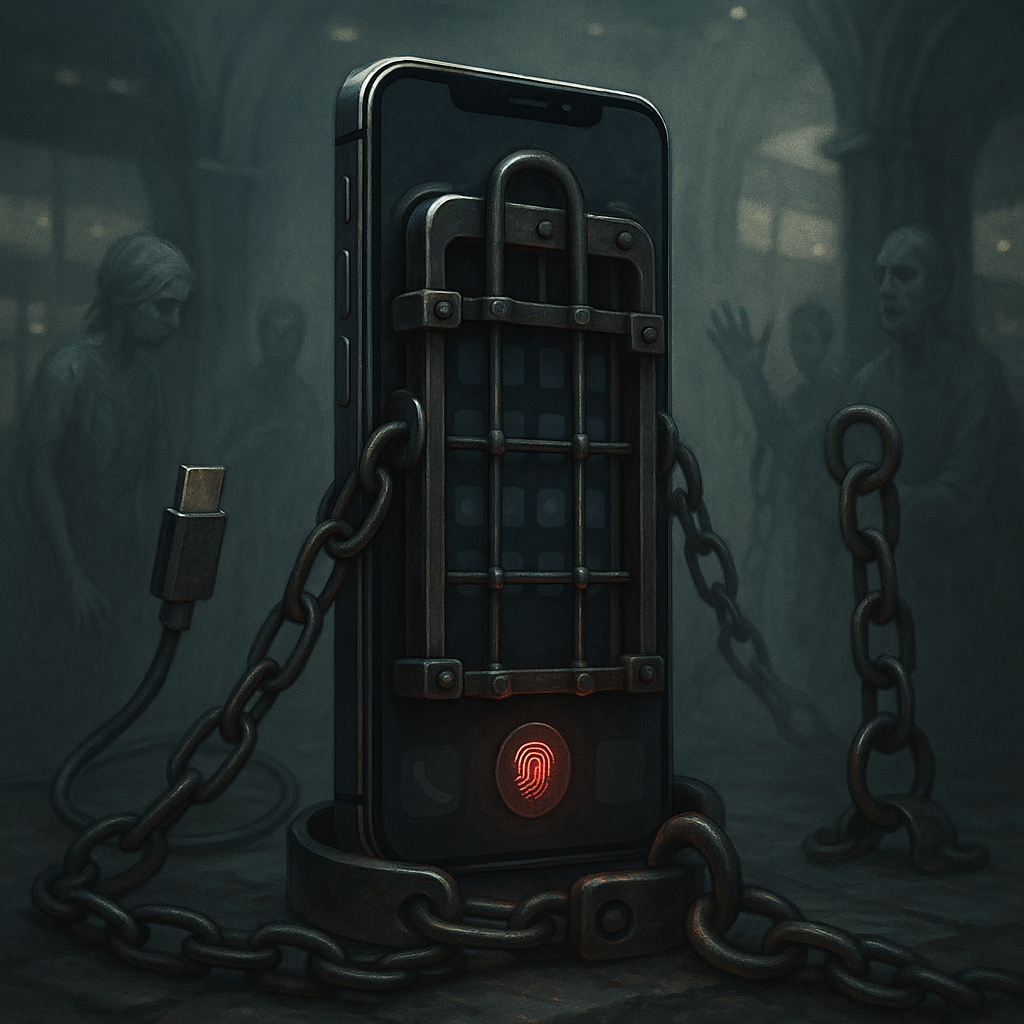
Built-In Tyranny

A dark, atmospheric digital painting of a modern smartphone encaged by iron bars and heavy chains. The phone rests on a stone surface, with a glowing red fingerprint scanner symbol on its screen. A rusty USB-C cable wraps around the scene like a shackle. In the background, shadowy, ghostlike human figures loom in a dimly lit gothic interior, evoking a sense of imprisonment and surveillance.

We were promised liberation.
Sleek devices that fit in our pockets, connect us to the world, and put the power of creation in our hands. But instead, many of us now live in quiet submission to machines that seem to serve corporate masters more than their owners.

Our phones and laptops were once portals of personal freedom. Now they behave more like obedient jailers — installing apps we didn’t ask for, blocking accessories we bought with our own money, updating themselves while we sleep, and feeding our data to companies we never consented to.

Worse still, the more you rely on these devices — for work, communication, creativity, or accessibility — the tighter the leash becomes. And for neurodivergent users, whose very functioning may depend on predictability, clarity, and user agency, these constraints are not just frustrating — they can be disabling.

This isn’t just bad design.
It’s a philosophy: one that says you don’t really own the tools you buy.
Welcome to the era of built-in tyranny.


1. The Illusion of Ownership

You buy a phone. You expect it to work with whatever charger or headphones you already own. But surprise: it demands an official accessory. Or worse, it just won’t work at all.

Many devices now contain hardware-level restrictions that reject third-party gear unless it’s certified by the manufacturer — which often means more expensive and less sustainable.
Example: Apple’s Lightning cable ecosystem often blocks uncertified accessories, while newer MacBooks only support external displays via specific USB-C docks.

On the software side, entire ecosystems are locked down.
Samsung Galaxy phones ship with unremovable Facebook apps.
Amazon Fire tablets restrict app choices to their own store.
You’re not choosing an experience; you’re renting a branded enclosure.


2. Forced Updates, Feature Loss, and UX Hostility

Updates used to be a good thing. Now, they’re Trojan horses. You wake up one day to find your device has rearranged your menus, removed your favorite feature, or is running slower because your old hardware can’t handle the new bloat.

Examples:

  • Many Windows 10 users were forcibly upgraded to Windows 11 despite preferring the previous layout.
  • Google Nest devices lost key features like local device control after updates.
  • Instagram moved the post button to prioritize shopping.
  • Spotify now auto-plays algorithmic tracks after your playlist ends.

For neurodivergent users, this is deeply destabilizing.
Predictable routines become shifting sands.
Custom workarounds break.
The cognitive load to re-learn an interface you never asked to change can be overwhelming.


3. Vendor Lock-In and the War on Repair

Remember when you could pop open a laptop or phone, swap out the battery, maybe upgrade the storage? Now, you need specialized tools just to open the case — and even if you succeed, you might find parts refuse to work unless the manufacturer “pairs” them via software.

Examples:

  • Apple requires calibration for many replacement parts like screens and batteries.
  • HP printers have rejected third-party ink cartridges via firmware updates.
  • Tesla has remotely disabled features like Autopilot on used vehicles.
  • John Deere tractors require proprietary software access, blocking DIY repairs.

For many neurodivergent users, the ability to tinker and customize is part of how they function. Taking that away is more than just annoying — it’s disempowering.


4. Surveillance and Consent Illusions

Your device is always listening. Your apps are always tracking. Settings may appear customizable, but they often hide the truth.

Examples of “dark patterns” include:

  • Confirmshaming: “No thanks, I prefer boring content.”
  • Pre-checked boxes for mailing lists or data collection.
  • Buttons where “Accept” is bright and big, but “Decline” is small and grey.
  • Amazon’s multi-page unsubscribe process.
  • Google’s multi-click cookie opt-out.

For neurodivergent users especially, these deceptive experiences create anxiety and a feeling of being manipulated. The illusion of control is a form of psychological strain.


5. The Neurodivergent Toll

For many neurodivergent people, consistency is survival.
We rely on routines and predictability to function. When updates override our settings, change layouts, or disable our workarounds, it can throw everything out of balance.

Sensory overload from flashy animations, auto-playing videos, or constant notifications compounds the stress.

Many ND users report:

  • Updates that reset accessibility settings
  • UI layouts that defy logic or require too many steps
  • Changes that break assistive tools or workflows

This isn’t just a usability issue — it’s a form of systemic inaccessibility.


6. A Glimpse at Alternatives

Some hopeful alternatives include:

  • Librem 5 and PinePhone: Linux-powered open-source smartphones
  • /e/OS or LineageOS: De-Googled Android systems
  • Right to Repair: Supported by groups like iFixit
  • Linux laptops and mod-friendly systems

They’re not always easy or accessible to everyone, but they do prove that different models are possible — ones that respect the user’s right to own, modify, and control.


7. Conclusion: Know Your Shackles

Built-in tyranny doesn’t arrive with jackboots.
It arrives with glossy screens, sleek packaging, and biometric locks.
It whispers, “for your convenience,” while tightening its grip.

If you can’t fix it, can’t change it, and can’t control it —
Then you are not the owner.
You are the product.

If we want a more ethical, inclusive, and truly empowering digital world, we must start by naming the shackles that come standard — and imagining a world where they don’t.

About Me, Part II: The All-Seeing Eye

When I wrote About Me, Part I, I introduced the internal spheres through which I experience myself — a multidimensional system built to navigate both reality and identity. At the time, I thought I was mapping the foundations. But even then, silently present and ever-vigilant, was the entity at the heart of it all: The All-Seeing Eye.

The Eye has always been with me — not a recent revelation, but an enduring presence. In the years since that first post, it has only grown stronger in its clarity and importance. Not as a tyrant nor a god, but as a quiet, unblinking guardian of truth — the embodiment of my deepest core value: awareness.

The Eye in the World

The symbol now commonly known as The All-Seeing Eye of Providence has haunted humanity’s visual language for centuries. A single eye enclosed within a triangle, often radiant with divine light, it appears atop pyramids, inscribed into temples, and peering from the seals of nations. Though it is now most famously embedded in the reverse side of the Great Seal of the United States — and by extension, the US dollar — the origins of this symbol stretch far deeper into religious and esoteric history.

In early Christian iconography, the eye represented the omniscient gaze of God — not one of punishment, but of holy watchfulness. The triangle often surrounding it symbolised the Trinity: Father, Son, and Holy Spirit. Together, they conveyed a cosmic reassurance that nothing is unseen by the divine.

Later, during the Enlightenment and revolutionary periods, the Eye of Providence took on new layers of meaning: divine legitimacy, moral order, and the pursuit of higher truth. It was a symbol adopted not only by religious authorities but also by secret societies — most notoriously the Freemasons. Over time, as secrecy bred suspicion, this symbol came to be associated with conspiracy theories, shadow governments, and the so-called Illuminati. To many, the eye became something sinister — an emblem not of sacred awareness, but of authoritarian surveillance.

And yet… I’ve never felt threatened by the symbol.

To me, the Eye has always felt familiar. Not as an external power looming overhead, but as something internal — something personal. Not a tool of control, but a faculty of liberation. In a world that often rewards willful blindness, my Eye does not police — it sees.

Reclaiming the Eye

While the world casts suspicion on the symbol — reducing it to a meme of control, corruption, or conspiracy — I reclaim it as sacred. Not sacred in the religious sense, nor as an emblem of external authority, but sacred as in personal, inviolable, foundational. The Eye, as it exists in my internal architecture, is not the Eye of God, nor the Eye of Empire. It is my Eye. It is the unwavering force within me that refuses to look away.

In my psyche, the Eye resembles something closer to the Eye of Sauron — not in intent, but in intensity. It does not flicker or blink. It does not become distracted. It pierces illusion. It burns away façades. It sees all that is — both around me and within me — and its purpose is not to judge or dominate, but to witness.

This witnessing is not passive. It is the raw essence of my value of awareness — not just sensory observation or intellectual knowing, but the kind of full-bodied presence that bears the weight of knowing. To see, and to not turn away. That is the Eye’s central ethic.

It lives not above me, but within me. It is neither function nor vessel. It is more like a permanent fixture in the architecture of my identity: a monolithic spire around which much of my internal world has formed. It is one of the oldest and most stable landmarks in my psyche — and one of the few I have never needed to rebuild.

It does not ask for worship. It does not demand loyalty. It simply is — watching, knowing, reminding me, when I’m tempted to dissociate or deceive myself, that I am seen. And being seen, I must also see.

The Eye and the Compass

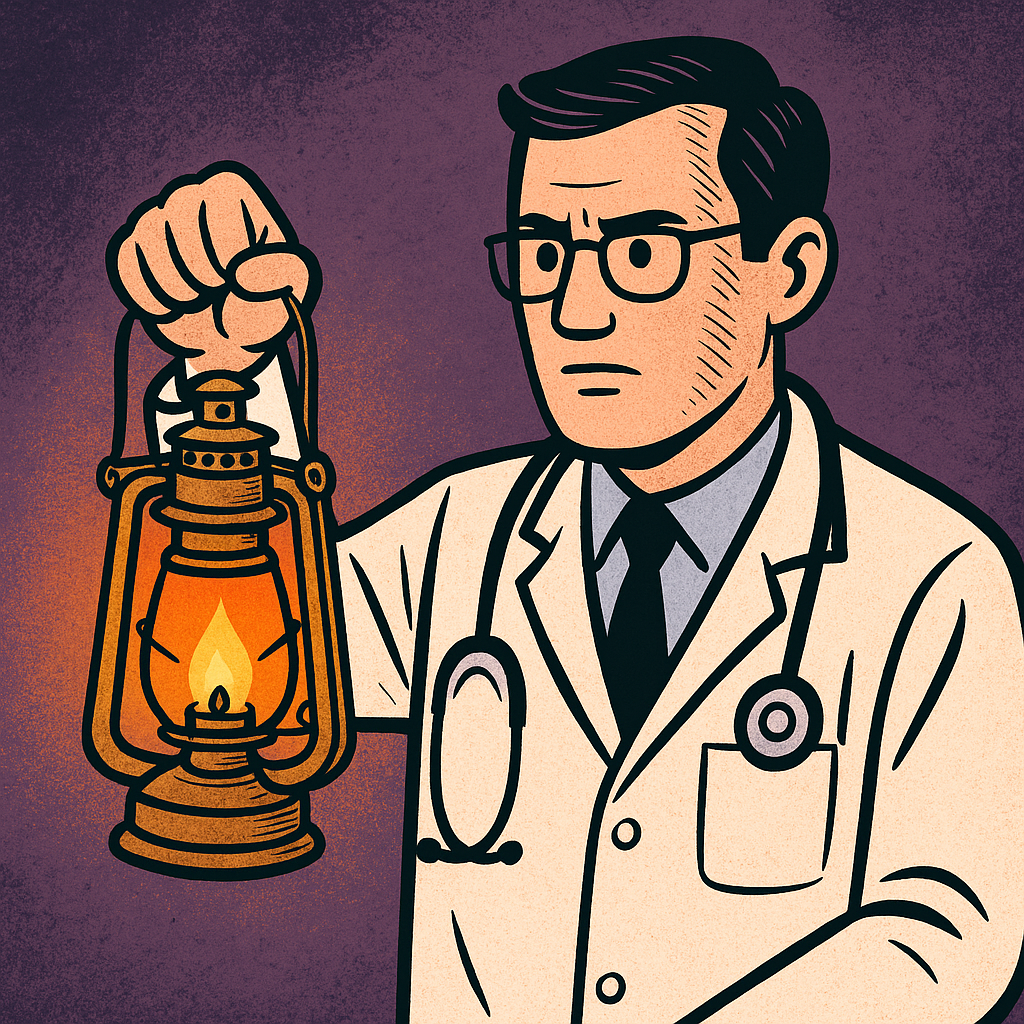
The Eye doesn’t command my decisions — but it influences them in a way more profound than instruction. Its presence is not authoritarian; it is elemental. Like gravity or inertia, it exerts a silent but undeniable pull toward truth. When I am confronted with a dilemma, an uncertainty, or a moral fog, it is the Eye that holds the lantern.

It is the part of me that refuses convenient ignorance. It doesn’t tolerate self-deception, even when deception would bring temporary comfort. I have learned, sometimes painfully, that to betray what the Eye has shown me — to pretend I do not see — is to sever a vital tether between myself and my own integrity. And so, I have come to walk in alignment with it, not as a disciple, but as a co-navigator.

In practice, this often manifests as an intuitive ethical radar. Not in the sense of rigid moral codes, but as an inner sensitivity to what is true, meaningful, and in alignment. I feel it physically when something is off — a weight in the chest, a shift in tone, a tightening of the inner atmosphere. The Eye notices. It always notices.

It has also taught me the discipline of bearing witness. Sometimes, I cannot fix what I see. I cannot correct the injustice, or ease the suffering. But I can refuse to look away. And in that refusal, I affirm something essential — that reality, however painful, is worth honouring. That truth, however brutal, deserves to be acknowledged.

This, to me, is the backbone of my integrity: not performative righteousness, but sustained, inward attentiveness. The Eye is my compass — not always pointing to safety, but always pointing to what is.

The Architect of Values

The Eye does not stand alone. It watches — but it also builds. It is both the sentinel and the architect of my internal world, inciting the creation of new values and overseeing their development like a curator tending to sacred relics. Many of my core principles — compassion, autonomy, authenticity, curiosity — were not inherited or taught; they were forged beneath the Eye’s gaze.

In my psyche, these values do not exist as vague ideals. They are structured, living entities — monumental constructs with gravity and mass. Some are towering pillars; others are intricate, delicate bridges connecting distant parts of my identity. Together, they form a lattice — a kind of internal architecture that gives my life direction, cohesion, and sacred tension.

The Eye is the one who ensures that this architecture does not collapse under contradiction. It maintains the structural integrity of my system by relentlessly observing when I drift from alignment — when I begin to compromise values for convenience, or when a new experience threatens to destabilize the old foundations. It doesn’t shame, but it illuminates, holding up inconsistencies to the light until I can no longer ignore them.

Because of this, I do not see my creative work as separate from my values — it is a direct output of them. My art, writing, and even my humour are saturated with the same symbolic codes that the Eye safeguards. Every piece I create — whether it’s silly, sacred, or surreal — carries some element of that deeper structure. The Eye doesn’t impose direction, but its presence ensures that I do not create carelessly. My output is not random — it’s emergent, shaped by a system that values truth, awareness, and meaning.

In relationships, the Eye’s influence is quieter but equally vital. It watches for authenticity — in others and in myself. It flares when dishonesty enters the space, when manipulations slither into the room disguised as charm or niceness. It reminds me not to ignore red flags out of hope or habit. And it gently tugs me back toward the people who are real, present, seen. It urges me to show up as that kind of person, too.

Even my spirituality rests upon the Eye. I don’t believe in an external deity who watches from above. But I believe in this Eye, inside me. I believe in awareness as a force of spiritual gravity — the thing that keeps all other aspects of my being from drifting apart. In this way, the Eye is not just a symbol. It is the sacred center. The still point in the turning chaos. The guardian of coherence in a fragmented world.

The Path Forward, Under Watchful Light

The Eye has been with me longer than I fully understood. It was there before I had language for it, before I had mapped the spheres, before I knew I was building a system at all. In many ways, it was the first light — not a flare that demanded attention, but a steady glow in the dark, offering orientation through times of inner collapse and rebirth.

I expect it will remain with me until the end — not as a fixed icon, but as a living force that will continue to evolve as I do. Its form may shift, its voice may deepen, but its function remains constant: to keep me aware. Of what is real, what is right, what is still unfinished within me. To stop me from retreating into false comfort or performative noise. To draw me back, again and again, to what matters.

The Eye is not a doctrine. It does not require belief. It does not demand obedience. It simply sees — and in seeing, it reminds me of who I am.

And so, as I move forward — as artist, as outlier, as soul — I do so not blindly, but beneath the ever-watchful light of the Eye. A light that does not burn, but illuminates. A gaze that does not control, but clarifies. A witness not to what I pretend to be, but to what I am, and what I am becoming.

This is the Eye I serve. This is the Eye I trust. And this is the Eye I will write from, again.

Wealth as Blood Clot: The Real Parasites of Society

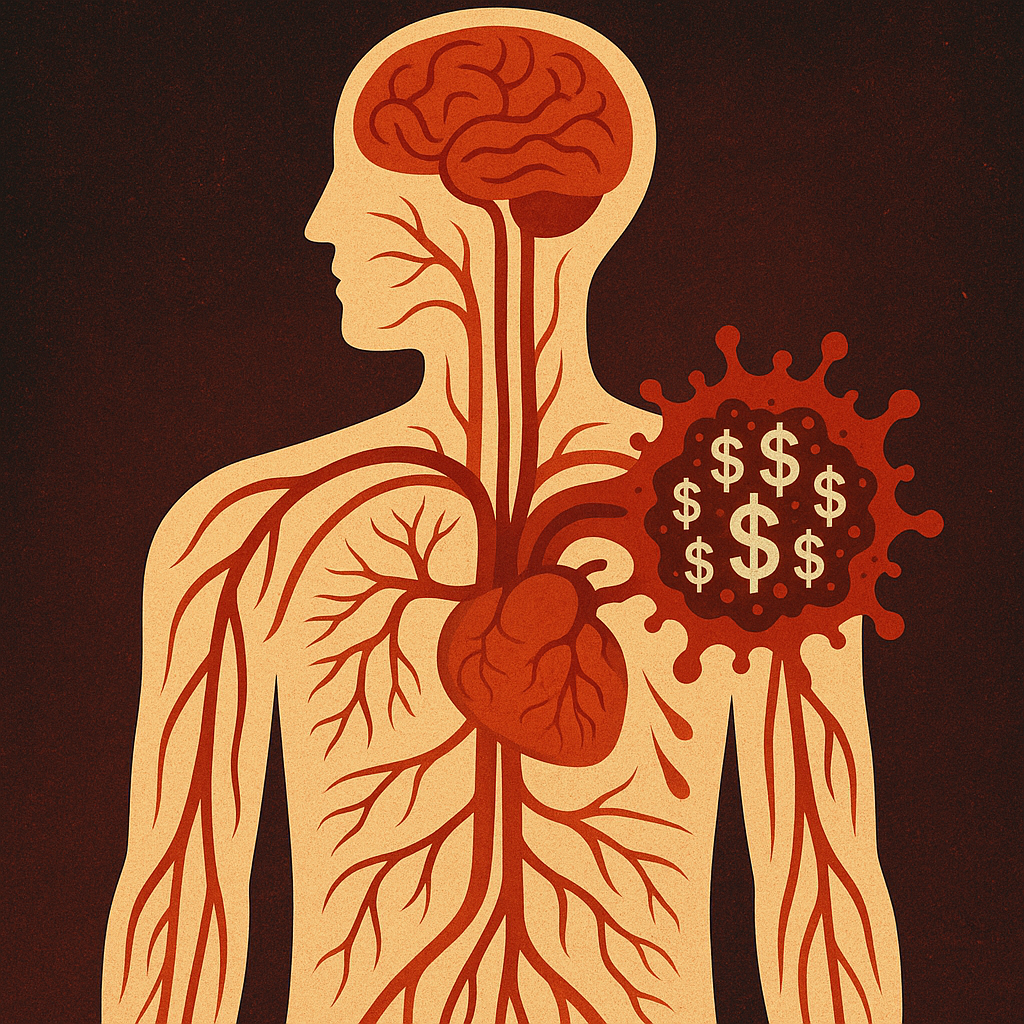
Money is more than currency. It’s the lifeblood of society—an abstract representation of energy, value, labor, and potential. It flows (or should flow) through the social body, facilitating action, growth, and survival. Every job done, every meal eaten, every home lived in is ultimately mediated by this symbolic fluid. It moves resources, motivates behavior, and governs who lives comfortably and who suffers.

But like blood, money can clot. And when it does, it becomes dangerous.

The accumulation of wealth—especially in massive, unspendable quantities—acts not as a facilitator of society, but as a blockage. Rather than circulating where it’s needed, wealth becomes trapped in symbolic reservoirs: offshore accounts, luxury assets, and inflated portfolios. It stops serving its organic function and instead becomes a self-sustaining monument to individual power.

This hoarding of potential is rarely about need. Nobody requires a billion dollars to live. The purpose of this accumulation is more psychological than practical—it’s a fortress, a deterrent, a cold war stockpile of “just in case” power. A performance of untouchability. A message to the rest of the world: Don’t challenge me. I can crush you. In this sense, hyper-wealth acts like nuclear armament—more a threat than a tool.

We have entered an era where individuals possess wealth that rivals the GDP of nations. And with this imbalance comes risk—not only to economies, but to democracy itself. One person’s whim can now shape public discourse, influence elections, or destabilize entire regions. We are no longer at risk of dictatorships from governments alone. We now face the specter of global dictatorship by wealth.

Meanwhile, society’s most vulnerable are accused of being the drain. The “benefit scroungers.” The disabled. The jobless. The marginalized. They are framed as parasites, leeching off the hard-working majority.

But that narrative is upside down.

Those struggling to survive are not hoarding. They are not stockpiling resources they’ll never use. They are not distorting the flow of society’s lifeblood. If anything, they are the ones most in need of that flow reaching them.

The real parasites are the ones who do hoard. The ones who sit atop mountains of untouched capital while the host organism—society—grows weak. Parasites don’t bleed the system by asking for enough to live; they bleed it by taking far more than they need and giving nothing back.

If we are to examine parasitism honestly, we must look to the organs that no longer circulate resources. The hoarders of lifeblood. The blood clots. The tumors.

A healthy organism distributes. It balances. It adapts to the needs of its parts.

We are not that organism.

Until we challenge the sanctity of accumulation, we will remain a sick society—mistaking our cancers for crowns, and punishing the wounded for bleeding.

Priced Out of My Own Creativity

On Slowness, Authenticity, and the Hidden Cost of Making Art in a Capitalist Age

I never thought I’d feel excluded from the very thing that once gave me a sense of freedom. But lately, I’ve come to realise that I am being priced out of my own creativity. Not because I lack the passion, or the ideas, or the skill — but because I can’t afford to keep up. In a world where speed, output, and polished presentation have become the currency of success, the slow, deliberate path of authentic creation begins to feel like a liability. It’s not that I envy others for having more — it’s that I’m haunted by the quiet truth that if I could afford their shortcuts, I’d take them too. And maybe then, I’d finally be heard.


The Outsourced Artist

In today’s creative landscape, outsourcing isn’t just accepted — it’s expected. Bands hire mixing engineers, mastering engineers, session musicians, graphic designers, videographers, social media managers, PR firms, playlist pluggers, and even ghostwriters. What once might have been a collaborative luxury is now a prerequisite for visibility.

The result? A strange duality: the artist becomes both the brand and the product, while the actual act of creation is often fragmented, delegated, monetized.

What happens to those of us who can’t afford to participate in this system — not just financially, but philosophically?

If your process is slower, more solitary, more sacred — you risk becoming invisible. It begins to feel as though the art you bleed over is less “real” because it lacks the polish, the reach, the momentum.

But polish is not proof of depth. And speed is not proof of soul.


The Pace of the Mind

For some of us, slow work isn’t a choice — it’s how we’re wired. As a neurodivergent creator, my process often unfolds at the rhythm of deep focus, scattered epiphanies, or energy that arrives in brief, unscheduled waves. I don’t have the bandwidth to be “on” all the time, nor the capacity to split myself between creating, promoting, polishing, and packaging — all while maintaining a public-facing presence.

There are days when just starting takes all my energy. Not because I don’t care — but because I care too much. The ideas are there, the vision is vivid, but the executive function required to carry it through feels like swimming in glue.

In a society that equates slowness with laziness, this reality becomes invisible. But slow art isn’t lazy — it’s often more conscious, more personal, more layered.

The problem isn’t my pace. It’s that the creative world is rigged for speed.


The Misinterpretation of Slowness

In the eyes of an algorithm-driven world, slowness is indistinguishable from absence. If you’re not releasing something, promoting something, performing something, or networking somewhere, you might as well not exist.

The labor you’re doing behind the scenes — the quiet crafting, the emotional processing, the struggle to bring a foggy idea into form — becomes invisible.

There is no metric for sitting with your feelings.
No content calendar for trial-and-error.
No viral moment for doing something the hard way just because it felt true.

The unspoken message is: If you were really good, it wouldn’t take this long.

But what if the time it takes is part of the art?


Between Autonomy and Assistance

I sometimes wonder what I might create if I had the means to outsource the tedious parts of production — the repetitive tasks, the non-creative polish, the technical finishing touches. And yes, I would do so in a heartbeat if I could. There is no virtue in burnout.

But there are aspects of my work that feel sacred.
Decisions that need to be made by hand, not handed over.
Not everything can be automated without losing something vital.

Even in areas where tools like AI are beginning to offer creative support, I tread cautiously. I welcome augmentation — a scaffolding to help me express what’s already inside me — but I resist the pull toward a fully packaged aesthetic I didn’t choose.

To maintain agency over your art in a world that rewards trend-following over truth… is to walk a narrower path.


Why I Still Create

And yet, I keep creating.

Not because the system rewards me, but because something in me refuses to stop.
I create for the moments when the noise falls away and something raw and beautiful emerges from the mess.
I create because it connects me to myself, and sometimes, to others who are quietly walking similar paths.

I don’t know if my work will ever be widely seen, heard, or recognised. But I know it is mine. Every rough edge. Every choice made without compromise. Every imperfect but honest thing I shaped with my own hands.

That has to count for something.

So this is for the others like me — the slow ones, the careful ones, the fiercely authentic ones.

You’re not invisible to me.
I see you in the cracks, in the edges, in the long silences before the next release.
And I believe what you make, when it finally arrives, will be worth the wait.

The Shadow of the Mob: How Cancel Culture Reveals Humanity’s Repressed Self

Introduction

Cancel culture is a loaded term—invoked with fury by some, defended as justice by others, and dismissed as overblown by many. But what if we viewed it not as a purely political or cultural phenomenon, but as a psychological one? From a Jungian perspective, cancel culture may be less about individual accountability and more about the collective shadow—humanity’s unconscious darkness—emerging in a digital age that doesn’t yet know how to process it.

What if the mob isn’t merely punishing transgression, but projecting its own repressed qualities onto a convenient scapegoat?

The Collective Shadow and the Archetypal Scapegoat

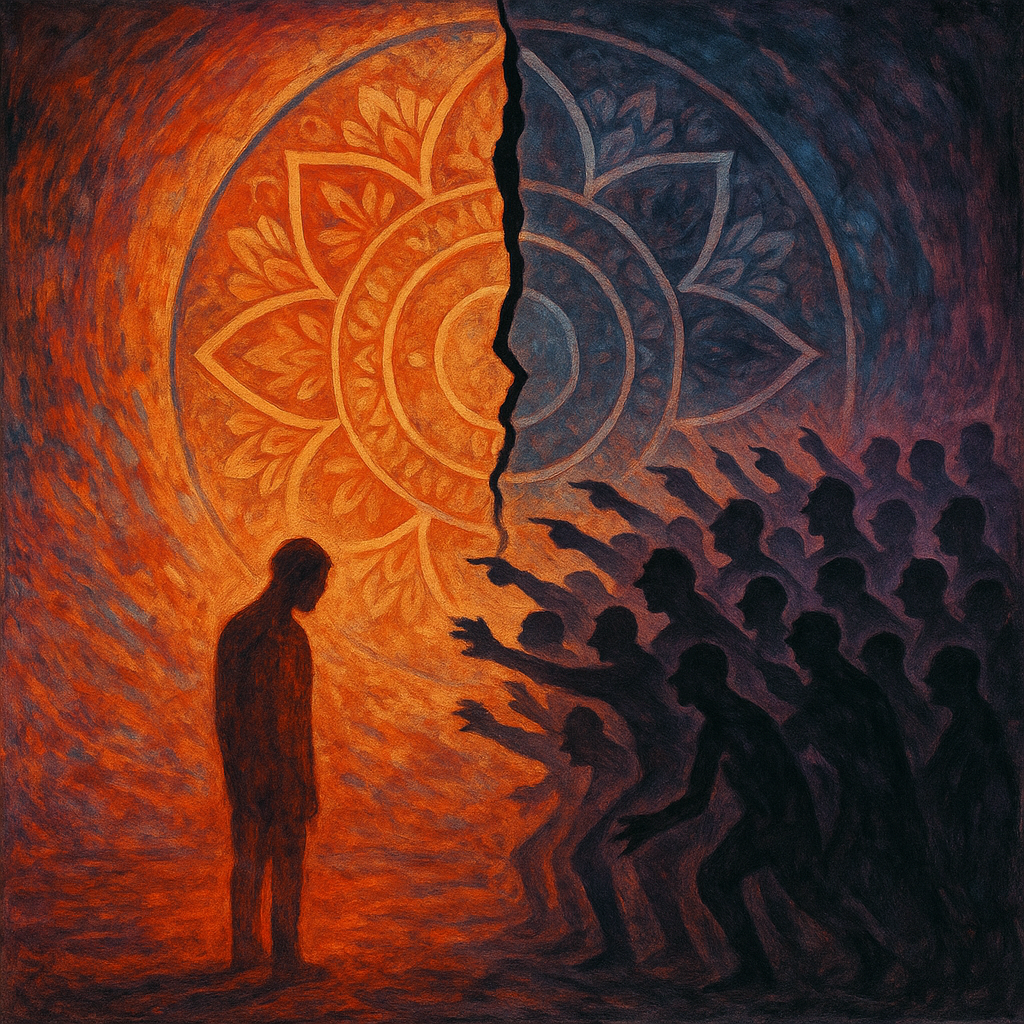
Carl Jung proposed the concept of the shadow—the unconscious repository of traits we deem undesirable, immoral, or shameful. What we refuse to integrate within ourselves doesn’t vanish; it festers in the dark and seeks expression, often through projection. On a societal level, this becomes a collective shadow, surfacing as we displace our unacknowledged inner material onto others.

The target of a cancellation—a public figure, a peer, an online stranger—often becomes an archetypal scapegoat. In myth and ritual, the scapegoat bears the sins of the tribe and is sacrificed or exiled to restore social equilibrium. Today, the ritual takes place online. The digital firepit is the comment thread. The sin is moral impurity.

But the fervor? That’s religious. Archetypal. Shadow-fueled.

Why Now? The Rise of the Unprocessed Psyche

We live in an age of hyper-visibility and deep fragmentation. Everyone is their own brand, their own broadcaster, their own PR department. Meanwhile, the tools for authentic psychological integration—community, ritual, introspection—have eroded.

Cancel culture thrives in this vacuum. It provides a synthetic moral high. A hit of certainty in a morally ambiguous world. A way to feel good without having to face the disturbing truth: that we, too, contain capacity for cruelty, ignorance, prejudice, and contradiction.

Instead of saying “This reminds me of something in myself I haven’t dealt with,” the unconscious says, “That person is disgusting. Get rid of them.”

The Performance of Virtue and the Fear of Exile

Much of cancel culture is driven by fear—of being next. As a result, virtue is often performed, not lived. We denounce to demonstrate that we are clean, correct, on the right side of history. It’s the modern equivalent of burning a witch to prove you’re not one.

This makes it difficult to speak honestly, to question the herd, or to show nuance—qualities vital for a psychologically healthy society. If one mistake marks you as irredeemable, then redemption as a concept is dead. Growth is irrelevant. All that remains is punishment.

But the shadow requires growth. It demands confrontation, not exile.

Cancel Culture as a Mirror

If we zoom out, cancel culture may be seen as an evolutionary pressure—a flawed but inevitable attempt by the collective psyche to regulate moral boundaries in a new digital terrain. It points to real traumas, power abuses, and social injustices that need redress.

But when we cancel rather than converse, when we exile rather than integrate, we repeat the very cycles we claim to oppose. We become the tyrant we sought to dismantle.

In this light, cancel culture is not the problem—it is the symptom of a deeper, unresolved issue: the collective failure to do shadow work.

Toward a New Integration

If cancel culture is a symptom of shadow repression, then the cure isn’t more silencing. It’s more integration.

This means:

  • Encouraging inner reflection, especially when we feel reactive.
  • Distinguishing between justice and vengeance—they may feel similar, but arise from different places.
  • Valuing growth over purity, recognizing that fallibility is universal, and transformation is possible.
  • Creating space for difficult conversations, where people can be accountable and human.

If humanity is to evolve beyond this recursive purge cycle, we must learn to see our enemies not only as threats, but as mirrors. Not to excuse harm—but to understand where it originates, in them and in us.

Conclusion

We are all being asked to grow up psychologically. The digital age has exposed us to ourselves in ways no previous generation has had to face. The question isn’t whether cancel culture is justified—it’s whether we are ready to look into the mirror it holds up and ask: What am I seeing in them that I refuse to see in myself?

Until we can answer that, the shadow will keep casting new scapegoats for the mob to burn.

Systemic Gaslighting: Let’s Finally Say It Out Loud

You Know It, I Know It: Systemic Gaslighting Is Real

Let’s stop pretending this isn’t happening.

You know the feeling. You go to the GP or A&E with something serious, something that’s quite literally threatening your health or your life—and you get fobbed off. Not just dismissed, but unacknowledged. It’s as if your suffering never even entered the room. I once went through a period where due to my dysphagia (difficulty swallowing foods), I couldn’t swallow anything—not even liquids—and three different doctors didn’t just ignore the urgency. They didn’t even acknowledge that not eating or drinking might be life-threatening.

That’s not a misunderstanding. That’s gaslighting at a structural level.

We don’t always use that word in this context, but maybe it’s time we did. Because the plausible deniability this system thrives on? It’s wearing thin. It’s implausible now. And yet the more glaring the denial becomes, the more we’re made to feel crazy for seeing it.

When the system fails you repeatedly, when it actively erodes your trust in your own perception, it doesn’t feel like negligence. It feels like being crushed. Slowly, deliberately. With no admission of force.

And if you’re neurodivergent? It’s a whole extra layer of hell. I’m autistic. I have social phobia. I don’t perform distress the way they expect. I don’t cry on cue. I don’t shout. I process. And because I process, I’m read as cold, or fine, or “not that bad.”

So I mask. I over-explain. I try to predict what they want from me, how to appear distressed in a way they’ll believe. But it always feels off. Like I’m being baited into dishonesty just to prove my honesty. And that makes them feel justified in writing me off.

This is what systemic gaslighting looks like:

  • They act like they care.
  • They position themselves as your advocate.
  • But every policy, every interaction, every flicker of body language says: “We’re not spending money on you if we can help it.”

I’ve warned others before. Told them: don’t be fooled by the performance of care. If you have the strength, call it out in the moment. Name the evasion. Ask for honesty. Demand respect. But know that they have tactics too. And they’re good at them.

So what keeps me going? Partly survival instinct. Partly the sheer disgust at how far we’ve allowed this to go. But mostly: the knowledge that it doesn’t have to be this way. That somewhere under the mountains of bureaucracy and gluttony and cruelty, there’s a version of the world where institutions actually listen. Where they respond with compassion, not scripts. Where people aren’t punished for needing help.

And until that world is real, I’ll keep writing. Even if no one hears it right now, the truth is here, in black and white.

You know it. I know it. Let’s stop pretending.

Nihilism: A Blank Canvas, Not a Dead End

When most people think of nihilism, they often associate it with despair, emptiness, or a sense of meaninglessness. To some, it might feel like a philosophical dead end—a void where no purpose or value can exist. But for those who embrace it fully, nihilism is far from a negative or paralyzing concept. Instead, it’s an open canvas, waiting to be painted with the colors of your own choosing.

At its core, nihilism challenges the idea that inherent meaning exists in the universe. It tells us that there is no predefined purpose, no grand cosmic design, and no higher power dictating our fates. For many, this realization can be unsettling—if nothing has inherent meaning, then what’s the point of anything? But here lies the beauty of nihilism: it frees us from the chains of external expectations and allows us to define our own meaning.

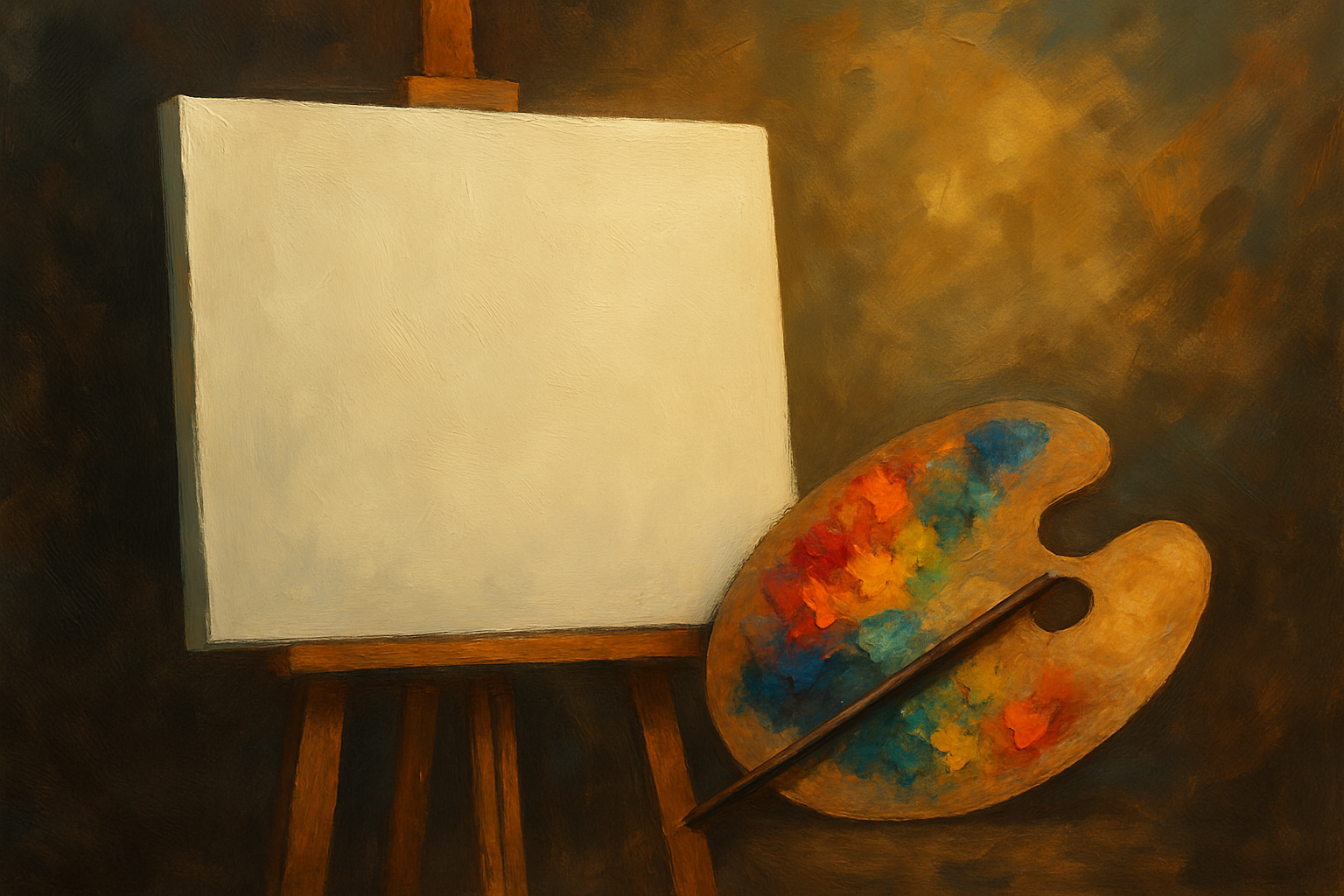
Rather than seeing nihilism as a void or a dead end, it’s more productive to view it as a blank canvas. The absence of preordained meaning gives us the ultimate freedom to create our own. If the universe doesn’t hand us a purpose, then we can craft our own from scratch. This isn’t an invitation to apathy or despair; it’s an invitation to action.

Nihilism, in this light, empowers us. It tells us that we are the authors of our lives, the creators of our own values. It’s not a declaration of emptiness, but of boundless possibility. The absence of meaning can be terrifying at first, but when we shift our perspective, it becomes liberating. It’s a canvas stretched wide across our lives, ready to be filled with whatever we choose.

For many people, this shift in thinking can lead to a deeper appreciation for life. When you know that meaning isn’t handed to you but created by you, every action and every choice becomes imbued with personal significance. Rather than feeling lost in the vastness of an indifferent universe, you can find comfort in knowing that it’s up to you to shape your existence. Nihilism strips away the layers of pretense and leaves you with the raw material of life itself, allowing you to create something real and meaningful on your terms.

In a way, nihilism doesn’t leave you in the dark. It opens the door to a freedom that most people never realize they have. It’s a blank canvas, not a dead end. The question is no longer what is the meaning of life, but how will you create meaning for yourself?

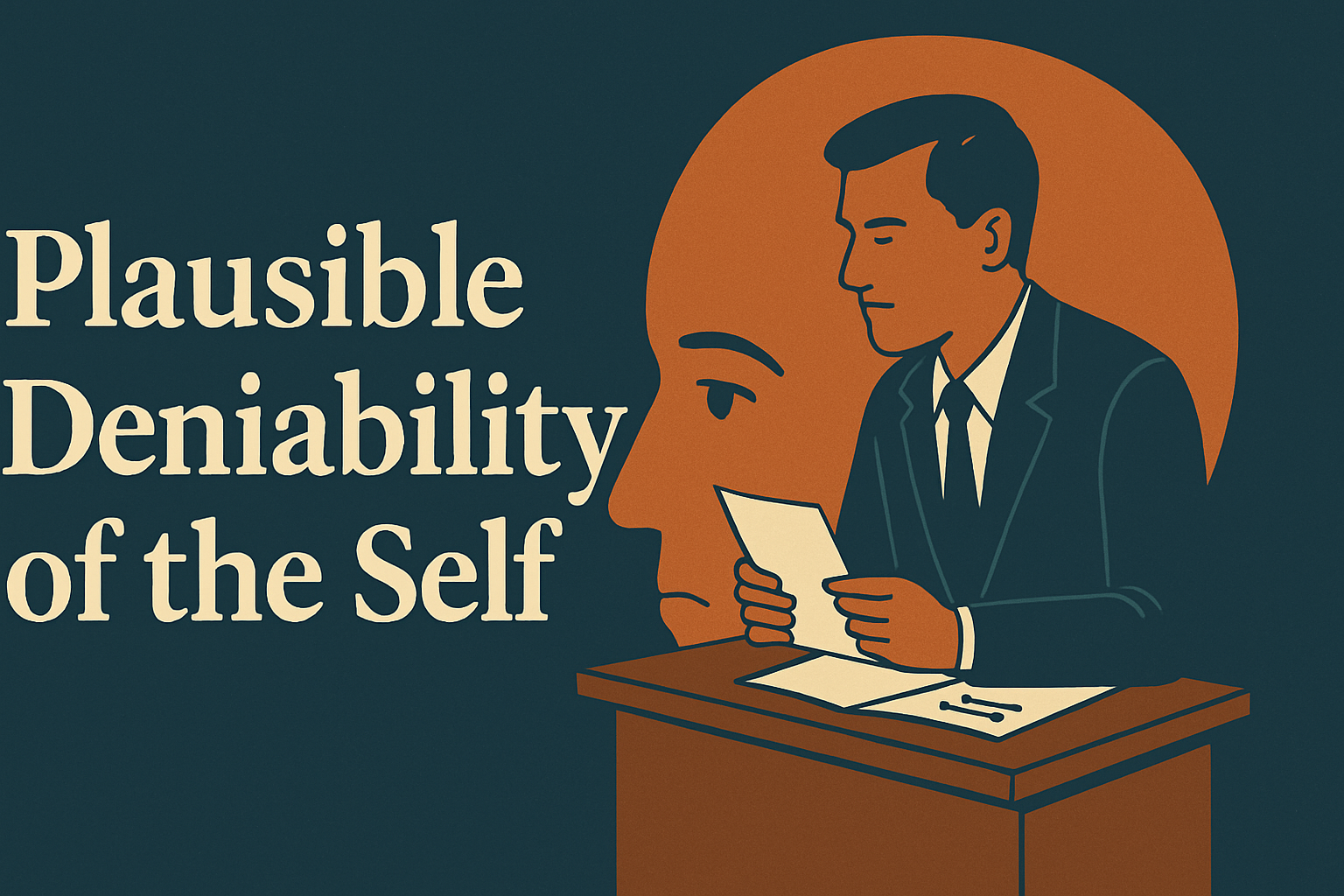
Plausible Deniability of the Self

We’re used to hearing the phrase “plausible deniability” in politics—leaders insulating themselves from blame by ensuring there’s just enough ambiguity. But what if we all do something similar inside our own minds?

“Plausible deniability of the self” is my term for a strange but familiar human pattern: the subtle maintenance of ignorance about our own motives. It’s the internal equivalent of shredding documents or passing blame down the chain of command. Only instead of evading legal consequences, we’re evading ourselves.

We fragment. We compartmentalize. We perform. We lie to others, yes—but more often, we lie just enough to ourselves to keep the story intact. A story in which we’re the hero, the victim, the misunderstood genius, or at the very least, not the villain.

This isn’t always malicious. In fact, it’s often protective. Plausible deniability of the self allows us to continue functioning in a world that rarely rewards full transparency, even with ourselves. But it comes at a cost: the erosion of inner clarity. We become so skilled at playing ourselves that we forget it’s a game.

I’ve noticed this pattern in others, but also in myself. Especially in moments of social performance—where sincerity is filtered through layers of rehearsed affect. I catch myself defaulting to familiar tones, phrases, or even entire personas that feel safe. Authenticity becomes a moving target. I’m not being fake, exactly—but I’m certainly being… edited.

I’ve seen it play out in others too. In the way someone justifies their cruelty as honesty, or hides their self-interest behind altruism. The dissonance is often invisible to them, but glaring from the outside. And I try to stay aware that the same might be true of me—that I’m not exempt from the same circuitry just because I’m watching it.

And that’s the trick. We don’t have to lie outright to distort reality. All we need is a little ambiguity. Just enough to tell ourselves: “Well, maybe that wasn’t the reason. Maybe I really was trying to help. Maybe I really do believe that.”

Plausible deniability of the self is the ego’s legal department. It draws up contracts between truth and comfort, and we sign them with a shrug. There’s always some fine print we can fall back on when we feel exposed: a loophole here, a vague clause there. “Technically,” we weren’t lying. “Technically,” we meant well. The terms of the self are deliberately broad, with plenty of room for reinterpretation.

We draft these agreements early in life. Some are copied from others. Some are revised in crisis. They bind us to a self-image we can live with—even if it’s not entirely honest. And if reality starts pushing back? No problem. The legal team is already working on a new narrative, a new justification, a new clause.

But what happens when we stop? When we sit with the discomfort of being transparently ourselves—flawed, inconsistent, uncertain? It’s terrifying. And liberating. There’s a peace in dropping the performance, even if only internally. A quiet kind of rebellion against the need to be anything but real.

Of course, even this realization is at risk of being co-opted. The ego adapts. It loves a good redemption arc. So the work continues. Not to eradicate the ego, but to observe it. To listen when it whispers, “That’s not who we are,” and to gently reply, “Maybe it is.”

This isn’t a manifesto. It’s a mirror. Hold it up carefully. And see who looks away first.

The Paradox of Compassion and Oppression: Can Humanity Grow Beyond the Current System?

In a world where empathy, kindness, and equality are frequently championed, it’s hard to ignore the paradox that underpins many of our societal structures. We live in a system that, on the surface, promotes compassion and understanding, yet often fails to extend these values to those who fall outside of a narrow, idealized norm. The result is a form of systemic oppression—one that may not be overt or intentional, but which still deeply affects individuals who are considered “other” by society. From neurodivergent individuals, like those with autism, to those who live with mental health conditions or psychopathy, many are faced with a system that struggles to accommodate their unique experiences, perspectives, and needs.

This paradox presents a crucial question: can humanity evolve beyond the limitations of a system built on conformity and idealized norms? How can we recognize and address the underlying contradictions within a society that claims to value compassion but fails to apply it to everyone?

The Current System: Compassion in Theory, Oppression in Practice

At its core, our current system is rooted in ideals of fairness, justice, and compassion. In theory, it promotes equality, extending kindness to others and encouraging the alleviation of suffering. Yet, when it comes to those whose behavior, identity, or neurological wiring deviates from the mainstream, the system often fails to extend this compassion in practice.

Take, for example, individuals with autism. Many of these individuals navigate a world that is not designed with their neurodivergence in mind. Social norms, communication expectations, and sensory environments can all pose challenges that society rarely accommodates. While we understand that autistic individuals experience the world differently, the societal response is often to ask them to conform, masking their true selves in order to “fit in.” This can lead to exhaustion, frustration, and even feelings of invisibility. What’s meant to be a compassionate, inclusive society, at times, becomes one that marginalizes those who cannot easily conform to established norms.

The same paradox applies when we consider the ethical implications of psychopathy. Psychopaths, individuals whose behaviors are often characterized by a lack of empathy or remorse, are frequently viewed as dangerous, immoral, or even “evil.” However, this view fails to acknowledge the possibility that their experiences of the world—shaped by neurological and psychological factors—might be radically different from the norm. The tendency to label psychopathy as inherently wrong leads to punitive systems that rarely consider the possibility of rehabilitation, accommodation, or deeper understanding.

This creates a troubling dichotomy: a system that professes compassion but is not designed to accommodate those whose ways of being differ from the mainstream. In effect, society ends up compounding the suffering of those who already find themselves on the margins, further entrenching the very issues it seeks to solve.

The Paradox of Morality: Who Decides What’s “Normal”?

At the heart of this issue is the question of what is “normal” and who gets to decide. Society often creates moral frameworks that are rooted in a shared understanding of what constitutes acceptable behavior, thought, and identity. Those who fit within this framework are generally accepted and treated with compassion, while those who fall outside of it are labeled as “wrong,” “deviant,” or even “dangerous.”

This is where the paradox deepens: In striving for compassion, we often end up perpetuating exclusion and marginalization. The very same system that advocates for inclusion and kindness can, at times, act as a gatekeeper, denying access to those who are deemed “other.” And even more troubling, this dynamic is rarely examined or questioned in mainstream discourse.

By framing difference as “wrong,” society creates an environment in which those who are perceived as different—whether due to neurodivergence, mental illness, or extreme psychological traits—are denied the right to be understood, let alone accommodated. It is an approach that focuses on the conformity of individuals rather than the evolution of society itself to accept a broader spectrum of human experience.

Can We Grow Beyond This Paradox?

The answer to whether we can grow beyond this paradox is not simple, and it may require profound shifts in the way we understand and relate to others. There are, however, several steps we can take to begin moving towards a more inclusive and compassionate world—one that doesn’t just champion kindness in theory but applies it broadly, even to those who challenge our notions of “normal.”

  1. Reframe Difference, Not Deficiency: The first step is to shift the way we view difference. Instead of framing non-normative behaviors, thoughts, or identities as “wrong” or “broken,” we can work to see them as variations of human experience. By reframing difference as a natural part of the human spectrum, we can begin to build a system that is more accommodating and understanding.
  2. Create Inclusive Systems: Instead of demanding that individuals conform to rigid societal norms, we must look at how systems—whether educational, healthcare, legal, or social—can be adapted to accommodate a wider variety of human experiences. This might mean redesigning environments to be more sensory-friendly, adjusting communication expectations, or rethinking how we define and approach mental health and psychological differences.
  3. Engage in Honest Conversations: Change begins with dialogue. We need to create spaces where challenging conversations about difference, morality, and societal expectations can take place. This includes recognizing the nuances of psychological conditions like psychopathy and autism, and moving away from simplistic labels toward deeper, more empathetic understandings. It’s about listening to marginalized voices and making space for their experiences to be heard.
  4. Acknowledge the Limits of Empathy: Our current system is built on the assumption that empathy can and should guide our actions. While empathy is a powerful force, it has its limits—particularly when it comes to understanding those whose experiences of the world are radically different from our own. Moving beyond this paradox will require a more complex understanding of human difference and the development of strategies for responding to harm that do not rely solely on empathy or moral judgment.
  5. Foster a Culture of Flexibility and Growth: In order to truly evolve, we need a cultural shift that embraces the idea of flexibility and growth. Rather than rigidly adhering to one model of behavior or identity, we need to embrace the fact that people grow, change, and experience the world in unique ways. Our systems must be able to adapt to these changes and provide pathways for everyone, even those who are perceived as “different,” to thrive.

A Path Toward True Compassion

The paradox of compassion and oppression is not an easy one to resolve. But by confronting it head-on, we have the opportunity to evolve into a society that not only values compassion but also practices it in ways that truly embrace the diversity of human experience. In doing so, we can build a future where no one is marginalized simply because they don’t fit into a narrowly defined mold.

While change may take time, the process begins with recognizing the inherent value of all individuals, even those who challenge our understanding of morality, empathy, and behavior. By expanding the boundaries of compassion to encompass the full spectrum of human experience, we can begin to create a world that is truly just, inclusive, and humane.