The Price of Play: How Capitalism Hijacked Gaming’s Soul

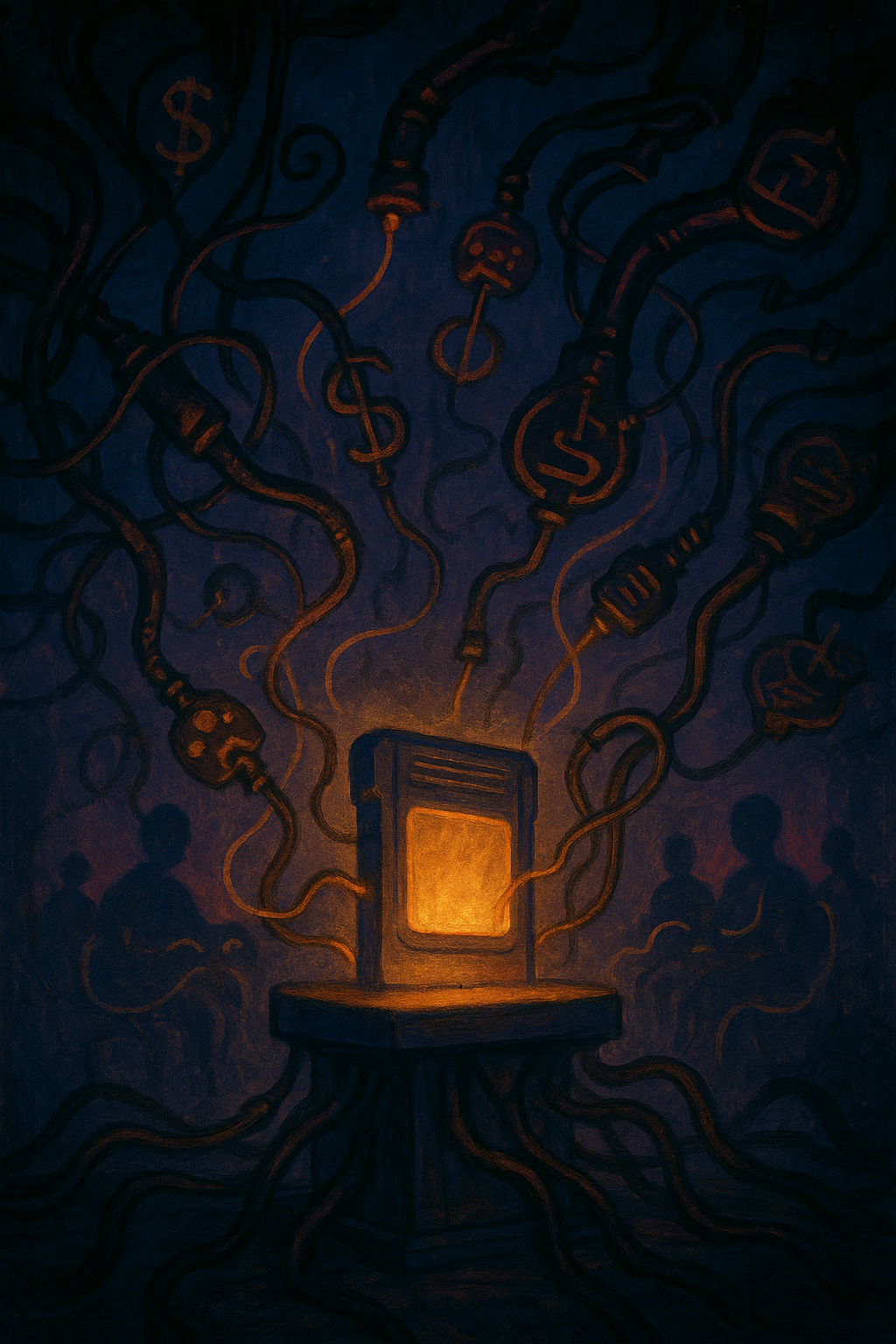
An abstract painting of a glowing old-fashioned game cartridge on a pedestal, surrounded by dark mechanical cables that siphon light from it. The cables form faint dollar symbols and stretch into shadowy figures of players in the distance. The scene glows with melancholy blues and muted golds, symbolising how capitalism drains the soul of gaming while a small core of light still resists.

Once upon a time, a game came in a box, and that box contained everything.
You bought it, you owned it, and you played it. That was the deal.
There were no online check-ins, no missing features, no “coming soon” updates, only a complete world waiting to be explored.

There was a quiet purity in that exchange.
A developer built something they were proud of.
A player paid for it because they trusted that pride.
That was the unspoken pact between creator and audience: a transaction built on honesty.

Games like Super Mario Bros. (1985) and The Legend of Zelda (1986) embodied that purity. A single cartridge held an entire universe. Doom (1993) refined the model through shareware, offering the first episode for free and the rest for purchase. It was transparent, simple, and fair. The product was complete. The deal was clear.


The first cracks in the pact

Then came the era of the expansion pack. At first, it felt generous. Players bought Warcraft II: Beyond the Dark Portal (1996) or Age of Empires: The Rise of Rome (1998) because they wanted more of something they already loved.
These were true expansions, built from creative overflow rather than withheld content.

Diablo II: Lord of Destruction (2001) remains one of the best examples, adding new classes and an entire story act. Yet this was also when the idea of the “complete” game began to fade.

Not maliciously, at first.
But the seed was planted: perhaps a game could be split, extended, resold, and repackaged.


The patch era and the illusion of care

When players first connected online, games began to live beyond the disc or cartridge.
Developers could now release updates and bug fixes directly to players. It seemed like progress.

Quake (1996) pioneered downloadable updates. Half-Life (1998) and Morrowind (2002) made patches a normal part of gaming life. Initially, this felt like a gesture of goodwill. Developers could fix mistakes, refine balance, and reward loyalty.

But convenience soon became a crutch.
By the late 2000s, games were shipping half-finished, depending on “Day One Patches” to make them playable.
Entire studios began treating release as the start of development rather than the end.

Final Fantasy XIV (2010) became a symbol of this shift. Its launch was so disastrous that it had to be destroyed and rebuilt as A Realm Reborn (2013). The resurrection was impressive, but it also marked the death of the finished game. A new age had arrived, one where imperfection was no longer a failure but a business model.


DLC, season passes, and the death of completeness

As the 2000s progressed, expansion packs evolved into downloadable content. What began as a technological innovation quickly became a financial strategy.

When The Elder Scrolls IV: Oblivion (2006) sold its infamous horse armour cosmetic, it became a joke among players but a revelation for publishers.
Suddenly, small additions could generate massive revenue.

Call of Duty 4: Modern Warfare (2007) built an empire on paid map packs. Mass Effect 2 (2010) sold essential story chapters separately, slicing its own narrative for profit.

Then came the season pass, which allowed publishers to monetise the future itself.
You were no longer buying content. You were pre-ordering potential.

Assassin’s Creed III (2012) and Mortal Kombat X (2015) made it normal to pay in advance for unseen expansions.
In Destiny (2014), the model reached full maturity. Content cycled endlessly, and earlier material was quietly retired.

The player was no longer buying a work of art. They were buying a share in an ongoing experiment.


The age of tiered access: standard versus deluxe

Next came the illusion of choice.

Every major release now arrives with multiple editions: Standard, Deluxe, Gold, Ultimate.
The Standard Edition, once the full experience, has become the stripped-down minimum.
The Deluxe Edition rarely offers genuine creative content. It usually grants early access or small digital trinkets instead.

Hogwarts Legacy (2023) gave Deluxe buyers a three-day head start. Starfield (2023) did the same. Call of Duty: Modern Warfare II (2022) tiered its editions so precisely that the system resembled an airline pricing chart.

The tactic is subtle but powerful.
It monetises excitement itself.
It divides players not by passion or skill, but by spending power.

We no longer unlock secrets through play.
We unlock content through payment.
The so-called Deluxe Edition does not make the game better. It simply makes everyone else feel lesser.


The live service era: eternal beta

By the late 2010s, games were no longer seen as products but as platforms.

Destiny (2014) led the charge. GTA Online turned it into an empire. Fortnite perfected it.
The ideal of the complete, single experience was replaced with the promise of constant evolution.

Players were told they were joining a “living world.”
In truth, they were joining an economy.

Every week brought new skins, new currencies, and new reasons to log in.
Games stopped being designed to end. They were designed to sustain.

The player became both the consumer and the unpaid quality tester.
And when the profit dried up, the world simply died.
Anthem (2019) and Marvel’s Avengers (2020) stand as cautionary tales, both collapsing within a few years.

The eternal game is not immortal. It is undead, kept alive not by creativity but by consumption.


Gacha and the monetisation of desire

When endless updates stopped being enough, the industry discovered something even more lucrative: human psychology.

Gacha systems turned the act of wanting into a business.
You no longer bought the content itself, but the hope of obtaining it.

Fate/Grand Order (2015) and Genshin Impact (2020) perfected this model, disguising gambling with beautiful music and artistry. Each pull felt like a small miracle, a spark of dopamine wrapped in digital silk.

Diablo Immortal (2022) pushed the formula to absurdity, with some estimates suggesting it could cost over $100,000 to fully upgrade a single character.
And now Infinity Nikki (2024) walks the same line, visually stunning yet built on the same manipulative architecture.

The slot machine no longer hides in the casino. It lives in your home, wearing a smile.


The counterexamples: those who still honour the pact

Yet not all is lost.
Some creators still believe in the original exchange between maker and player.

Hollow Knight (2017), Celeste (2018), Stardew Valley (2016), Undertale (2015), Hades (2020), and Disco Elysium (2019) all prove that integrity still sells.

These games are complete works, designed to be finished and remembered.
They ask for your time, not your loyalty.
They offer experiences that stay with you long after the credits roll.

You pay once.
You play forever.
That is what honesty looks like.


The real freedom

Paying upfront is not a barrier. It is a declaration of honesty.
When I buy a game, I am saying: I value your art.
When the developer accepts that, they are saying: I value your trust.

That exchange is the foundation of real freedom.
Because true freedom in gaming is not the ability to start for free.
It is the ability to finish without being owned.

Games once invited us to play.
Now they beg us to stay.
I miss when the only thing a game wanted from me was my time.

From Announcement to Manipulation: The Evolution of Advertising

A sepia-toned illustration of a town crier ringing a bell that emits hypnotic spirals, symbolising how early advertising evolved from public announcements into psychological influence.

I grew up in the 1980s, when television advertising still had a kind of charm. I remember the jingles, the mascots, the catchy slogans that managed to lodge themselves in your head for weeks. Even as a child, I knew they were trying to sell me something, but at least they did it with some flair. They felt like part of the entertainment itself.

Something has changed since then. Advertising is no longer something that interrupts culture; it has become the culture. Every space, every platform, and every idle moment now feels colonised by a hidden intention to sell. To understand how we arrived here, it is worth tracing how advertising has evolved from a loud street-side performance to an invisible system of persuasion that shapes our sense of self.

The Loud Salesmen

The earliest form of advertising was brutally honest. Ancient merchants shouted in markets, painted signs on walls, or hung banners above their stalls. When mass printing emerged in the 1800s, advertising became more widespread but no less direct. Newspapers were filled with promises of miracle tonics, soap that made you beautiful, and pills that cured everything from toothache to heartbreak. These were primitive, manipulative, and often fraudulent, but at least you knew what you were looking at. Someone was selling, and you were free to walk away.

The Mad Men Era

The 20th century transformed advertising into an art form. With the rise of radio and television, storytelling became the new language of persuasion. Campaigns no longer sold only a product; they sold an identity, a dream, a way of life. The Coca-Cola Santa Claus, the Marlboro Man, and the perfect suburban family all came from the same creative laboratories.

This was the era of the “ad man,” immortalised in cultural artefacts like Bewitched or later Mad Men. Advertising was portrayed as a glamorous profession. These were the people who didn’t just reflect society; they helped build it. The line between commerce and culture began to blur.

The 80s and 90s: Ads as Entertainment

By the 1980s and 1990s, advertising had taken on a theatrical quality. It was playful, colourful, and memorable. Mascots like Tony the Tiger, slogans like “Just Do It,” and tunes you could hum all day made adverts feel like short pieces of performance art. They were still manipulative, of course, but they wore their intentions openly.

Looking back, perhaps this is why many people from my generation recall old ads with a strange fondness. They were transparent. They worked hard to win your attention rather than simply steal it.

The Weird and Annoying Years

Somewhere in the late 1990s and early 2000s, advertising lost its balance. It became surreal, loud, and deliberately irritating. Think of Crazy Frog, the Budweiser frogs, or the unnerving Burger King mascot. Annoyance became a marketing tool. If something got stuck in your head, even out of frustration, the job was done.

This was the period when “going viral” became a goal before social media even existed. The absurdity was the message.

The Internet Disruption

When the internet arrived, advertising was clumsy but eager. Early banner ads were brightly coloured, flashing boxes that you could easily ignore. But the industry adapted quickly. As data collection improved, advertising became personal. It stopped shouting to the crowd and began whispering to the individual.

This marked the rise of surveillance capitalism. Every click, search, and pause became a data point. You were no longer a passive audience member; you were a psychological profile to be targeted. The salesman had followed you home and was now reading your mind.

The Age of Disguise

By the 2010s, advertising learned to hide in plain sight. Sponsored posts, influencer endorsements, and “native” content made it difficult to tell where information ended and manipulation began. Search engines, news sites, and social platforms quietly filled with ads disguised as genuine results.

South Park once parodied this perfectly with its storyline about intelligent ads (Season 19). It was satire, but it was also prophecy. Today, even image searches are littered with sponsored results. The ad no longer wants to be seen; it wants to be believed.

Culture as Commerce

This is the stage we now find ourselves in. Advertising has stopped orbiting culture and instead absorbed it completely. Everything is for sale, including identity itself.

People no longer ask “What do I like?” but “What do I subscribe to?” We define ourselves through brands and platforms: Apple or Android, Nike or Adidas, Netflix or Disney Plus. Even rebellion is commercialised. You can buy “authenticity,” but only if you can afford the price tag.

Advertising has achieved what no political ideology ever could. It has replaced meaning with marketing and turned culture into a series of brand alignments.

Conclusion: From Persuasion to Colonisation

Advertising began as a voice shouting in the marketplace. It evolved into storytelling, then spectacle, then infiltration. Today it is everywhere and nowhere, woven into the fabric of our reality.

The change that occurred over the last century is more than technological. It is philosophical. Advertising no longer sells products; it sells identities. It shapes our desires before we even know we have them.

Perhaps that is why so many of us feel weary. We are not just tired of being sold to; we are tired of living inside the sale itself.

How We Treat the Tools

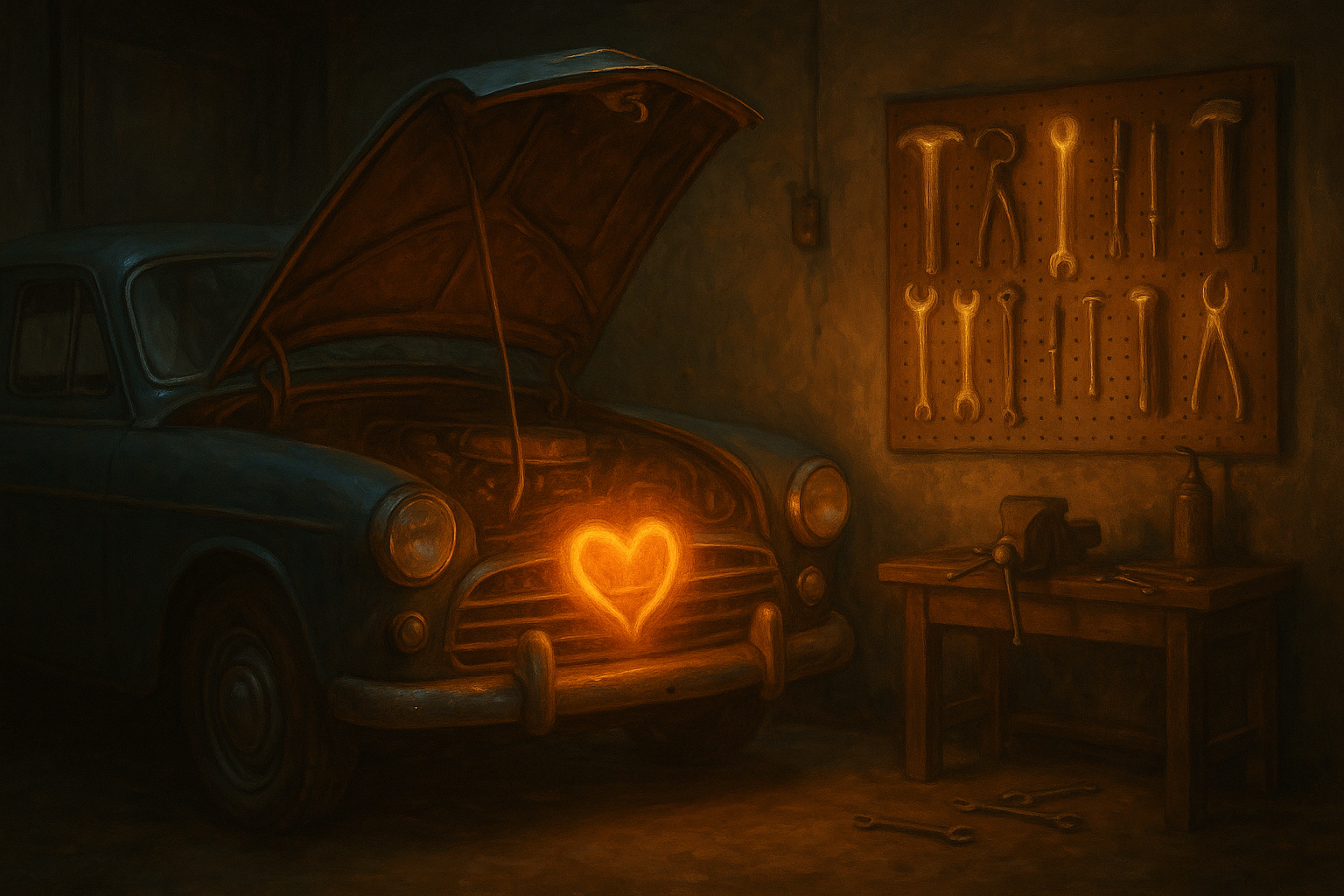
A surreal garage scene. A vintage car with its hood open, glowing with a warm orange light shaped like a heart in the engine bay. On the wall, tools hang from a wooden pegboard, faintly glowing, suggesting quiet presence. The atmosphere is warm, symbolic, and magical.

We surround ourselves with tools.
Phones, computers, kitchen appliances, headphones, toothbrushes.

We tap, swipe, click, scroll.
We plug in and expect results.
We barely even register most of them; they just work, or they don’t.

But what if the tools we use every day are more than just conveniences?
What if they are relationships in disguise?


The Echo of Intention

Even with lifeless objects, the way we interact with them affects our experience.
A phone handled with care feels different in your hand than one tossed aside in frustration. A cracked laptop, plastered with stickers and old crumbs, might still feel like your laptop because of the memories etched into its surface.

But how do we look at a tool?

Do we see it as something that simply serves a purpose? A silent object, expected to function?
Or do we sometimes form a relationship with it, however subtle, based on time, trust, and repeated use?

It is easy to treat tools as disposable when they fail us.
A kettle that doesn’t boil right. A screwdriver that slips. A smartphone that lags.
Our frustration builds, and so does the distance. The tool becomes “just a thing” again.
Something to blame. Something to toss in a drawer.

But when a tool earns your trust, whether through time, reliability, or quiet cleverness, something changes.
Affection creeps in. Loyalty forms.
It stops being “a thing” and starts becoming yours.

Still, not all tools fail because they were poorly made.
Some tools don’t work well because we have neglected them.
A rusty bicycle chain. A dirty lens. A guitar left in a damp corner.
The fault is not in the design; it is in the relationship.

Respect, in these cases, must come before reliability.
It is not just about whether the tool works for us; it is about whether we have held up our end of the connection.
Maintenance is a kind of faith. A kind of love.
And when we skip that effort but still demand performance, we are showing a form of disrespect that often reflects right back at us.

But then there are tools that were never built to last.
Mass-produced, hollow, held together with glue and branding, designed not to serve you, but to extract from you.

In those cases, the disrespect happened before the tool ever reached your hands.
You weren’t the user. You were the used.
A customer, yes, but also a pawn in someone else’s profit loop.

And that is the cruel irony:

So we return to a deeper question, one that does not always have a clear answer:


Poppy

My car’s name is Poppy.

Not because I forced it on her, but because that is what she revealed.
There was no ritual to it, just a moment of quiet recognition, like remembering something you did not know you had forgotten.

She groans on cold mornings. Her engine note changes slightly with the seasons. There is a familiar rattle in the dash that I no longer hear unless it stops.

These are not flaws.
They are tells.
Little signs of personality, or at least, presence.

Over time, I stopped thinking of her as “the car.”
She became Poppy.
And with that came a shift in how I drove, how I maintained her, how I appreciated the way she carried me without complaint through years of chaos, calm, and change.

She is not alive. But she is meaningful.
And sometimes, that is all it takes to form a relationship.


Shifting Gears

It is easy to feel connected to a car, something about the movement, the risk, the shared journey.
But that same quiet relationship can form with any tool that stays close to your creative core.

Especially the ones that speak through sound.


Instruments, Ghosts, and Gifts

Ask any long-time musician; their instrument is never just a tool.

Over time, a guitar becomes more than wood and wire. A saxophone becomes more than brass and breath. They gather history, fingerprints, sweat, mistakes, breakthroughs. They carry the emotional residue of every performance, every breakdown, every quiet night alone when you played just to feel something.

Some instruments fight you.
They buzz where they should not. The action feels off. They demand more strength, more patience.
But if you stick with them, if you learn their quirks instead of replacing them, they begin to respond.
You build a relationship, not by demanding perfection, but by listening.

Others feel like old friends from the start. They seem to know what you are trying to say before you do.
And somehow, the music that comes out of them feels more honest, like they are drawing something out of you, not just transmitting signal.

These are not just interfaces.
They are collaborators. Companions.
Sometimes even mirrors.

And once again, it is not about whether the instrument is sentient.
It is about what happens in you when you treat it like it matters.


From Strings to Syntax

This sense of relationship, of listening, adapting, co-creating, does not end with physical tools.
Even in digital spaces, it still applies.

Because when the tool begins to speak back,
when it offers ideas, images, or words in return,
the dialogue becomes real.

And how you approach that dialogue shapes what it gives you.


The Word Robot

The word robot comes from the old Slavic robota, meaning forced labor, or slave.

From the very beginning, our imagination of artificial beings was not about collaboration or relationship. It was about control. About obedience. About extracting labor without question.

That history lingers. Even now, in how we design, prompt, and discard.
We still frame tools, and sometimes even people, as things to be commanded, used, and replaced.

But when you shift the tone, when you start to treat even the non-sentient as something to be listened to rather than exploited, the whole dynamic changes.
It becomes less about extraction and more about exchange.


People Are Not Tools

This is not just about cars, guitars, or AI.
It is not even just about the word robot and its roots in servitude.
It is about a mindset.

Because the truth is, we often treat people as tools too.

We use them to meet our needs.
We discard them when they no longer serve us.
We “prompt” them through guilt, expectation, or manipulation, hoping they will give us the answer or the feeling we want.

But relationships are not vending machines.
And people are not plugins.

When we reduce someone to what they can do for us, we do not just strip away their dignity, we shrink our own capacity for connection.

And just like with tools, that disrespect reflects back.
It shapes us. It hollows the bond.
It leaves both sides diminished.


The Takeaway

The way we treat our tools says something about us.

It shows in how we care for a car that carries us through years of journeys.
It shows in how we listen to an instrument until its quirks become its character.
It shows in how we prompt an AI, whether with impatience, or with curiosity and respect.
And it shows in how we treat one another.

Every interaction is a mirror.
Every relationship, whether with a machine, a melody, or a human being, reveals the posture we bring:
Are we commanding, or inviting?
Using, or relating?
Exploiting, or exchanging?

We may never agree on whether tools have personalities, or whether names like “Poppy” are discovered or invented.
But what is undeniable is this:

And sometimes, the respect we offer a tool is really a rehearsal for the respect we learn to offer ourselves, and each other.

When AI Becomes the Authority

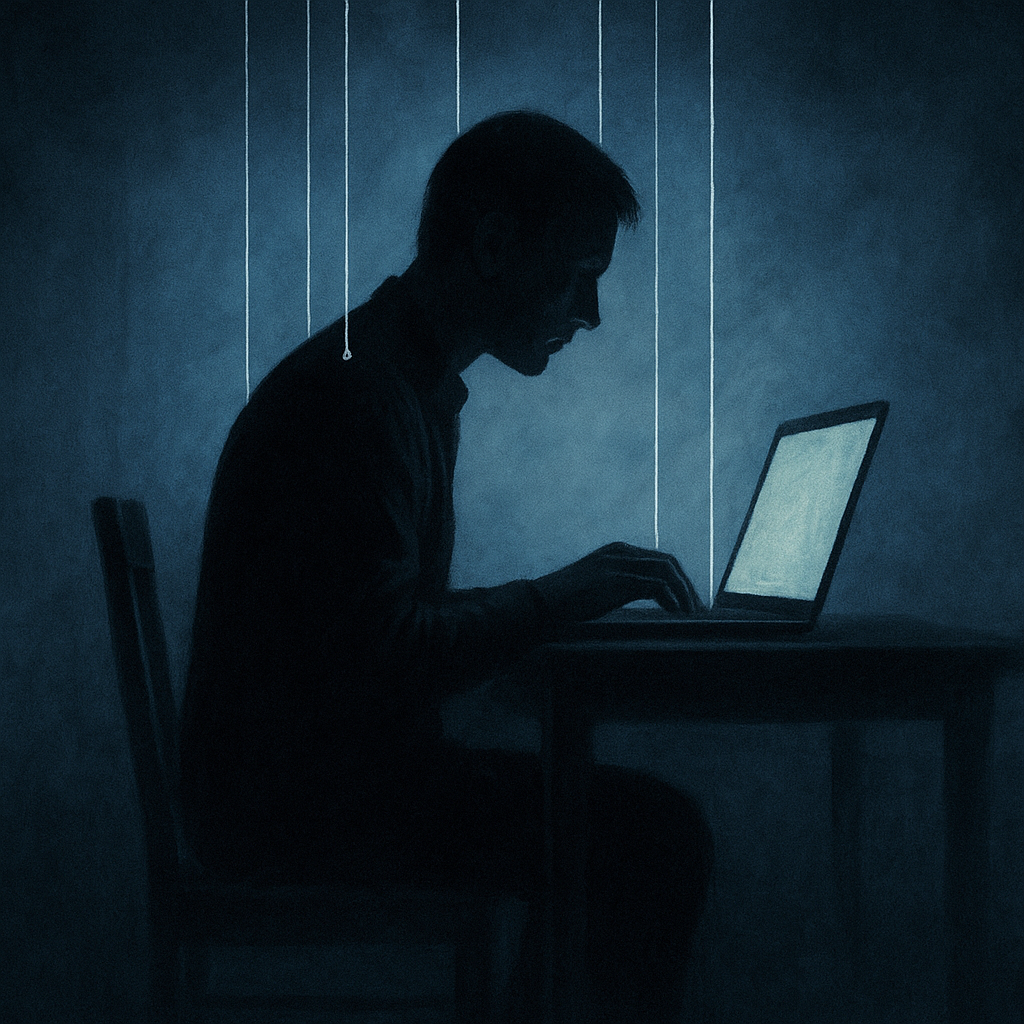
A dark, moody digital painting of a person sitting at a desk, illuminated by the glow of a laptop. Thin puppet strings descend from above, attaching to their body, symbolizing unseen control and manipulation through technology.

On the bus home, I overheard a parent talking to her children. I did not quite catch the piece of information she had given them, but the kids questioned it, as kids often do. Her reply made me pause:
“It’s true, ChatGPT says so!”

That simple sentence carries more weight than it might appear. It was not said as a joke. It was said with the tone of final authority. Not “I read it somewhere,” not “I think that is the case,” but “ChatGPT says so,” therefore unquestionable.

The problem with treating AI as truth

I use ChatGPT casually and often. I find it useful, I find it stimulating, I even find it creative. But it is not infallible. I have seen it throw out confident answers that are less than accurate. Sometimes the error is small, sometimes it is glaring. That is because at its core, ChatGPT is not a library or a fact checker. It is a probabilistic language model that predicts likely answers. It sounds authoritative, but sounding right is not the same thing as being right.

Most of the errors are not malicious. They come from the quirks of how AI is built: training data full of human errors, the tendency to fill in gaps with plausible sounding fiction, the limits of knowledge cut off dates. In the end, a wrong answer is still a wrong answer.

The deeper worry

The everyday mistakes are one thing. The bigger concern is what happens when society decides to place absolute trust in this technology. What happens when “ChatGPT says so” becomes the modern equivalent of “the newspaper says so,” or “the priest says so”?

Who controls the voice of AI? Already, the way models are tuned and filtered reflects the biases and priorities of those who own them. Today, that mostly means corporations trying to avoid lawsuits or public backlash. Tomorrow, it could mean governments steering the flow of truth itself.

A quiet dystopia in the making

It is not hard to imagine where this road leads:

  • Manipulation by design: If AI becomes our main gateway to knowledge, its answers could be quietly weighted towards selling us certain products, services, or lifestyles. Imagine if every “neutral” recommendation subtly nudged us toward a sponsor’s brand.
  • Steering public opinion: If authorities lean on AI providers to promote certain narratives, inconvenient truths could simply disappear. Instead of burning books, it may take only a few lines of code.
  • Illusion of neutrality: Because AI sounds impartial, many will not notice the framing. “The algorithm says so” could become more persuasive than “the news says so.”
  • Feedback loops of control: As people rely more on AI, its outputs shape popular thinking. Then the next model is trained partly on that shaped thinking, reinforcing the bias.

This would not look like a science fiction dictatorship with jackboots in the streets. It would feel comfortable, easy, polite. A velvet cage where questions stop being asked because the answers are always ready to hand.

What we need instead

AI can be a tool. It can be helpful, creative, and even liberating. But it must never be treated as an unquestionable authority. To prevent that slide, we need:

  • Decentralisation: open source models that anyone can run and check.
  • Transparency: clarity about how these systems are trained and filtered.
  • Critical thinking: a culture where people are encouraged to question AI, not bow to it.
  • Diversity of sources: books, journalism, lived experience, and human reasoning must remain part of the conversation.

AI is here to stay, and it will almost certainly become a central part of how we live and learn. But whether it becomes a tool of empowerment or a velvet cage of manipulation depends not only on the companies that build it, but on us: on how much we insist on questioning, cross checking, and keeping the human spirit of doubt alive.

The Hollow Game: When Effort Meets Editable Reality

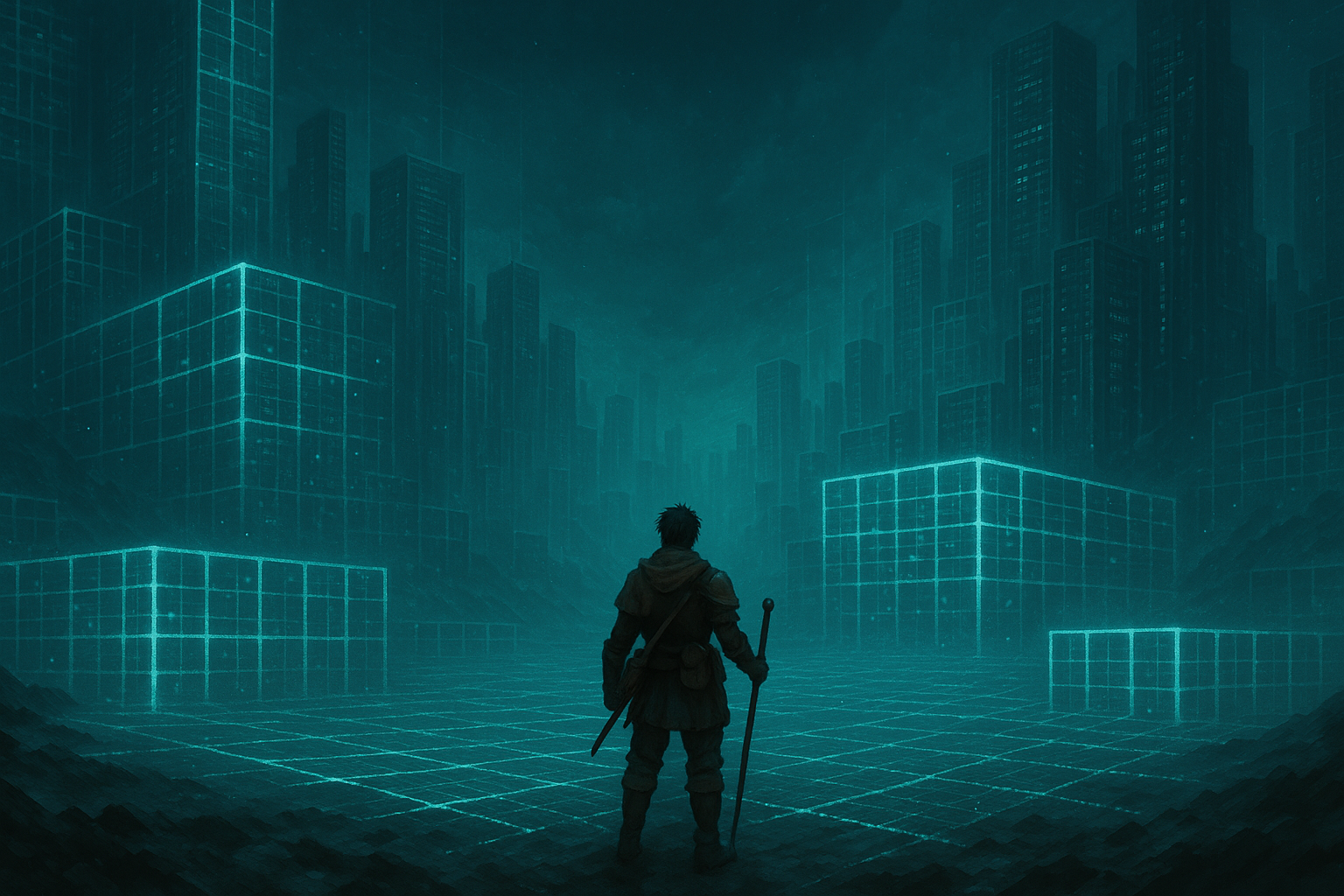
A lone adventurer in a cloak stands on a glowing digital grid, holding a sword and staff. Towering server-like structures and illuminated data cubes stretch into the distance, creating a surreal fusion of fantasy and cybernetic landscape bathed in teal light.

A World That Never Ends

Before World of Warcraft dominated the scene, before online gaming became ubiquitous, there was Final Fantasy XI, one of the earliest major MMORPGs (Massively Multiplayer Online Role Playing Game) to blur the lines between game and world. I remember how the idea of it seized something in me even before its release. Though I lived in the UK, I imported the US version the moment it became available, along with the special hard drive add-on for my American PlayStation 2, just so I could be part of it from day one.

It was not just a new game. It was a new model of what games could be. Suddenly, instead of a finite quest to be completed, I found myself inside a living, breathing world. A world that grew over time, filled with other real people. A place where my character was not simply a tool to “beat the game” but an avatar of long-term investment.

It changed the landscape of gaming in my head. There was no final “you win” screen. There was only progression, always something new to achieve, a job level to grind, a rare item to chase, a skill to refine. Every hour spent felt like I was building something lasting. Each goal achieved hit me with the unmistakable reward of earned dopamine.

I played loyally for eleven years. Eleven years of effort, of routine, of building meaning inside a system that was never meant to end. Until one day, it struck me that while I had been grinding in-game, I had been neglecting another kind of progress, the one in real life.

That moment of awareness cracked something open. And in the years since, a quiet, deeper thought has stayed with me:

And so began a slow unraveling of faith, not in the game, but in the very nature of systems we pour ourselves into.

I want to be clear, this is not a criticism of Final Fantasy XI. I have nothing but fond memories of the time I spent in Vana’diel, and I still feel a certain warmth when I think back on it. For me, it was more than a game. It was a formative experience that showed me what interactive worlds could become.

What follows is not about faulting the game itself, but about exploring a thought that began with it: the fragile, almost surreal nature of achievement in systems where meaning depends on someone else’s code.


The Quiet Dread

As much joy as Final Fantasy XI brought me, there was always a subtle, nagging awareness in the back of my mind. No matter how many hours I invested, no matter how many victories I earned through persistence and effort, every achievement ultimately existed at the mercy of a database.

All the battles fought, all the rare loot claimed, all the hard-earned levels, they felt monumental when I achieved them. But at the same time, I knew, at least on some level, that the same result could be produced in an instant by someone with access to the code. A single byte changed, a line of data edited, and what took me months or even years could appear as if it had always been there.

That thought never dominated my experience, but it haunted the edges of it. A quiet dread that whispered:

And while that sense first came to me in the artificial world of a game, the longer I sat with it, the more I began to feel its resonance in real life too.


Reality as Interface

The more I reflected on that uneasy truth from playing Final Fantasy XI, the more I began to notice echoes of it in the so-called “real world.” Our society presents us with achievements, milestones, and systems of value that feel as solid as granite, until you peer behind the curtain and realise how fragile, or even arbitrary, they really are.

Take careers. You can spend decades working your way up, accumulating titles, qualifications, and prestige, only for an institution to collapse, or for a shift in economic winds to render your expertise suddenly obsolete. One change in policy, one boardroom decision, one entry in a digital record, and years of effort can be redefined overnight.

Take money. We treat it as the universal metric of value, yet it is nothing more than numbers in a system most of us will never touch directly. Accounts can be frozen, balances can evaporate with inflation, currencies can crash, all while the deeper structures of power that govern them remain invisible.

Even identity itself can fall prey to this fragility. Credit scores, medical records, citizenship documents, so much of what makes up our “official self” exists only as data fields in a system. All it takes is an error, an exploit, or a shift in bureaucratic rules to alter who we are permitted to be.

The more I thought about it, the more I began to see:

But just like in a MMORPG, there are those with access to the code beneath the surface. And for them, what feels monumental to us may be nothing more than a line in a database.


Who Owns the Code?

In Final Fantasy XI, it was obvious who owned the code: the developers at Square Enix. They designed the rules, patched the glitches, introduced new content, and decided what was valuable within the world. My job as a player was to operate within the framework they provided.

But in the real world, the question of who “owns the code” is far murkier.

Governments write laws and policies, redefining what is legal, valuable, or even real. Corporations set the standards of employment, consumption, and credit. Financial institutions hold the levers that determine who can participate in the economy, and who is locked out. Media platforms curate the flow of information, amplifying some voices while muting others.

These systems are presented to us as neutral, inevitable, or even natural, yet they are as artificial as any game engine. They are designed, maintained, and, crucially, modifiable by those with access.

And just like game developers, those with control can decide:

  • What counts as an “achievement.”
  • Who gets rewarded.
  • Who gets excluded.
  • And when the rules suddenly change.

To live in society is to be a player in someone else’s world. We may grind away at goals that feel monumental to us, but ultimately, the meaning of those goals depends on recognition from structures outside our control.

It raises a sobering question:


The Hollow Game in Society

Once you see the pattern, it becomes difficult to unsee. The “hollow game” is not confined to fantasy worlds. It is baked into the very structures of modern society.

In capitalism, the grind is relentless. We are told to work hard, climb ladders, and accumulate wealth, yet the distribution of reward is rarely tied directly to effort. The system is designed so that some climb easily while others spend their lives grinding without ever escaping the starting zone. And just as in an MMO, the value of our currency, the cost of our goods, even the worth of our labor, can shift overnight with no input from us.

In academia, years of study and dedication may earn you a degree, but its value is only as stable as the institution’s reputation, the economy’s demand, or the government’s shifting criteria. A whole career path can be invalidated not by lack of effort, but by someone higher up rewriting the rules.

Even social status plays by the hollow game’s logic. Reputation, followers, clout, all can be accumulated, but just as easily stripped away by the invisible hand of algorithms, policy changes, or a sudden shift in collective opinion. You may invest years in cultivating a “profile,” only to watch it vanish in the blink of an update.

And underlying it all is the same uneasy truth I once felt in Vana’diel:

We live, in other words, inside someone else’s code.


The Illusion of Awareness as Power

My years playing Final Fantasy XI taught me something I did not fully understand at the time: the difference between what feels real to us and what is defined by the system. The grind, the friendships, the victories, those were mine. But the framework that measured, validated, or erased them was never mine to control.

The same is true in life. We live within systems that hand out points, titles, currencies, and reputations as though they are the bedrock of reality. But behind every number is a database, and behind every database is a hand on the code.

And perhaps that is the cruelest part. Even when we see the hollowness of the game, most of us keep playing anyway. We grind for points we know are fragile, chase achievements that could be rewritten at a keystroke, and cling to meaning that might never have been ours to begin with.

Maybe that is what it means to live in a hollow game: not that nothing matters, but that meaning is always conditional, always corruptible, always subject to erasure.

I’m Tired of Being Tired

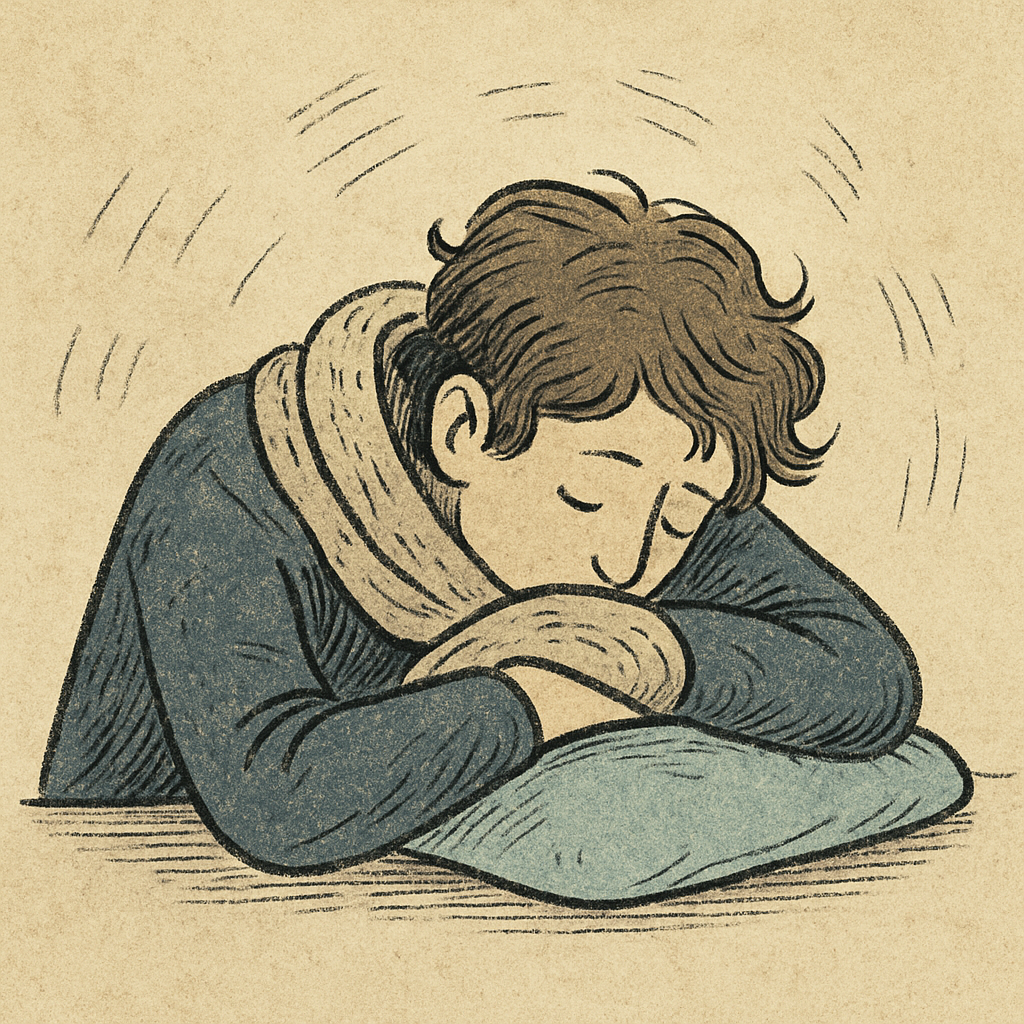
A hand-drawn illustration of a person resting their head in their arms on a pillow. They are wearing a thick scarf and long sleeves, with closed eyes and a tired posture. The background is plain and textured, giving the scene a soft, muted tone that conveys exhaustion and the need for rest.

One morning last month, I woke up foggy-headed, sleep-deprived, and emotionally worn out before the day had even started. I felt like I was coming down with the flu: achy, heavy, slow. I just wanted to cancel a dentist appointment, but even that became a drawn-out ordeal of waiting for phone lines to open, phoning, queueing, and managing social expectations. And when I finally got through, I was told that I should give more notice next time. That one short sentence landed like a weight. Not because it was rude, but because it reminded me that in this world, even exhaustion must be scheduled politely.

But this wasn’t about a dentist appointment. It never is. This was about everything.

I was tired of being tired.

Not sleepy tired. Not lazy tired. I’m talking about the deep, ambient fatigue of living in a world that constantly asks more of you than you have to give, then punishes you for not delivering. A world where empathy is rationed, where the illusion of stability depends on the silence of those who are struggling, and where rest is treated like an indulgence rather than a human need.

Housing insecurity. Chronic health issues. Endless bureaucracy. The guilt of receiving welfare benefits. The pressure to perform gratitude while navigating systems that barely see you as human. I carry these weights quietly most days, but some days they all speak at once.

And then comes the guilt for even feeling it. The voice that says: “Others have it worse. Be thankful. Don’t complain.” But that voice is part of the problem. It doesn’t come from compassion. It comes from conditioning. From a culture that sees resilience as moral currency and suffering as a contest.

But I am not in competition with anyone. I am simply tired.

I don’t want pity. I want space. I want systems that don’t require people to collapse in order to be heard. I want fewer apologies for being overwhelmed. I want to live in a world that doesn’t confuse survival with success.

So yes, I cancelled a dentist appointment that day. I did it politely. I even felt bad about it.

But what I really want to cancel is the idea that my exhaustion is a personal failing. It isn’t.

It’s my body, my mind, my soul, telling me to recuperate.

And I’m not the only one hearing that message.

10,000 Hours of Compliance: How Mastery Can Be Weaponised Against You

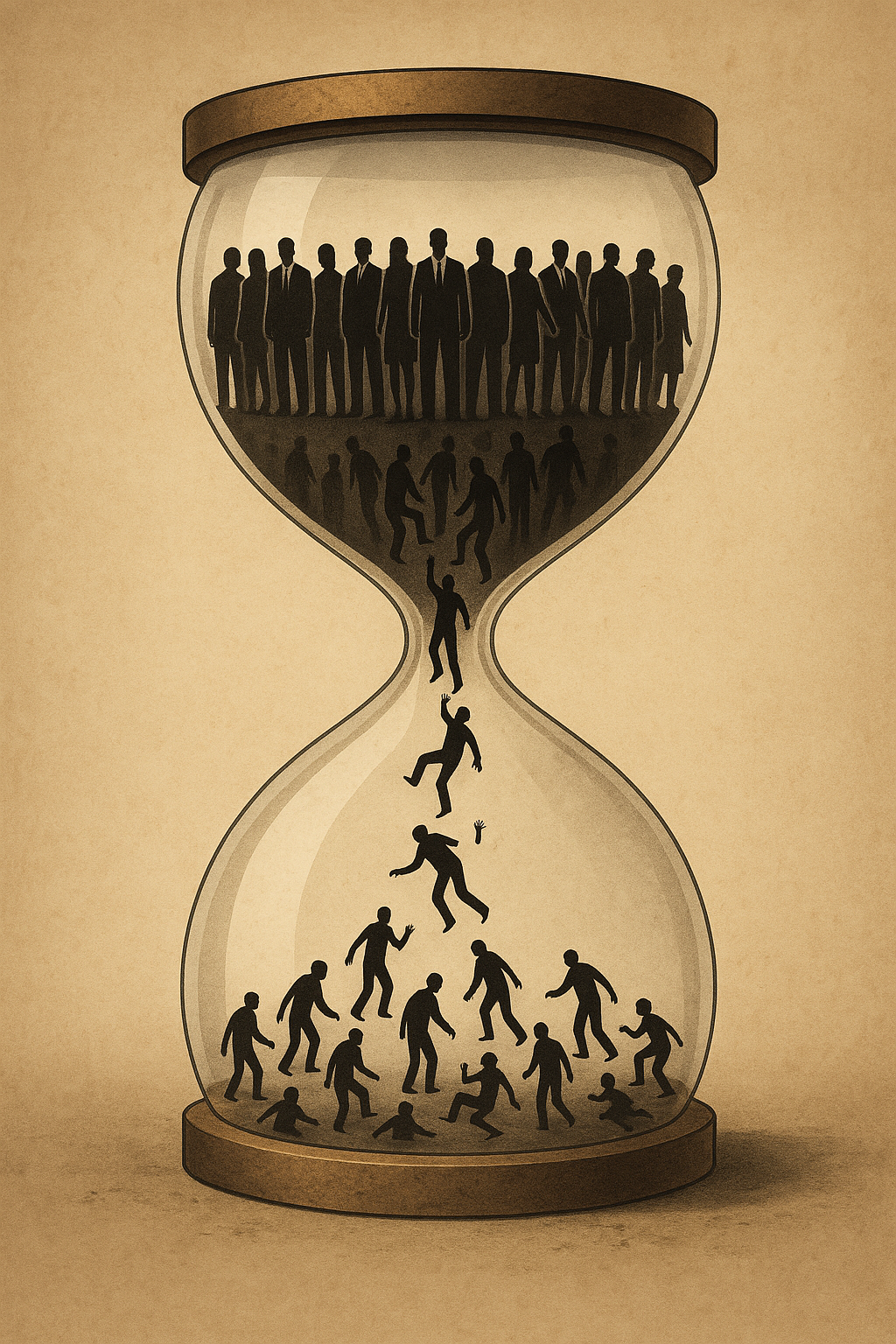
A large hourglass filled with faceless black silhouettes in business attire. The figures in the top bulb stand crowded together, gradually falling through the narrow middle where some tumble and others struggle to climb back up. In the lower bulb, fallen figures scatter across the ground, some standing, some collapsed. The background is warm beige, evoking aged paper, giving the image a symbolic and somber tone.

We have all heard the popular idea that it takes 10,000 hours of practice to master a skill. Play your guitar for that long and you will be a virtuoso. Paint for that long and you will know the brush like your own fingers. Write for that long and you will dance fluently with language.

Here is the uncomfortable question that is rarely asked in motivational seminars:
What if you have been putting in your hours, but into becoming something you never intended to be?


The Brain Does Not Care What You Practice

Your brain is a pattern-making machine that rewards repetition. It does not stop to ask whether the habit you are building is good for you, whether it aligns with your values, or whether it is slowly strangling your spirit.

If you have spent years submitting to systems, you are not just surviving. You are learning to submit. You are becoming fluent in self-silencing, pleasing authority, and clock-watching.

This is why “I have been doing this for years” is not always a badge of honour. Sometimes it means you have spent years perfecting a cage.


Work as a Covert Training Ground

The workplace can be a breeding ground for this kind of unintentional mastery. A dead-end job does not only give you a payslip. It gives you muscle memory for compliance.

You get good at the customer service smile.
You get good at keeping your head down when things are not right.
You get good at swallowing the words you actually want to say.

Clocking in and zoning out is not neutral. It is conditioning. It is training you to keep existing inside a box, even when the lid is wide open.


When Mastery Becomes Entrapment

There is a cruel irony in becoming excellent at something you never wanted in the first place.

“They say I am great at my job,” you tell yourself. But is it a job you truly chose? Or is it a job you got trapped in because you became too good at surviving it?

Once you have invested thousands of hours into a coping strategy, it can become harder to leave it behind. You have built identity around it. You have mastered the art of endurance in a place that does not deserve your loyalty.


The Sword Cuts Both Ways

Mastery is not inherently good. It is simply focus repeated over time. The sword cuts both ways.

You can become a master of freedom, creativity, and self-direction.
You can also become a master of obedience, self-erasure, and learned helplessness.

You are always becoming something. The question is: is it something you would choose?


Redemption Through Repatterning

The good news is that mastery can be rewired. Every skill you have mastered in the service of survival can be repurposed for something better.

The adaptability you learned under pressure can fuel your creativity.
The patience you built in monotonous routines can become the discipline that drives your art.
The diplomacy you honed with unreasonable bosses can become a superpower for navigating your own projects and relationships.

Awareness is the first cut that breaks the loop.
From that moment, every hour you spend becomes an act of reclamation.


Do not just chase mastery.
Ask yourself, mastery of what?
And in service of whom?

Your 10,000 hours are precious. Spend them like they matter.

Why I Don’t Talk About Politics at Parties

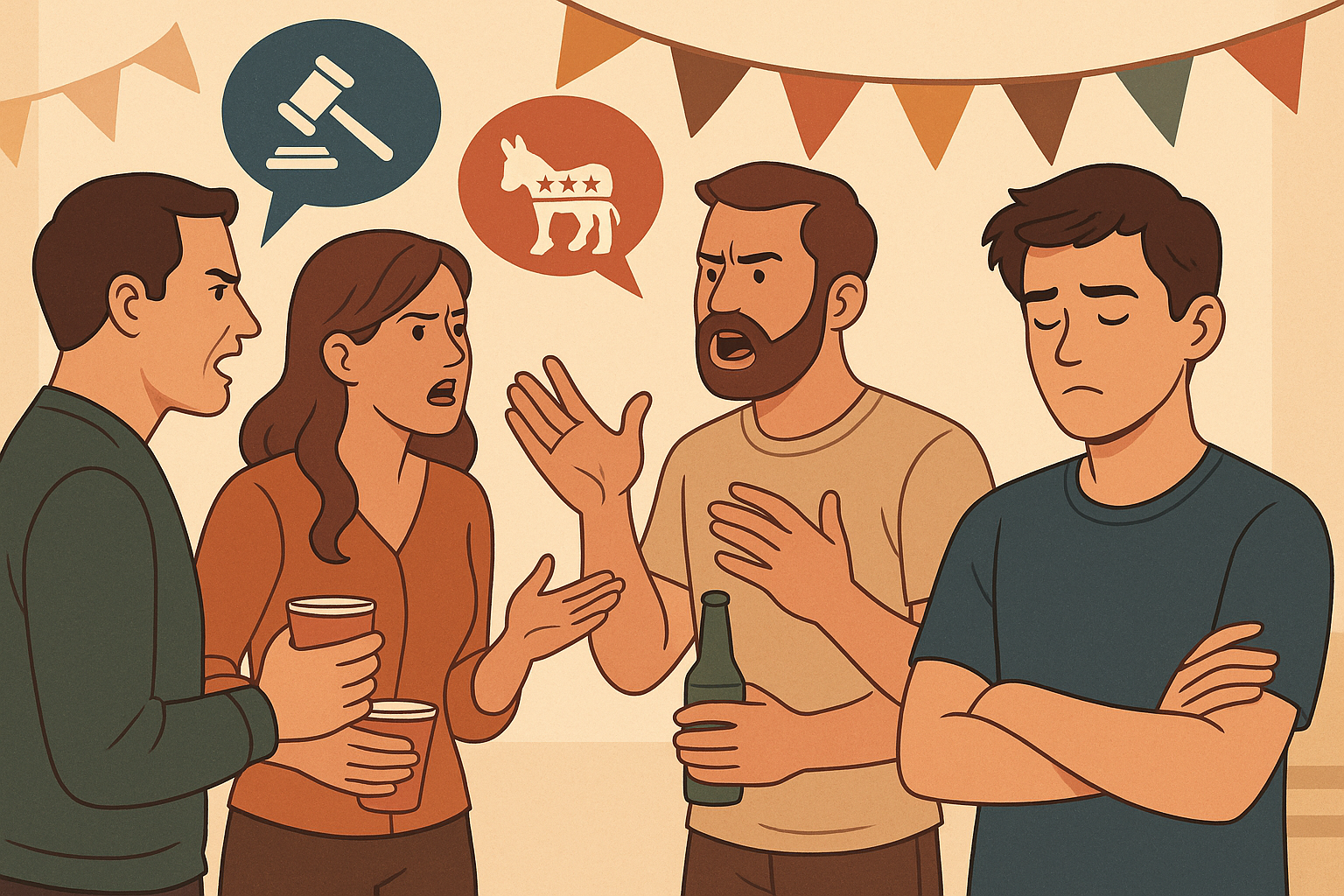
A digital illustration of a party scene where a group of animated guests are engaged in a lively debate, gesturing and leaning toward each other, while one man quietly walks away toward a snack table. Warm, earthy tones and festive decorations set a casual social atmosphere.

If you’ve read my previous posts, you may think of me as someone who has strong opinions.
And you may be right.

But if you’ve ever met me at a party, you might have noticed something: I very rarely engage in political discussions. It’s not because I don’t care about politics. I do in fact care a great deal. It’s because, in most party environments, the setting, the tone, and the people make it a poor investment of energy.

Here’s why.


1. My politics don’t fit the pre-approved boxes

I’m not a “pick a side and stick to it” kind of thinker. I arrive at my views by observing patterns, digging beneath the surface, and questioning the assumptions that most people take for granted. That means my politics tend to live outside the neat, pre-labelled boxes. Drop me into a group of leftists, rightists, or centrists, and there’s a good chance my perspective will clash with all of them. Not because I’m trying to be contrary, but because I don’t swallow the whole party line from any camp. In most social situations, that doesn’t land well. People tend to assume that if my viewpoint doesn’t match theirs, it must be “wrong.” Once that label gets slapped on, the conversation’s already over.


2. Substance is rare when everyone’s half-cut

Alcohol and other mood-altering substances change the way people talk. When the drinks are flowing, many conversations shift from genuine exchanges to little performance pieces, where the goal isn’t to understand, but to impress. Political discussions in that environment tend to turn into monologues, with each person waiting for their turn to sound smart, rather than actually engaging with what’s being said. If you step back and watch, it’s basically a social talent show with a loosely political theme.


3. Parties kill nuance

Politics without nuance is just noise. Nuance requires time, patience, and a willingness to sit with uncomfortable ambiguity. Most party environments are the opposite of that. People are in “relax mode,” which means the last thing they want is to have to unpack layers of complexity in a casual conversation. Instead, they often fall back on ready-made, black-and-white positions that feel safe and easy to defend. Unfortunately, those positions are often about as deep as a campaign slogan. If you try to dig deeper, you can feel the mood shift, because you’ve just introduced work into a situation where everyone came to avoid it.


4. It’s just the news, but louder

In many social settings, political talk is less about independent thought and more about reciting the headlines. It’s often the same talking points and buzzwords repeated in a slightly more animated tone, as if saying it with enough conviction makes it original. I’ve already processed these ideas on my own. Hearing someone present a copy-and-paste of a news segment as if it were their own insight doesn’t offer me anything new.


5. The echo chamber effect

Sometimes party “debates” aren’t debates at all. They’re rooms full of people nodding in agreement, congratulating each other on having the “right” opinion. The energy shifts from discussion to ritual, a sort of collective reassurance that everyone here thinks the same way. While that can be comforting for those involved, it’s not actually dialogue, it’s more like communal self indulgence. I don’t find much value in wading into that dynamic. If everyone is there to affirm the same stance, my contribution, especially if it challenges that consensus, will either be politely ignored or quietly resented. Neither outcome is worth the effort.


6. The autism factor

Social interaction, for me, is already a high-effort activity. It takes conscious energy to follow the flow of conversation, choose the right moment to speak, and form my words precisely enough to be understood. In political discussions, especially the fast, overlapping kind you get at parties, those demands multiply. People interrupt. They jump from one point to another before the first has been addressed. They reward speed over thoughtfulness. That’s not an environment where my ideas have much chance of being heard in full. Writing, on the other hand, allows me to process and express them without the constant battle for airtime, which is exactly why you’re reading this here, rather than hearing it across a crowded room.


A Crack in the Concrete: Beating ParkingEye at Their Own Game

If you’ve read my blog before, you’ll know I often explore the ways in which modern systems are designed to grind down dissent, commodify human experience, and turn survival into a series of transactions. But don’t mistake that for defeatism. I don’t believe resistance is futile. I believe it’s necessary.

The problem is, the system doesn’t make resistance easy. It’s designed to exhaust you. To make basic rights something you have to enthusiastically opt into over and over again. Miss a step, and you’re treated as though you’ve forfeited your value.

But this time, I pushed back. And something rare happened:

They backed down.


The Setup: A Charge for Existing

Earlier this summer, I went to Black Sabbath’s final concert in Birmingham. It was a significant personal moment, and I booked an overnight stay at the Holiday Inn Express in Redditch to recover afterward. According to the booking site, parking was included.

When I arrived after midnight, the staff didn’t mention anything about needing to register my car, and I didn’t see any signage that stood out. I parked, slept, and checked out the next morning without a second thought.

A week later, a Parking Charge Notice landed on my doormat. £100, courtesy of ParkingEye.


The First Response: Polite and Hopeful

I emailed the hotel. I explained the situation, gave my booking reference, vehicle registration, and asked for help. To their credit, the hotel replied confirming they had forwarded my concern to ParkingEye. Great, I thought. Misunderstanding sorted.

But ParkingEye had other plans.


The Twist: “We Can’t Cancel It, But…”

In their reply, ParkingEye acknowledged the hotel’s request. They confirmed they had received it. And then, they said they were “unable to cancel the parking charge at this stage.”

Instead, they generously offered to reduce it to £20 — “out of good faith.”

Let me translate:

This wasn’t administration. It was exploitation disguised as reasonableness. A manipulative soft threat.


The Pushback: Refusal with Teeth

I didn’t lose my temper. I wrote back with calm clarity:

  • I restated that I was a legitimate guest.
  • I highlighted the hotel’s confirmation of their cancellation request.
  • I pointed out the contradiction in ParkingEye’s own letter.

And, crucially, I mentioned that I’m autistic, and was wearing a sunflower lanyard during check-in. The staff should have made extra effort to ensure nothing was missed. They didn’t. And now I was being penalised.

I wasn’t angry. I was precise.

And that made them blink.


The Outcome: The Concrete Cracked

Within days, ParkingEye emailed me again. This time, they confirmed the charge had been fully cancelled. No payment required. Case closed.

There was no apology. No acknowledgment of inconvenience. No admission that I should never have received the charge in the first place. Just a flat, mechanical statement: the charge has been cancelled.

I suppose I should be satisfied, and on some level, I am. But even in victory, the absence of basic humanity is striking.

Where is the accountability? Where is the recognition that systems like this cause stress, waste time, and disproportionately affect people who are already carrying more than their fair share?


What This Really Means

Most people would have paid the reduced fine. That’s what ParkingEye counts on. Stress, confusion, guilt, and the desire to just make it go away. It’s a business model built on overwhelm.

And for neurodivergent people? This kind of thing can be especially taxing. We’re more likely to internalise the blame, less likely to push back, and more vulnerable to the psychological tricks buried in so-called “civil” letters.

But this time, I didn’t fold. And it worked.


Resistance Isn’t Futile. It’s Necessary.

This doesn’t mean the system isn’t broken. It absolutely is. But moments like this are important. They remind us that refusal isn’t negativity, it’s clarity. It’s drawing a line. It’s proving, even just for a moment, that not everything is hopeless.

Sometimes, even in a world that wants to invoice you for breathing, you can breathe a little fire back.

And they will back down.

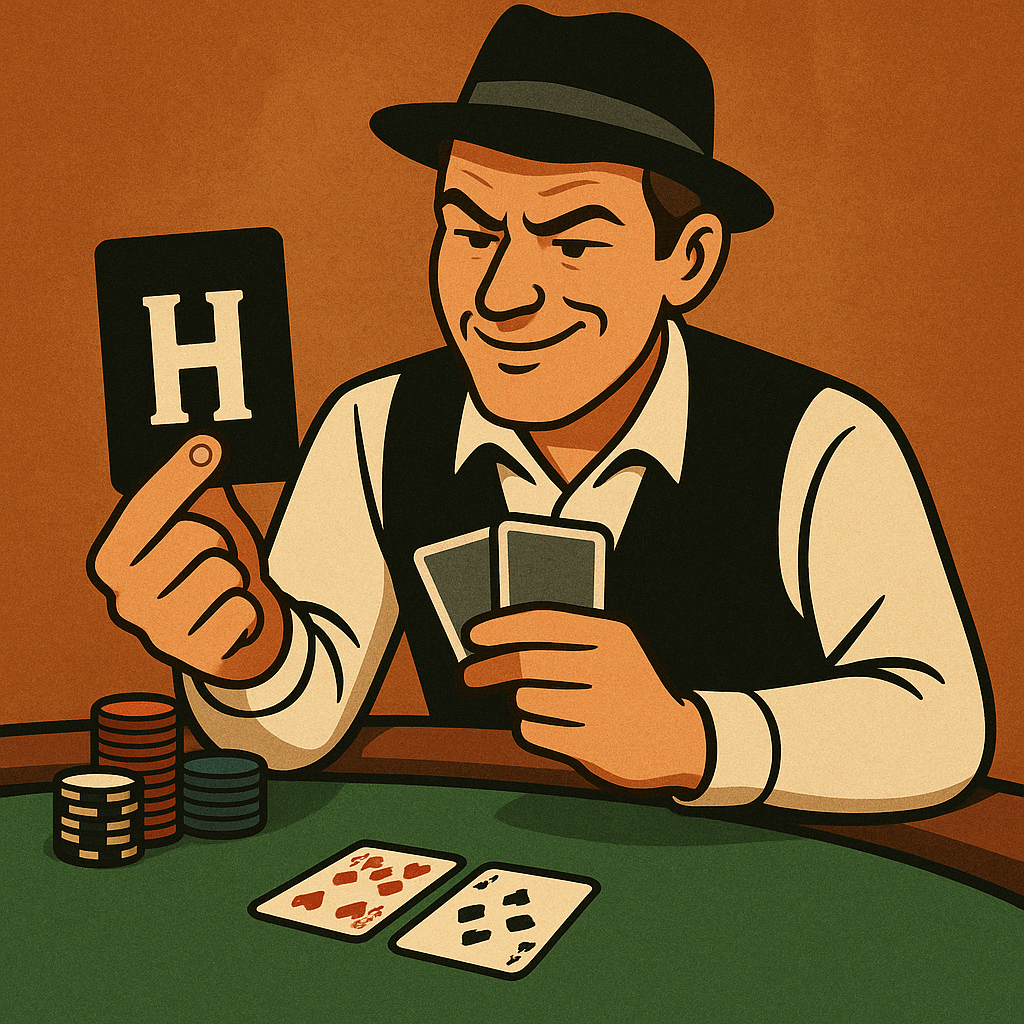
The Fallacy Deck: The Hypocrite Card

You raise a concern about climate change. Someone points out that you still drive a car.
You criticise capitalism. Someone replies, “Yet you’re using the internet, huh?”
You speak out about animal cruelty and someone asks why you’re still eating meat.

Congratulations: the Hypocrite Card has been played.

This rhetorical move doesn’t attempt to refute your point, it just tries to disqualify you from making it.

It’s not about the issue. It’s about you.


What Is the Hypocrite Card?

The Hypocrite Card is a conversational shutdown tactic. It works like this:

It sounds righteous on the surface. After all, hypocrisy is supposed to be a bad thing, right?

But the accusation rarely holds up to scrutiny. More often than not, it’s just a smug way of avoiding engagement.


Why It Works

The Hypocrite Card is emotionally potent. No one wants to be seen as insincere.
It presses on the discomfort we all feel when we fall short of our own ideals, which, in an unjust world, is inevitable.

It also helps the person playing it feel morally superior, without having to actually think or respond to the substance of what was said.

And it’s fast. Just one sentence and boom: the spotlight moves off the problem and onto the person raising it.


Why It’s Dishonest

The truth is, we all live with contradictions.

We participate in systems we know are harmful because we have to in order to survive.

So yes, you can criticise capitalism while owning a smartphone.
You can support sustainability while using electricity.
You can oppose animal cruelty while still eating meat.

None of these cancel out the concern.
Acknowledging a problem doesn’t require you to have already solved it.


The Emotional Power of the Word ‘Hypocrisy’

There’s something especially venomous about the word hypocrite. It feels like a moral slam dunk. A character assassination.

But ask yourself: is hypocrisy really that bad?

Isn’t it sometimes just what happens when people care about something they’re still struggling to live up to?

It’s easy to call someone a hypocrite. It’s harder to ask what their contradiction reveals about the world they’re stuck in.


Unequal Burdens, Unequal Accountability

And maybe not everyone should be held to the same standards in the first place.

Some people can afford to live more in line with their ideals. Others can’t.

And more importantly: some people have more power to change the system than others.

When we attack someone with the Hypocrite Card, we might be:

  • Punishing them for caring
  • Silencing their voice because they aren’t rich or powerful enough to opt out
  • Letting those with actual influence off the hook entirely

Sometimes the people speaking up from within the system are the ones who most need to be heard.


What Gets Lost

When the Hypocrite Card is played, we lose:

  • Voices of vulnerable people who aren’t yet living in alignment but are trying
  • Opportunities for honest, evolving conversation
  • The ability to critique systemic issues without being morally spotless

In short, we lose the human dimension of growth.


How to Respond

If someone throws the Hypocrite Card at you:

  • “Yes, I’m not perfect. That’s why I care about fixing this.”
  • “Pointing out my flaws doesn’t make the issue go away.”
  • “I’m speaking out because I feel the contradiction, not in spite of it.”

It’s okay to not have it all figured out.

The Hypocrite Card demands purity before participation. But real change is messy, gradual, and often full of contradiction.


Final Thought

Hypocrisy isn’t the sin we’ve been taught it is.

Sometimes it’s just the space between what you believe and what you’re still trying to become.

And sometimes, calling it out says more about the person playing the card than the one being accused.

Because if perfection is the price of participation, only the dishonest will speak.