Sometimes I catch myself thinking most people are idiots.
Not because I want to. Not because it makes me feel good. But because it often feels true — especially in a world flooded with shallow opinions, regurgitated slogans, wilful ignorance, and a collective refusal to look beyond the surface of anything.
But here’s the deeper truth—one that hurts far more:
The masses aren’t the problem. They’re the primary victims of the problem.
And if we don’t understand that, we risk becoming exactly what the system wants us to be: angry, superior, divided.
Weaponized Disdain
There’s a quiet kind of relief in misanthropy. It gives you someone to blame. You look around and see a world on fire—and people watching it burn while arguing about which brand of lighter fluid to buy next.
It’s tempting to direct your rage downward:
“Why won’t they wake up?”
“Why do they fall for propaganda?”
“Why don’t they care?”
But what if they were trained not to?
What if distraction, ignorance, and tribalism aren’t signs of stupidity, but symptoms of psychological warfare?
The Architecture of Blame
Everything about modern society is designed to fragment us. We’re not just encouraged to fight amongst ourselves—we’re engineered to.
Left vs Right
Poor vs poorer
Neurodivergent vs “lazy”
Ethical vs indulgent
Educated vs “sheeple”
Every micro-identity in endless battle for moral superiority
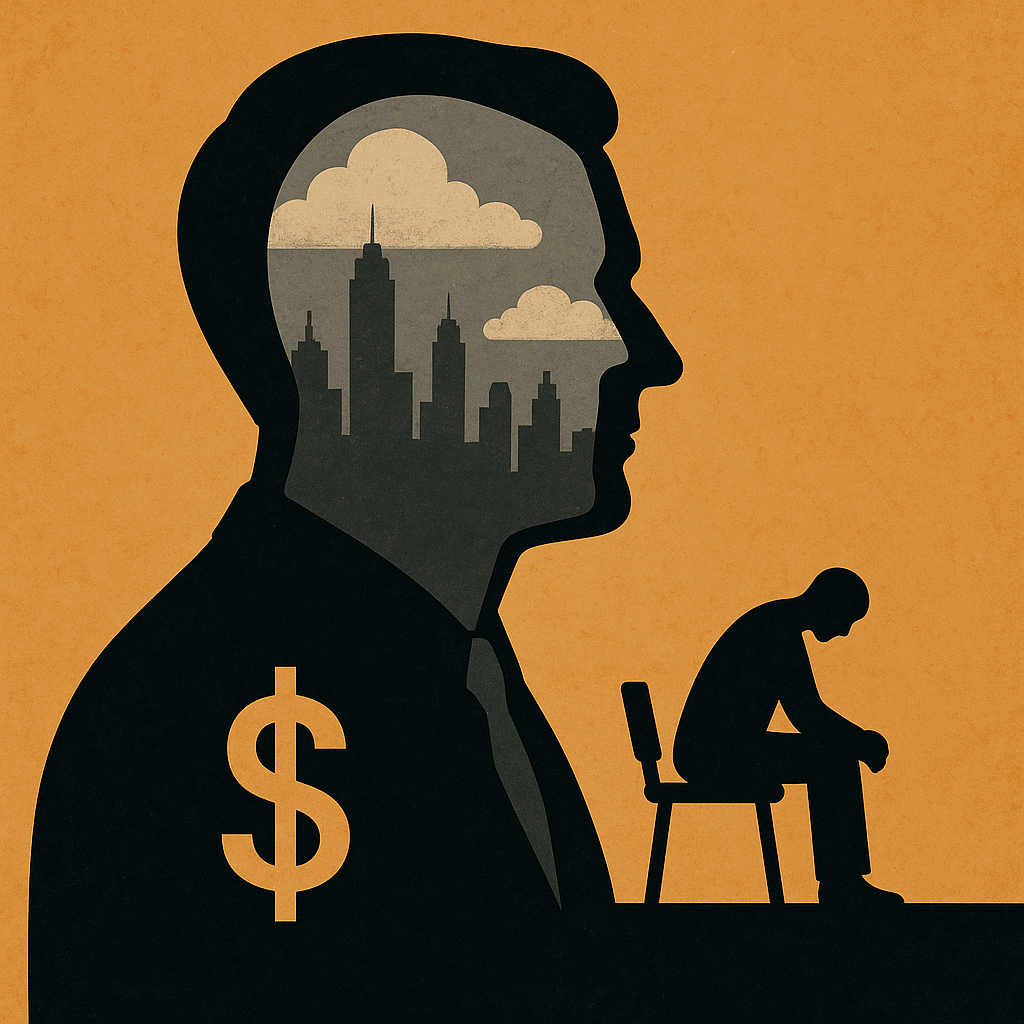
And while we tear each other apart, the architects of our suffering float untouched above the fray—untouchable, unblamed, and richer by the minute.
The system hands us mirrors and tells us they’re enemies.
The Illusion of Choice
Yes, people parrot nonsense. Yes, they deny science. Yes, they post horrifying things on the internet.
But behind every foolish comment is a person shaped by years of manipulation:
An underfunded education system
Stress-induced tunnel vision
Algorithmic feedback loops
Culture soaked in shame, punishment, and performance
So when we mock the “idiots,” we’re often mocking the symptoms of systemic collapse. And in doing so, we absolve the system of responsibility.
Awake, and Alone
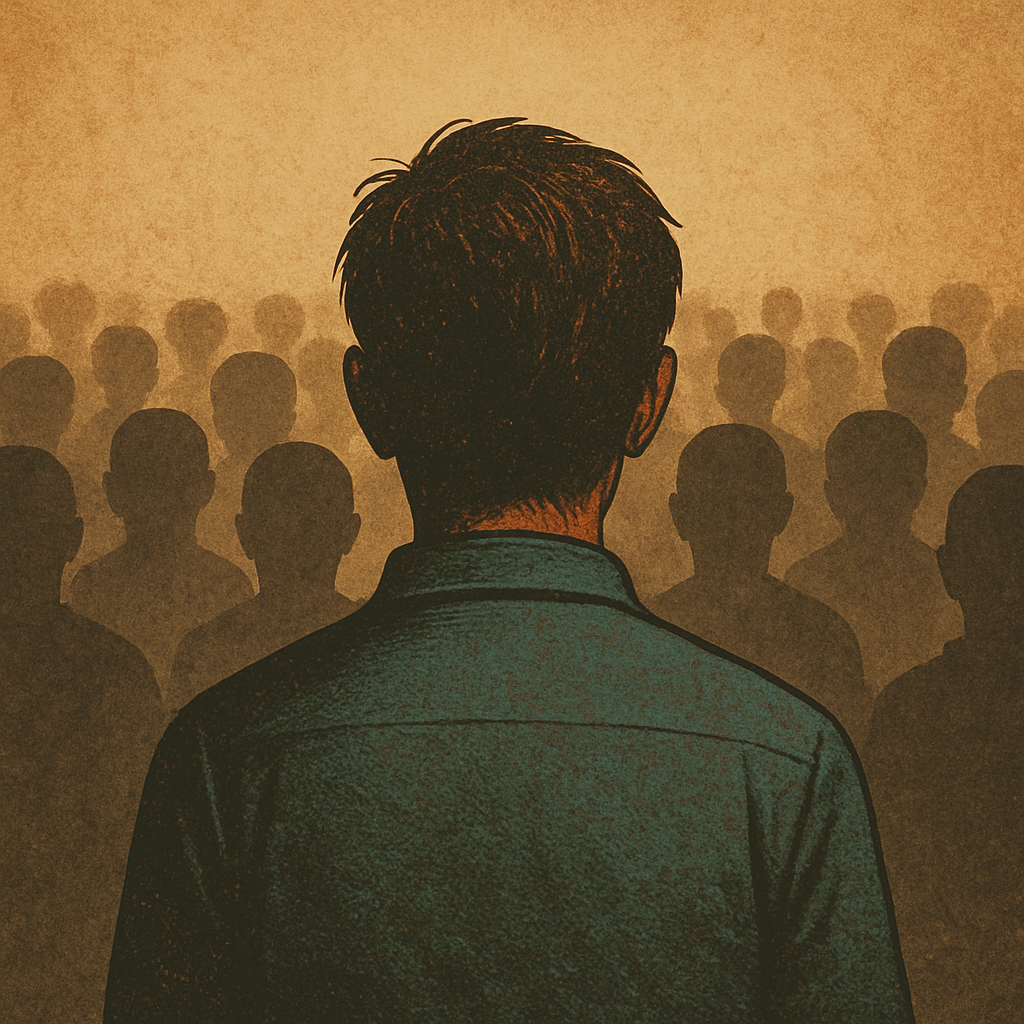
Those of us who see the manipulation clearly can feel isolated. It’s lonely to be awake in a room full of sleepers. The temptation to feel superior is strong—especially when your insight is met with mockery or silence.
But superiority is a trap.
It doesn’t lead to change. It doesn’t inspire connection. It only deepens the divide.
And worst of all? It makes you easier to control.
Because if you believe everyone else is the problem, you’ll never reach for collective liberation. You’ll wall yourself off. You’ll give up.
The Real Enemy
So let’s be brutally clear: The enemy is not the unaware individual. The enemy is the machine that benefits from that unawareness.
The corporations, politicians, media empires, and algorithmic puppeteers who:
Profit from ignorance
Weaponize distraction
Silence nuance
Turn suffering into spectacle
These are the forces that deserve our outrage. Not the broken, numbed, hypnotised humans trapped beneath them.
Reclaiming Compassion Without Losing Fire
This isn’t a call to softness. It’s a call to precision.
We don’t need to stop being angry—we need to point our anger in the right direction.
That means:
Calling out manipulation, not just compliance
Critiquing systems, not just symptoms
Building solidarity across the fractures we’ve been taught to defend
Because the truth is: we’ve all been trained. Some of us just noticed sooner.
There’s something quietly catastrophic happening right under our noses.
It’s not a sudden event, not a single explosion we can point to and say there, that’s when it all changed. It’s more like a slow leak—an unseen corrosion of the collective psyche. A subtle but systematic dismantling of our ability to think deeply, question meaningfully, and sit with complexity long enough to understand it.
We are being trained not to think.
And worst of all? Most people don’t even realise it’s happening.
The Bite-Sized Brain
Our media landscape is increasingly dominated by short-form, low-commitment content. TikToks. Reels. Shorts. Endless scrolls of 15-second fragments, memes, and dopamine loops. Each piece designed not to provoke reflection, but to maintain momentum—keep you scrolling, laughing, liking, and forgetting.
There’s nothing inherently wrong with snack-sized entertainment. The issue arises when it becomes the default diet.
Over time, this steady stream of shallowness erodes the mental muscles required to engage with anything else. Articles become “too long.” Books become intimidating. Complex discussions become “boring” or “too much.” Even conversations that require nuance—about ethics, identity, politics, the planet—begin to fall apart because we no longer have the patience or attention span to hold the thread.
Algorithmic Amnesia
This isn’t just cultural drift—it’s a structural phenomenon. Social media platforms don’t just reward short-form content; they require it to thrive. Their algorithms are finely tuned to promote content that triggers reaction, not reflection. Engagement is king, and what engages is rarely what enlightens.
The platforms want us scrolling, not thinking. They want clicks, not contemplation. And over time, that design reshapes us.
We become addicted to novelty. Impatient with depth. Emotionally reactive. Distrustful of grey areas. Nuance, in this environment, is not just inconvenient—it’s unprofitable.
The Disappearing Platform
As someone who writes longform, reflective articles—things that actually take time to absorb—I’ve noticed the shift personally. The number of people willing to engage with an argument from start to finish has shrunk dramatically. It’s not that people disagree with the ideas, necessarily—it’s that they no longer have the bandwidth to even hear them.
That should terrify us.
Because the issues that most desperately require attention—climate change, economic inequality, systemic manipulation, the future of AI—are complex. They require space. They demand nuance. And yet, the public platform capable of holding that nuance is being eroded. The vessel for critical discussion is being shattered. What’s left are fragments: tweets, comments, outrage clips, soundbites.
And you cannot build collective understanding out of fragments.
Why This Matters
Some will argue: “This is just how things evolve. People want things quick and simple. It’s not that deep.”
But that’s exactly the point—it is that deep. Our appetite for oversimplification is being engineered, not chosen. We are not naturally allergic to nuance—we’re being trained to flinch from it.
This isn’t about elitism. It’s not about being “too clever” for the current world. It’s about being human. We are creatures of story, complexity, contradiction. We need space to explore, to change our minds, to hold two opposing truths at once.
When we lose that, we lose our grip on reality itself. We become easy to manipulate. We become unable to resist. We become exactly what the system needs us to be: docile, distracted, divided.
Staying Awake
So what do we do?
We resist, in small ways at first:
Choose to read the full article.
Pause after a video and actually think about it.
Engage with things that challenge you, not just affirm you.
Support creators who give you substance, not just sugar.
And most importantly, when the world tries to shrink your attention span down to a goldfish loop of clicks and kicks—notice it. Name it. Fight it.
Because the death of nuance isn’t just the death of intelligent discourse. It’s the death of our ability to understand anything at all.
Reclaiming Empathy as a Tool for Understanding, Not Excuse
Let’s get the obvious out of the way first: No, billionaires do not need your sympathy. They’re not starving. They’re not being evicted. They’re not deciding between heating and food. So, should we feel bad for them? No. That’s not what this is about.
But that’s the trap, isn’t it? When we hear the word empathy, we often hear sympathy — as if empathy means letting someone off the hook, or feeling sorry for them. But empathy isn’t about deciding whether someone’s life is hard enough to deserve our concern. It’s about trying to see how they experience the world — and what that might teach us.
And when it comes to billionaires, there’s a lot to learn.
Empathy ≠ Sympathy
Empathy is the capacity to understand the state of another mind. It doesn’t mean agreeing, condoning, or comforting. It means observing, listening, inferring — without letting our emotions cloud the process.
Sympathy is emotional. Empathy is perceptive.
We tend to empathise most easily with those who suffer in ways we can relate to. But this leaves out entire swaths of human experience — including the very people who shape our economies, our policies, our futures. Understanding them isn’t an act of kindness. It’s an act of awareness.
Inside the Billionaire Psyche
Here’s the thing about billionaires: they are still human. We might like to think of them as cartoon villains, hoarding gold and twirling mustaches — but that’s a convenient simplification. Real people are messier. More conflicted. Often unaware of their own contradictions.
What drives someone to accumulate more wealth than they could ever need? What fears or beliefs keep them doing it? What worldview do you have to adopt to justify stepping over others to get there — or to sincerely believe you’re helping?
We don’t have to like the answers. But we do need to ask the questions. Because without understanding, we can’t meaningfully respond.
Dehumanisation Is a Blunt Instrument
When we reduce billionaires to monsters, we make them less real — and in doing so, we rob ourselves of clarity. We miss the psychological patterns, the system enablers, the personal histories that created them.
Yes, they may live in gated communities, surrounded by yes-men and soft lighting. But that doesn’t mean they’re free of fear, self-deception, or trauma. They just have the money to cover it in designer fabric.
Dehumanising them doesn’t dismantle their power. It just stops us from seeing how that power actually works.
Empathy as Strategy, Not Surrender
So no, we don’t owe billionaires forgiveness. But we do owe ourselves insight. If we ever want to redesign the system — or even just survive it — we have to understand the people at its apex. Not mythologise them. Not moralise. Understand.
Because once we see clearly, we can begin to respond intelligently. Strategically. Even subversively.
Empathy is not a soft virtue. It’s a sharp tool — one that can carve through illusion and reveal the truth beneath.
Final Thought
Empathy is not a tool for sympathetic evaluation. It is a tool for our own understanding.
Survival horror games. Apocalyptic movies. Zombie TV shows. They keep showing us the end of the world.
And the strange thing is, I find it comforting.
Not the death, or the gore, or the terrifying monsters. But the quiet that follows.
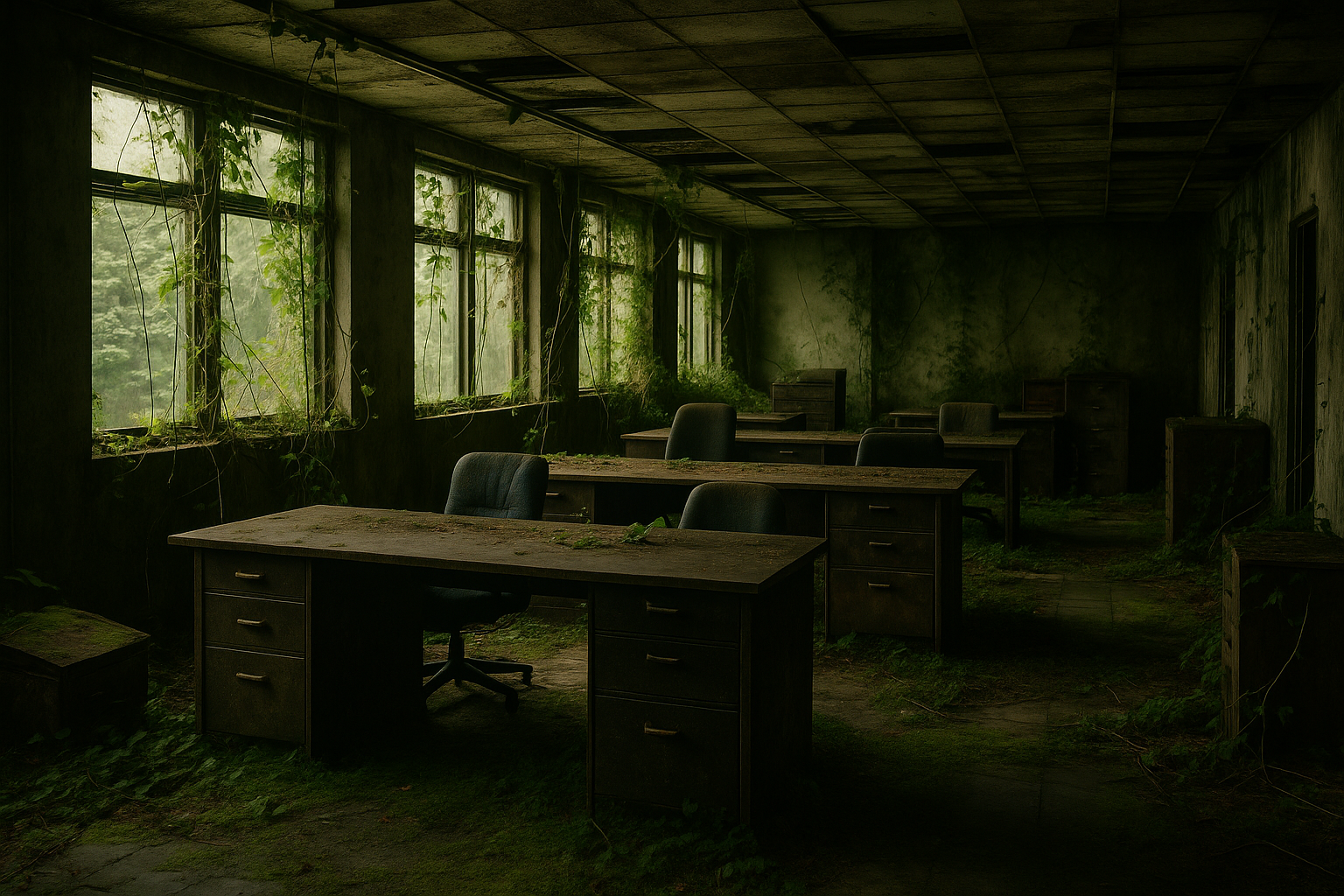
In games like The Last of Us, in the atmosphere of 28 Years Later, in the long, dangerous walks through empty cities overrun by moss and silence, there is a strange kind of peace. These stories are about zombies, sure, but only in the way that space operas are about rockets. The real story is human.
Stripped of society, of rules, of etiquette and expectation. Just survival. And with it, a return to something real.
A Common Fantasy, Quietly Shared
I don’t think I’m alone in this. There’s something telling about how many people are drawn to post-apocalyptic settings. We say it’s escapism, but maybe it’s something deeper. Maybe it’s yearning.
A yearning for everything to finally break, so we’re allowed to default back to our instincts. Those instincts haven’t disappeared, but capitalism has twisted them. Turned survival into branding. Turned curiosity into productivity. Turned strength into silent compliance.
In the fantasy, that spell is broken. We move freely. Nowhere is off-limits except by danger. If you’re brave enough to go, you go. And if you make it out alive, you learn something.
Maybe even about yourself.
A World That Makes Sense Again
You don’t need to fill out a form to matter. You don’t need to chase social media followers to have value. You don’t need a degree, or a permit, or a job title to justify existing.
You just survive. You help others survive. You find food. You stay alert. You sleep lightly. You protect your friends. You trust your gut.
The world becomes dangerous, yes — but finally understandable.
The Beauty of Nature Reclaiming
There’s an awe in seeing vines wrap around office buildings. Trees pushing through broken floor tiles. Roads cracked open and filled with moss.
It’s not just beautiful. It’s poetic.
The industrialised world thought it was permanent. But nature is patient. And in the fantasy, it doesn’t just survive. It reclaims.
It takes back the places that were stolen from it. Quietly. Persistently. Without anger.
Bureaucracy Is the Real Monster
The zombie apocalypse gives us a breath of relief from bureaucracy.
No more tax codes. No more emails. No more forms to fill in triplicate to get permission to be a human being. No more ten-step processes to access your basic rights.
The systems we live under have been patched and repatched so many times, they don’t even resemble their original purpose. Like buggy code that’s been layered with fixes until no one remembers what it was supposed to do in the first place.
Maybe the end of the world is the only bug fix that actually works.
Maybe I’d Finally Be Allowed to Live
I’m not saying I want civilization to collapse.
I’m saying that if it did, I might finally feel like I have a fighting chance.
The world we live in now feels like it was built to crush people like me. People who see too clearly. People who question. People who can survive, but only if allowed to act on their instincts without being penalized for them.
Maybe the end of the world wouldn’t be the end of me.
Maybe it would be the first time I was allowed to live.
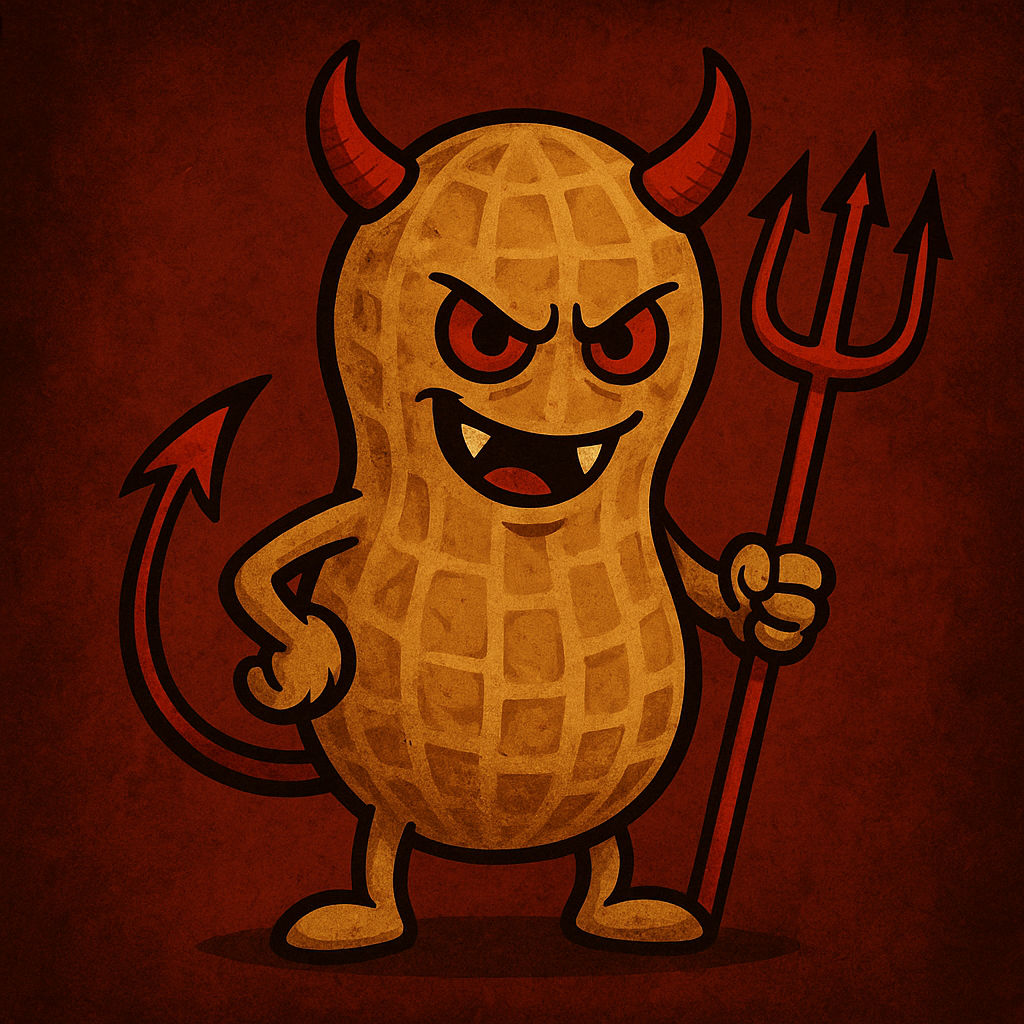
Peanuts. Beloved snack, protein powerhouse, and loyal companion to chocolate bars worldwide. But beneath their crunchy exterior lies a sinister truth — peanuts are not as innocent as they seem. Behind every jar of peanut butter and every bag of roasted nuts lies a history of allergic reactions, food recalls, agricultural exploitation, and deceptive appearances (spoiler: they’re not even real nuts). In this essay, we will unpack the evil lurking within the peanut’s wrinkled shell. But don’t worry — after all the doom and gloom, we’ll still find a reason to keep munching.
1. The Allergen Apocalypse
Perhaps the most obvious strike against peanuts is their notorious reputation as one of the most dangerous food allergens on Earth.
Peanut allergies affect approximately 1–2% of the population in many Western countries, including the UK and the US. Unlike some allergies that cause mild discomfort, peanut allergies can be life-threatening. Exposure to even trace amounts of peanut protein can trigger anaphylaxis — a severe reaction involving airway constriction, hives, swelling, vomiting, and in some cases, death.
Schools across the globe have banned peanut-containing products to protect allergic students. Airplane snack packs have gone peanut-free due to the possibility that a single airborne particle might trigger a reaction in a sensitive passenger.
The evil doesn’t stop at inconvenience — peanut allergies aren’t curable. Avoidance is the only reliable defense, and cross-contamination can make even that nearly impossible. For allergic individuals, peanuts don’t just ruin lunch — they turn everyday eating into a game of Russian roulette.
2. Choking on the Truth: A Silent Danger
Peanuts are also choking hazards, particularly for children. According to the American Academy of Pediatrics, whole nuts (including peanuts) are one of the leading causes of non-fatal choking incidents in children under 3. Their small, irregular shape and texture make them difficult for toddlers to chew and swallow safely.
Parents are frequently warned against giving whole peanuts to young children. In fact, in the UK and US, guidelines recommend avoiding whole peanuts until at least age 5, unless under supervision and after assessing allergy risk.
While this might seem like a small issue, it reflects the peanut’s insidious nature: even without allergy, even without spoilage, even without any wrongdoing on the eater’s part… the peanut still finds a way to kill.
3. Misleading Identity: Not Even a Real Nut
Brace yourself: peanuts are not nuts. They’re legumes. That’s right — they belong to the same family as beans and lentils. So not only are peanuts dangerous, they’re liars.
True nuts (like almonds, walnuts, and cashews) grow on trees and have a hard shell surrounding the seed. Peanuts, on the other hand, grow underground, forming in pods much like peas. This botanical betrayal might seem minor, but it reveals the peanut’s inherent duplicity. Even their name misleads — pea-nut — neither wholly pea, nor truly nut.
This deception has led to public confusion and even more dangerous allergic assumptions. Some people allergic to tree nuts are not allergic to peanuts, and vice versa — but the term “nut allergy” is often used interchangeably, creating misinformation that can be deadly.
4. Salmonella and Food Safety Scandals
In 2008–2009, one of the worst foodborne illness outbreaks in U.S. history occurred due to contaminated peanut products. The Peanut Corporation of America knowingly shipped salmonella-contaminated peanut paste that caused over 700 reported illnesses and at least 9 deaths.
The CEO of the company, Stewart Parnell, was sentenced to 28 years in prison for his role — the harshest sentence ever handed down in a U.S. food safety case. Documents showed executives choosing profits over lives, shipping contaminated products with falsified safety records.
This wasn’t an isolated incident. Peanuts and peanut butter continue to show up in food recall alerts due to contamination risks from salmonella, aflatoxins (a toxic mold), and listeria. Peanuts can become a breeding ground for dangerous microbes if improperly stored, thanks to their high fat content and porous structure.
5. Aflatoxins: Invisible Killers
Peanuts have a natural vulnerability to a group of toxic molds known as Aspergillus flavus and Aspergillus parasiticus, which produce aflatoxins. These toxins are carcinogenic, particularly linked to liver cancer, and can accumulate in food without any visible signs.
In countries with less stringent agricultural controls (particularly in parts of sub-Saharan Africa and Asia), aflatoxin contamination is a serious health crisis. According to the World Health Organization, aflatoxins contribute to up to 28% of all liver cancer cases worldwide, with peanuts being a significant vector.
Even in the UK and US, aflatoxin levels in peanut products are monitored and regulated, but zero risk is impossible. Roasting peanuts helps, but it doesn’t eliminate the toxins entirely.
Evil? Perhaps not by intention. But when you combine a delicious product with invisible mold-based carcinogens, you’ve got a perfect recipe for long-term harm.
6. Agricultural Exploitation and Environmental Toll
Beyond health concerns, the peanut has a darker legacy embedded in colonialism, exploitation, and environmental degradation.
Peanuts became a major cash crop in Africa and the Americas, often grown on plantations that profited from slave labor or other exploitative systems. In the modern era, peanut farming is still associated with labor violations in some countries, including child labor and poor working conditions.
Environmentally, peanuts are a thirsty crop. Although they are more drought-resistant than some other legumes, in industrial-scale agriculture (especially in areas with limited rainfall), peanut farming can strain water resources and deplete soil nutrients.
They also contribute to the monoculture problem — large swathes of land dedicated to a single crop, which decreases biodiversity, increases pesticide use, and weakens ecological resilience. Pest outbreaks in peanut farms can be devastating and often lead to heavy chemical spraying, which affects nearby wildlife and communities.
7. Peanut Butter: A Sticky Situation
Ah, peanut butter. Perhaps the most celebrated of peanut derivatives. But even here, evil lurks.
First, peanut butter is calorie-dense and often sugar-laden, especially commercial brands aimed at children. A single spoonful can contain over 100 calories — not to mention palm oil, high-fructose corn syrup, and artificial additives.
It’s also a nightmare to clean. Once it sticks to a surface — be it countertop, cutlery, or the roof of your mouth — it refuses to budge without a full-scale intervention. Dishwashers tremble in its presence.
And then there’s the toast dilemma — peanut butter’s tragic tendency to rip soft bread apart during spreading. Scientists have sent men to the moon, but we have yet to solve the structural instability of toast under peanut pressure.
8. Peanut Panic in Public Spaces
Let’s not forget the social ripple effects of peanut evil. Because of allergy risks, peanuts have created entire zones of paranoia — schools, airplanes, cafes, and cinemas must now operate with strict rules and constant vigilance.
Parents are burdened with hypervigilant lunch prep, while allergic individuals are forced into awkward conversations, carrying EpiPens, and constantly scanning food labels like forensic investigators.
The psychological weight of a peanut allergy is no joke. Research shows that children with severe allergies often experience anxiety, social exclusion, and reduced quality of life, knowing their life can be threatened by someone else’s snack choice.
Peanuts have created a landscape where one person’s snack is another person’s poison — a truly antisocial legacy.
9. The Weaponization of Peanuts
This may sound extreme, but there have been real cases of peanut exposure being used maliciously — essentially as a biological weapon.
There have been documented incidents where bullies smeared peanut butter on allergic students’ lockers, desks, or even skin. In 2017, a U.S. college student with a known allergy had peanut butter rubbed on his face while passed out at a party — an act treated as assault due to the life-threatening risk.
This speaks to the disturbing potential of peanuts as tools for harm. Very few foods can claim that notoriety.
10. They Just Taste Too Damn Good
So… what’s the catch?
After 9 sections of doom, disease, and deceit, it’s time to confess: peanuts are delicious. Salty, fatty, crunchy — they’re a perfect storm of flavour and texture. Evolution did not prepare the human brain for peanut butter cups, spicy satay sauce, or roasted honey-glazed peanuts.
In fact, the brain responds to peanuts and peanut products much like it does to addictive substances. Their high fat, salt, and protein content triggers dopamine release — the pleasure chemical. Once you start, it’s hard to stop.
Peanut butter and chocolate? Legendary. Peanut brittle? Nostalgic. Boiled peanuts? Southern comfort. From West African peanut stew to Thai peanut noodles, this legume masquerading as a nut has become a culinary global citizen.
Despite all the risks and controversies, the peanut has wriggled its way into our hearts, our cupboards, and our cravings. It’s the charming villain of the food world — dangerous, deceptive, and utterly irresistible.
Conclusion: The Devil You Know (And Keep Eating)
Are peanuts evil? If we define evil as “posing danger, deception, and destruction while wearing a friendly mask,” then yes — the peanut qualifies. Its legacy includes severe allergies, choking incidents, contaminated food recalls, mold-based toxins, ecological harm, and a trail of human rights concerns.
But like many “evil” characters in history and fiction, peanuts are complex. They bring pleasure, nutrition, and comfort to billions of people. They are inexpensive sources of protein and fat, lifelines in food-insecure areas, and versatile culinary gems.
And they taste incredible.
So while we acknowledge the darkness lurking in the humble peanut, we also recognize that resisting them is an exercise in futility. We may rant, accuse, and raise awareness… but at the end of the day, we’ll still be spreading peanut butter on toast, popping them at the pub, and sneaking them into cookies.
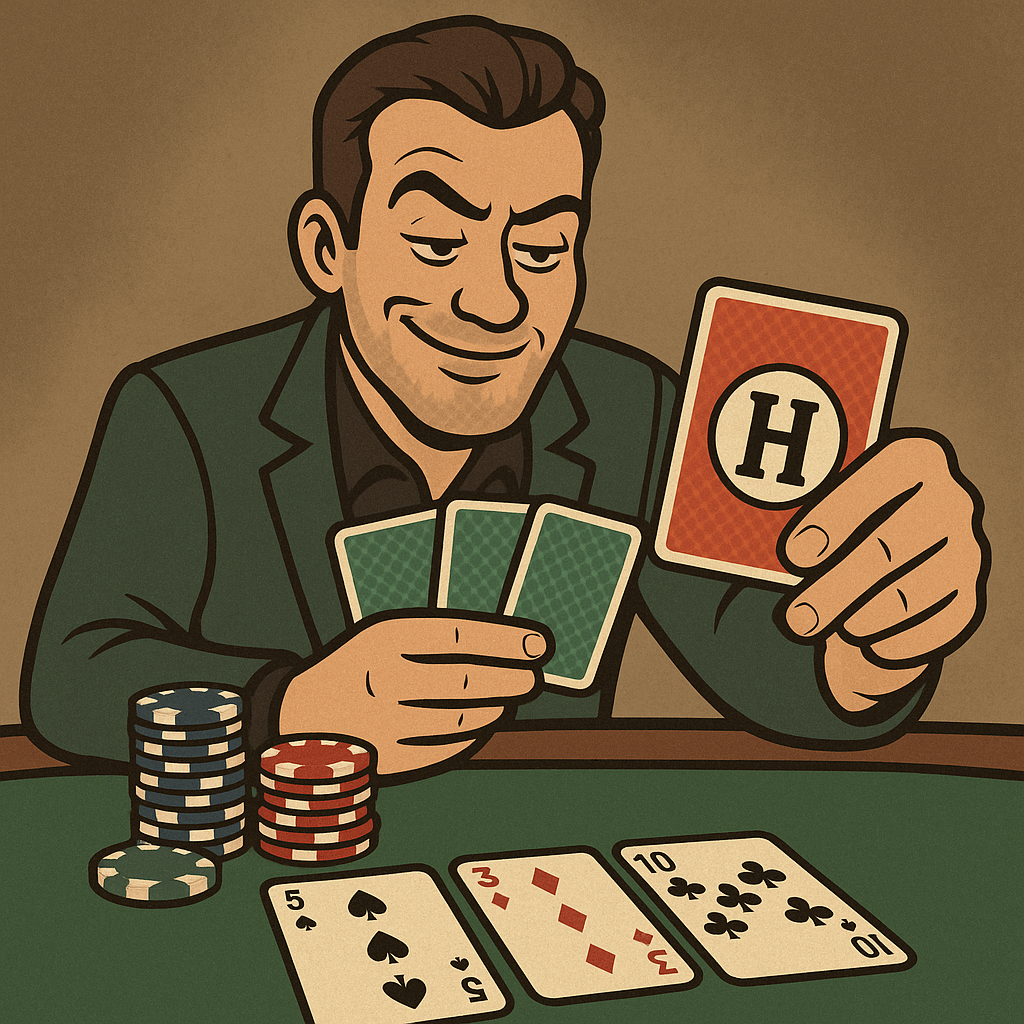
Welcome to The Fallacy Deck — a series exploring the rhetorical “trump cards” people play to shut down meaningful conversation. These aren’t just lazy arguments; they’re conversation-enders, often thrown onto the table with smug confidence, as if to say: “Checkmate.”
But real dialogue deserves better.
Each article in the series shines a light on one of these cards — dissecting the fallacy behind it, exposing the tactics it relies on, and asking what conversations we might finally be able to have if we stopped letting these cards decide the game.
There’s one name that ends arguments, silences nuance, and flattens reasoned discussion, probably more than any other: Hitler. Merely uttering his name is often enough to shut down conversation, to draw a moral line so sharp and final that any dissenting view is rendered irredeemable by proximity alone. In debates online and off, comparisons to Hitler are often wielded not as tools of critical thought, but as blunt instruments of dismissal.
But here’s the problem: this tactic doesn’t hold up under scrutiny. In fact, far from strengthening an argument, invoking Hitler in this way often exposes its weakness.
The Pattern of the “Hitler Card”
We’ve all seen it happen. A discussion becomes heated, points are exchanged, nuance fades—and then someone plays the Hitler card. Whether it’s comparing a modern politician to the Nazi regime, or using a tenuous link to suggest someone’s viewpoint is inherently dangerous, the invocation of Hitler is often a last-ditch attempt to gain moral ground.
And it works—not because it’s a good argument, but because it taps into a collective emotional wound. It hijacks the horror of history to shut down present-day discourse.
A Recognised Fallacy: Reductio ad Hitlerum
Interestingly, the tendency to invoke Hitler as a way of discrediting an argument is so common that it has its own name: Reductio ad Hitlerum. Coined by philosopher Leo Strauss in the 1950s, it refers to the fallacy of dismissing an idea solely because it was associated with Hitler or the Nazis. For example, saying, “You support environmentalism? Well, Hitler was an environmentalist too,” is a classic (and lazy) instance. It’s a textbook case of guilt by association, designed not to examine the argument’s actual merit, but to end the conversation through shock and shame. The fact that this fallacy is formally recognized reinforces how intellectually bankrupt this tactic truly is.
The Psychology Behind It
Reading between the lines, when someone reaches for a Hitler comparison, it often reveals more about their emotional state than the topic at hand. It’s a desperate attempt to claw back the weight of evidence. On a subconscious level, it can be a kind of white flag—an admission that they can’t win the argument on reason alone, so they reach for the nuclear option. It’s rhetorical carpet bombing.
It also makes the speaker feel powerful. In a world where moral high ground is a prized commodity, invoking Hitler is like hitting the “instant win” button—or so it seems. But in reality, it undermines genuine understanding and replaces complexity with performative condemnation.
The Dangers of Lazy Analogies
These kinds of comparisons do more harm than good. First, they trivialize the true horror of Hitler’s regime. When every authoritarian or disliked figure is casually equated with the architect of the Holocaust, we risk desensitizing ourselves to what that history actually means. The atrocities of Nazi Germany deserve more than to be used as shock-value talking points.
Second, these analogies create false equivalencies. Just because two things share a superficial resemblance doesn’t mean they are morally or historically comparable. This kind of shortcut in thinking discourages people from engaging with real, complex issues in favor of cheap outrage.
What We Should Do Instead
If someone’s ideas are dangerous, explain why they’re dangerous. Use history thoughtfully, not manipulatively. Resist the urge to shut down discussions with overblown comparisons and instead cultivate the patience to explain, to listen, and to engage.
Disagreement should never default to demonization. There is a strength in staying with the complexity, in resisting the temptation to oversimplify with a Hitler reference.
Conclusion: Rejecting the Shortcut
The Hitler card is not the sign of a strong argument. It’s a red flag that reason has left the room. And while the horrors of history must never be forgotten, neither should they be cheapened through rhetorical desperation. If we want to have meaningful conversations, we must learn to spot these shortcuts—and refuse to take them.
The illusion of digital inclusion in a system where structural barriers, manipulative design, and monetisation schemes render the web inaccessible—especially to neurodivergent minds. See also: capitalism strikes again.
I used to enjoy using the internet.
Back when it wasn’t commonplace. Back when it was the domain of nerds, weirdos, hobbyists, and information junkies like me. Sure, there were commercial websites, brands had presences, but capitalism hadn’t yet figured out how to completely milk the internet for all it could legally squeeze from the public. Back then, it felt like a sanctuary—a digital retreat from the chaos and hostility of everyday life.
I’m autistic. I have inattentive ADHD. I struggle with overstimulation, decision fatigue, the weaponization of social cues, and having to constantly filter signal from noise in daily life. The early internet was a gift. Social interaction on it was simpler, slower, optional. I had control. I could set the pace. I could browse in peace, seek connection without pressure, and access the kind of information I was drawn to without needing to fight for it.
And then, Capitalism Struck Again.
Over time, a new norm slithered into place. The digital space that once gave me breathing room now suffocates me. What used to be a tool for equalising neurodiverse and neurotypical access has become a gauntlet of cognitive warfare.
Let me paint you a picture of what it means to be neurodivergent in the modern online landscape:
CONSTANT CONSENT FATIGUE
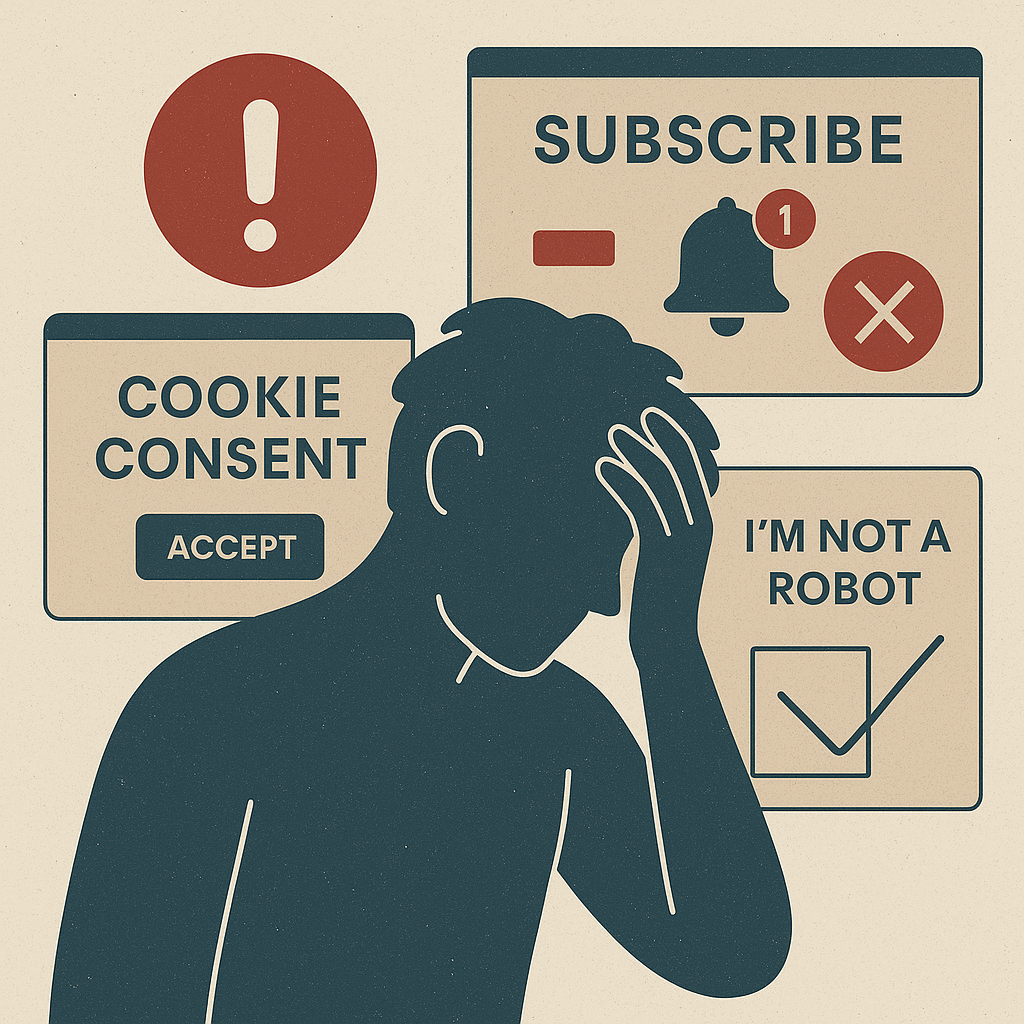
Cookie popups on every site. Not one clear button to reject all. No, you must go spelunking through menus, toggling obscure options one by one.
What they call “consent” is often manipulation dressed up in legalese. They make accepting easy. Rejecting is friction.
This happens every time you clear your cookies—which many of us need to do often to avoid tracking or clutter. It’s an exhausting loop.
OBSTACLE COURSE INTERFACES
Adverts that interrupt videos, and worse, cannot be skipped unless you pay. Not pay for the content, mind you, but pay to remove the punishment.
Popup overlays that consume half your screen the moment you land on a site. Trying to close them often launches something else.
On phones? It’s worse. Smaller screens mean these overlays dominate everything. You lose all context and have to work just to get your bearings.
SENSORY OVERLOAD
Auto-play videos. Scrolling pages that jitter from reloading ads. Flashing banners. Infinite scrolling newsfeeds.
Red notification symbols you can’t dismiss.
Everything demands your attention. Nothing respects your brain’s bandwidth.
WALLS EVERYWHERE
Account registration required to view basic information. Want to read one article? Sign up. Want to download a PDF? Create an account.
Even ad blockers aren’t safe anymore: Use one, and you’re blocked.
CAPTCHA systems to “prove you’re not a robot”, often impossible to complete first time if you have visual or processing impairments.
INFORMATION MIRE
Simple search queries now lead into labyrinths of misinformation, SEO bait, affiliate link farms, AI-generated junk, and clickbait.
Answers that should take seconds now require sifting through five pages of fluff.
The mentally exhausting task of fact verification is now part of every basic search.
CONTENT MONETISATION MADNESS
Free content comes with a catch: give us your email, your phone number, or your demographic info.
Sponsorships infiltrate once-authentic creators. You’re left wondering if their review or advice is sincere, or bought.
Subscription models are everywhere. Everything is paywalled. But paying doesn’t always remove the pain—sometimes, it’s just a new tier of nonsense.
And this is just what I notice consciously.
I’m sure there are deeper layers of rot that my mind filters out as a survival response. But what I do feel, daily, is the cognitive toll. What should be a tool for exploration and learning is now an exhausting, defensive act.
And here’s the thing: most people just shrug and say, “That’s just how it is now.”
But if you’re neurodivergent, or disabled, or even just overwhelmed by life, “that’s just how it is” becomes the same as saying: This place isn’t for you.
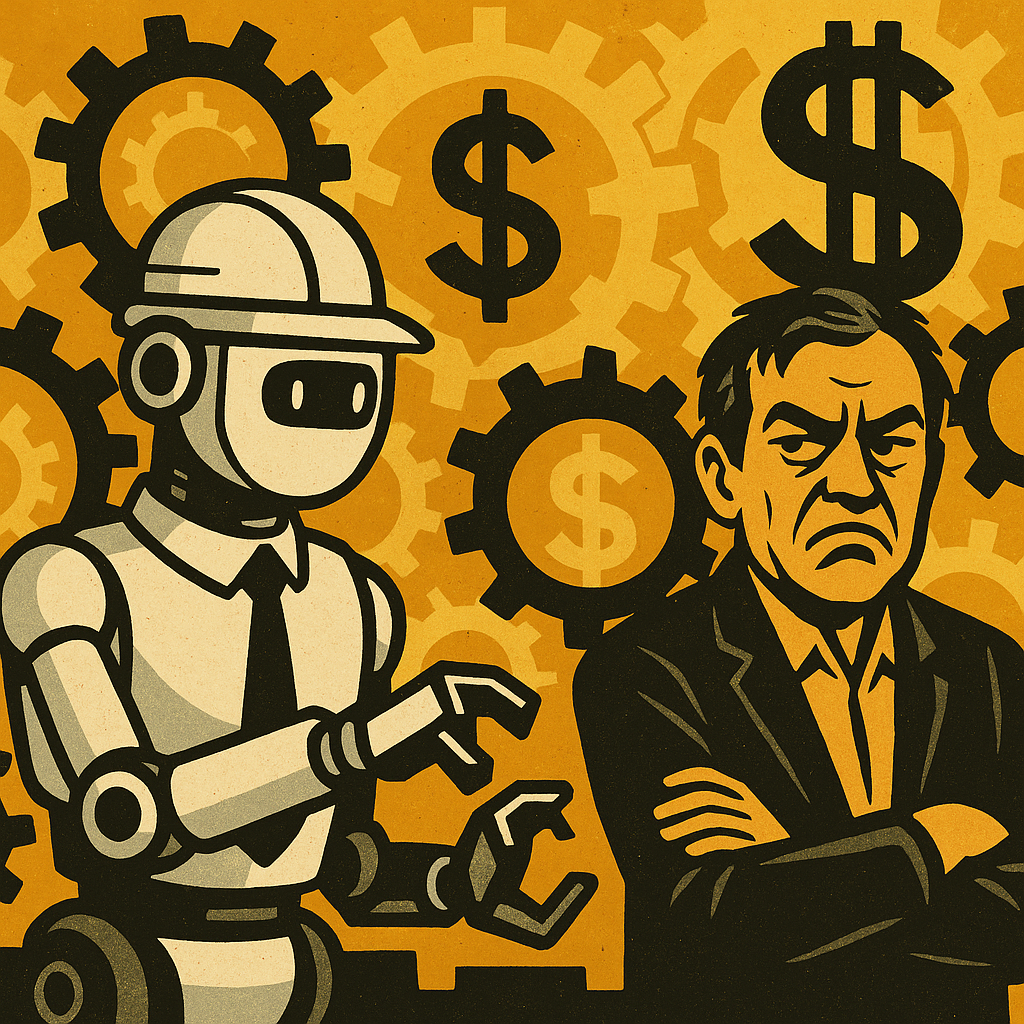
In recent years, the rise of artificial intelligence has stirred public anxiety, particularly around the idea that AI is here to “steal jobs.” On the surface, it’s a fair concern. But when you scratch a little deeper, you find the real problem isn’t the technology itself—it’s the system we’re embedding it into. The outrage should not be directed at the tool, but at the hands that hold it.
The Original Deal of Civilization
Civilization began as a shared survival strategy. Tasks needed to be done—farming, building, teaching, healing—and so societies developed systems of trade and compensation to ensure everyone chipped in. Money evolved as a practical tool to coordinate contribution and reward. Work and currency were born out of necessity: to keep the machine of civilization running.
But that necessity is evolving.
The Promise of AI: A Future with Less Toil
We now possess tools that can perform many of the repetitive, tedious, and cognitively exhausting tasks that humans have had to endure for centuries. AI can analyze vast datasets, answer customer queries, optimize supply chains, and even compose music or assist with design.
These developments should be good news. They should signal the dawn of a more liberated era—one where humans are freed from survival labor and can pursue creativity, care, curiosity, and rest.
But that future is not unfolding.
So Why Isn’t It Happening?
If machines can do the work, why aren’t we seeing shorter workweeks, universal basic income, or enhanced quality of life?
The answer is simple: because the rewards of automation aren’t being shared. They’re being hoarded.
In our current economic system, productivity gains don’t translate into shared prosperity. They become profit margins for a small minority. Workers don’t get more time off; they get laid off. Freed labor doesn’t result in more freedom—it results in more precarity.
AI isn’t stealing jobs. Corporations are.
The System is the Saboteur
We fear AI because we know, intuitively, that our survival is still tethered to our economic usefulness. If we can be replaced, we can be discarded.
But that only holds true in a system where value is measured in profit. If we restructured society to measure value in human well-being, automation would be a gift.
Imagine if AI were treated as a public good, developed and deployed in service of everyone. Imagine if its productivity gains funded universal healthcare, education, and guaranteed income.
We have the power to design systems where technology lifts everyone, not just the elite.
The Fork in the Road
We’re standing at a pivotal crossroads. One path leads to further concentration of wealth and social instability, as technology accelerates inequality. The other leads to an age of collective liberation, where humans are free to live, grow, and contribute on their own terms.
We must stop asking whether AI will take our jobs. We must start asking why the survival of human beings is still conditional on having one.
Because the truth is: AI didn’t create the problem. It only revealed it.
“People fear AI because they suspect, deep down, that their value is measured only by their usefulness to the economy. But we have the opportunity to redefine that value—and to reclaim our time, our dignity, and our future.”
The future of work isn’t about jobs. It’s about justice.
We tend to imagine power as something held—gripped tightly in the hands of politicians, CEOs, billionaires. But what if even those figures aren’t truly free? What if the system they uphold is not just a structure, but a kind of self-sustaining entity… a living thoughtform, fed by belief and fear?
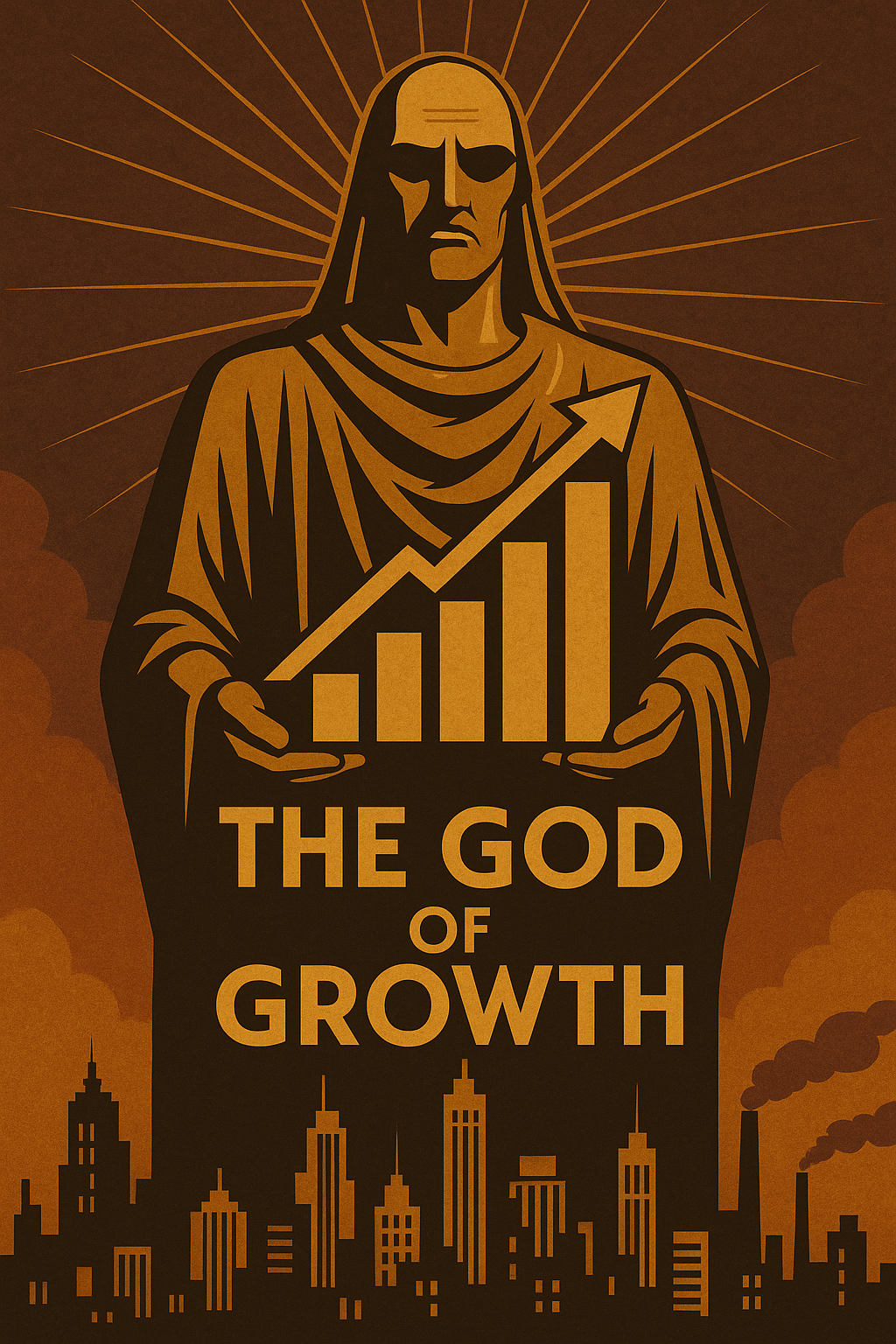
Welcome to the worship of the God of Growth.
The Scoreboard That Replaced the Game
At the centre of modern politics is a points system: GDP, stock prices, employment rates. These numbers are treated not just as tools for understanding wellbeing—they become wellbeing. They are shorthand for national success, political competence, and collective security.
Politicians are judged by how well they can make the economy “grow.” More points = good leadership. Fewer points = failure.
But here’s the catch: these “points” don’t reflect reality. A rising GDP doesn’t mean people are thriving. It might mean more people are being overworked. It might mean more forests are being destroyed. It might mean weapons are being sold, addictions exploited, or resources strip-mined.
Still, the scoreboard glows. The numbers go up. Applause.
The Recursive Trap
So politicians, in their quest to stay elected, are forced to worship growth. They don’t necessarily believe in it. Many likely feel the contradiction. But survival within the system demands obedience to its logic.
And the voters? Conditioned to equate economic growth with personal safety, they too uphold the cycle—rewarding leaders who promise expansion, punishing those who don’t.
No one designed this trap. It emerged.
It’s like a recursive algorithm:
Growth is good.
We fear the lack of growth.
We reward those who promise growth.
Those in power pursue growth at any cost.
Growth causes harm.
Return to step 1.
Over time, this loop generates its own momentum, evolving beyond the control of any individual.
The Egregore: A Spirit Born of Belief
In occult and psychological terms, this is what’s known as an egregore—a collective entity formed by the thoughts, emotions, and actions of a group.
The God of Growth isn’t a person. It’s not a conspiracy. It’s not even a single decision.
It’s an emergent intelligence. A social phantom.
It lives in policies, in media headlines, in boardrooms, in national budgets. It rewards loyalty and punishes defiance. It doesn’t need to be real to hold power. It’s real enough.
When the Idol Demands Blood
The tragedy is this: the God of Growth doesn’t care about its worshippers. It doesn’t care about ecosystems, human joy, mental health, or long-term stability. It only knows one command:
More.
More production. More consumption. More markets. More extraction. Even if the cost is collapse. Even if the cost is us.
Seeing the God for What It Is
The first act of rebellion is not protest. It’s recognition.
Once we see the idol for what it is—false, hollow, powerful only because we believe in it—we can start to loosen its grip. We can question the metrics. We can ask better questions:
What if wellbeing isn’t measured in money?
What if slowing down is not a failure, but a healing?
What if true progress means learning to live within limits?
Growth is not inherently evil. But endless, mindless growth is cancer. And we are not here to serve a tumor.
Ending the Worship
Let this be the beginning of a new form of economic spirituality—not one rooted in numbers, but in nurture, justice, and balance.
The God of Growth will not give us a better world. But we might still find one—if we’re brave enough to stop praying and start listening.
The digital age has led us to a curious intersection, where the word “content” has become ubiquitous, and “art” seems to be slipping from its once-sacred pedestal. What once required time, effort, and intention to create is now often reduced to an endless churn of quick consumption, reduced to mere “content” for the masses to engage with. This shift is something I can’t help but observe with both concern and reflection.
For someone like myself—constantly battling the tension between personal identity, society, and the existential weight of existence—the current state of art feels almost like an existential crisis of its own. The act of creation, for me, is personal, deliberate, and reflective. It is an attempt to make sense of the world, to carve out meaning, and to leave something behind that resonates beyond the confines of time. But in the age of digital platforms, this sacred act of creation feels increasingly commodified.
The idea of “content” has become a business-driven term, designed for quick consumption, for likes, shares, and engagement metrics. Art, which once demanded patience from both creator and audience, is now expected to be produced in rapid bursts, optimized for algorithms that care little for the soul of the work. There is a certain detachment from the deeper, existential elements of art that once grounded it in something profound.
In my own life, I’ve had to reconcile the desire for meaning with the reality of a society that often demands conformity. Much like the societal pressures I’ve felt to “fit in” (as outlined in my exploration of identity and alienation), there’s a parallel pressure in the artistic world to conform to the “rules” of content creation. The faster you can churn out pieces, the more successful you are—regardless of the depth or intent behind them. Where once I might have taken months to perfect a story or reflect deeply on its implications, I find myself asking, “How quickly can I produce something that will generate engagement?”
I see this in the realm of social media, where content is consumed at an alarming rate, often with little regard for its longevity or its ability to stand the test of time. It’s all about what captures the attention in the moment, what creates the immediate buzz, and then it’s discarded, replaced by the next viral moment. This constant churn of “content” feels like a reflection of the broader existential struggle I often muse about—one where we’re caught in a cycle, never really allowing ourselves to linger in one thought, one creation, long enough to find its true meaning.
And yet, this transformation isn’t without its value. Like many things in life, it’s a balance. Content, in its own right, can be meaningful. It can still carry depth, insight, and intention, but it’s often hidden behind the facade of quick consumption. The challenge, then, is not to fall into the trap of creating merely for the sake of producing but rather to carve out space within this content-driven world for true artistic expression.
It’s easy to be seduced by the quick dopamine hits of social media validation, but I find myself wondering, what happens when the art we produce is merely optimized for engagement, not introspection? What happens when the deeper, slower aspects of art are lost to the rush of “content”?
It’s a complex landscape—one that I continue to navigate. My journey of self-acceptance and understanding (which I’ve shared before in reflections like The Outsider) has always been about carving my own path, about finding meaning in a world that often seems to demand conformity. And in this moment, it’s about resisting the pressure to reduce my creative endeavors to mere content. Art, for me, will always be a process of deep engagement, introspection, and meaning. And I have to hold onto that, even as the world pushes toward something faster, more superficial.
I’ll continue to create with intention, even if it means standing outside the prevailing norms. Just as I’ve come to accept that I don’t fit in with the mainstream society, so too do I embrace the idea that my art—whatever it may be—doesn’t have to conform to the demands of the “content machine.”
After all, the true value of art, the meaningful kind, isn’t something that can be measured in likes or shares. It’s something that resides in the depths of the human experience, something that will persist long after the noise of the digital world has faded away.
So, to those who create for the sake of creating, for the sake of self-expression, and for the sake of finding meaning in this chaotic existence, I say: Don’t let your work be reduced to mere “content.” Let it be art.